Asia Intelligence Brief — Monday, September 7, 2026
Executive Summary
Asia Intelligence Brief for September 7: North Korea commissions the destroyer Kang Kon a day before allied drills open off Jeju, an Anak Krakatau
Asia Intelligence Brief — Monday, September 7, 2026
Key Facts
- The destroyer. North Korea commissioned the 5,000-tonne Kang Kon in Wonsan on Sunday, with Kim Jong Un calling it part of the state’s “nuclear counteraction system” a day before trilateral US-South Korea-Japan drills began off Jeju Island.
- The mountain. Indonesia’s Anak Krakatau erupted continuously from Friday night into the weekend, grounding roughly 170,000 passengers and closing as many as eight airports including Jakarta’s Soekarno-Hatta, with the alert level held rather than raised further.
- The charge sheet. The Philippines’ Ombudsman filed a 7.4-billion-peso plunder case against former House Speaker Martin Romualdez and three co-accused on Monday, while Romualdez’s own lawyers say they still don’t know whether freed witness Manuel Bonoan’s testimony is even part of it.
- The reshuffle. Prime Minister Sanae Takaichi is expected to keep her finance and foreign ministers in a cabinet reshuffle around 16 September, prioritising continuity while she tries to secure a meeting with Donald Trump before his 24 September summit with Xi Jinping.
- The count. Nepal’s disaster authority put Monday’s confirmed toll from the 26 August glacier collapse at 1,355 dead and 4,996 missing, as South Korea’s foreign minister spent the weekend in Kathmandu pressing the search for nine of his own citizens.
- The speech. Pakistan marked its 61st Defence and Martyrs’ Day on Saturday with its president and prime minister accusing India of sponsoring militant proxies, the same ceremony used to publicise a new Makkah Joint Defence Agreement.
North Korea spent Sunday commissioning a warship that had capsized during its own launch sixteen months earlier and calling it proof of a reliable nuclear deterrent, the same day a Sunda Strait volcano kept roughly a fifth of Jakarta’s flights grounded for a third straight day, Manila filed a 7.4-billion-peso plunder case against a former speaker whose star witness’s role is now disputed even by his own side, and Nepal’s confirmed toll from a fortnight-old glacier collapse climbed again. None of it resolved anything; all of it insisted otherwise.
Read in English, Korean, Bahasa Indonesia, Tagalog, Japanese, Nepali and Urdu, across the region’s largest outlets, each capital’s own press and our own Asia desk.
North Korea: The Destroyer That Sank Once Already
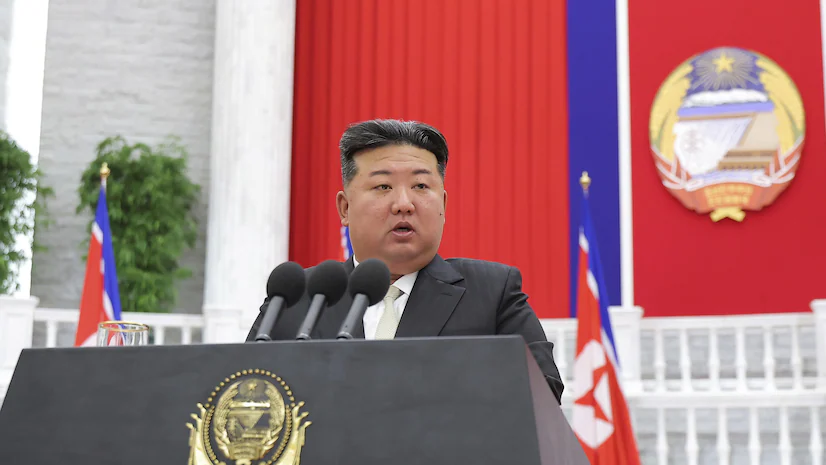
Kim Jong Un presided over the commissioning of the Kang Kon, a 5,000-tonne destroyer, at Wonsan on Sunday, sixteen months after the same vessel capsized during its own launch and had to be righted and relaunched. State media quoted him calling the ship part of “the state nuclear counteraction system” and pressing his navy to become, in his own words, a genuinely “nuclear armed force.”
The ceremony landed on the opening day of Freedom Edge, five days of trilateral drills the United States, South Korea and Japan are running off Jeju Island with roughly 560 Japanese troops involved, even after Washington quietly halved its own bilateral exercise with Seoul this summer and called the larger version “inappropriate and hostile” toward Pyongyang. Kim Yo Jong dismissed the trim as cosmetic; North Korea had separately fired about ten short-range ballistic missiles on 20 August as the allies’ earlier Ulchi Freedom Shield exercise wound down, a number Pyongyang now produces almost on schedule.
Kim brought his teenage daughter to Sunday’s ceremony, a presence South Korean intelligence has read for two years as grooming rather than sentiment, and promised a further “significant” naval advance within eight months. A warship that once had to be pulled upright out of the water is now the government’s chosen proof that its deterrent works, which says as much about the state of North Korean confidence as any missile count.
Indonesia: A Mountain With Its Own Flight Schedule
Anak Krakatau began a continuous lava-fountain eruption at 23:07 local time on Friday, its strongest activity of the year, sending an ash column that satellites measured at roughly fifteen kilometres over the Sunda Strait between Java and Sumatra. Indonesia’s disaster agency closed as many as eight airports at the peak on Sunday evening, including Jakarta’s Soekarno-Hatta, and by Sunday night nearly 120,000 passengers were stranded at that airport alone.
Six airports remained shut into Monday morning, with authorities citing repeated positive ash-paper tests rather than any single decision to reopen, and Garuda Indonesia cancelled its Jakarta, Bandung and Lampung services through Monday midday. Volcanologists held the alert at its second-highest level, Siaga, unchanged since early July, and said the rebuilt crater is too small to repeat 2018’s tsunami — the kind of reassurance a region remembers precisely because the last one proved wrong.
Philippines: A Case Filed, A Witness In Question
The Ombudsman filed a plunder case worth 7.4 billion pesos against former House Speaker Martin Romualdez, ex-lawmaker Zaldy Co and two co-accused at the Sandiganbayan on Monday, alleging kickbacks skimmed from national infrastructure budgets across at least fifteen occasions between 2022 and 2025. Ombudsman Jesus Crispin Remulla said the office had built the case over seven months and “based on evidence,” while Romualdez maintains Congress approves budgets but never releases funds or builds anything itself.
The filing follows the Sandiganbayan’s decision earlier this month to exclude and free Manuel Bonoan, the former public works secretary once expected to testify against Romualdez, who was separately arraigned on 4 September on a distinct 213.7-million-peso graft charge tied to Senator Jinggoy Estrada and pleaded not guilty. Romualdez’s lawyers responded to Monday’s filing by asking the Ombudsman to confirm whether any Bonoan allegation features in the case at all, which means Manila has now filed a headline prosecution without settling the one question that made headlines a week ago.
Japan: Continuity As The Plan
Prime Minister Sanae Takaichi is preparing a cabinet reshuffle for around 16 September that, by design, changes almost nothing markets would notice, with finance minister Satsuki Katayama and foreign minister Toshimitsu Motegi both expected to keep their posts. Katayama’s closeness to US Treasury Secretary Scott Bessent, built over roughly ten rounds of talks since July’s joint yen intervention, is reportedly the specific reason Takaichi does not want to remove her while Washington keeps pressing Tokyo on currency policy.
Takaichi is separately trying to secure a meeting with Donald Trump before his 24 September summit with Xi Jinping in Washington, with both leaders due to speak at the UN General Assembly on 22 September and a phone call as her fallback if no meeting materialises. Tokyo’s fear is specific rather than abstract, that Trump trades a concession on Taiwan for economic gain ahead of America’s midterms, which is why a prime minister who has not moved an inch on her own China policy in ten months is now working so hard to get in the room before the two men who might move it for her.
Nepal: The Number That Will Not Sit Still
Nepal’s disaster authority put Monday’s confirmed toll from the 26 August glacier collapse at 1,355 dead and 4,996 missing, thirteen more confirmed dead than Saturday’s count, with Chitwan district alone accounting for 363 of the deaths recorded so far. South Korea’s foreign minister Cho Hyun spent a three-day visit to Kathmandu pressing the search for nine of his own citizens, six from Doosan Enerbility and three from Korea South-East Power, all missing since the same hydropower site in Rasuwa flooded on 26 August.
“I promise to speed up search efforts for our missing nationals,” Cho told reporters after meeting Nepal’s foreign minister Shisir Khanal and the families still waiting, twelve days into a search his own government cannot resolve any faster than Kathmandu’s own can. A toll that keeps revising upward in single digits and low teens is, at this stage, less a crisis still unfolding than a bureaucracy still catching up with one that already has.
Pakistan: An Old War, Named Again
Pakistan marked its 61st Defence and Martyrs’ Day on Saturday, commemorating the 1965 war with India, with President Asif Ali Zardari urging New Delhi to “desist from promoting terrorism in Pakistan through its proxies” and Prime Minister Shehbaz Sharif calling for Kashmir’s resolution under UN Security Council resolutions. Officials used the same ceremony to publicise a new Makkah Joint Defence Agreement, framing Pakistan as a “net regional security provider” rather than simply a country refighting a sixty-one-year-old war in its own speeches.
The military’s own statement pledged forces “fully prepared to defend the country’s sovereignty,” language identical in substance to Defence Day messaging in each of the past several years, including the one Pakistan issued four months after last year’s four-day conflict with India ended in a ceasefire. A country can hold the same parade every September and still mean something different by it each time, but this year’s version offered little evidence that anything had actually changed.
A warship that once needed rescuing is now the state’s proof that nothing else does.
What This Means From Latin America
Indonesia’s grounded airports are the more literal warning for Latin America, where Guatemala’s Volcán de Fuego, Ecuador’s Cotopaxi and Mexico’s Popocatépetl sit under the same kind of monitoring regime that just held Anak Krakatau at its second-highest alert level rather than its highest, a judgement call regional aviation authorities from Quito to Guatemala City make on their own volcanoes several times a year. North Korea’s destroyer is a stranger fit for the region on its face, but the underlying pattern, a state buying credibility through hardware while a great power dangles diplomacy as the alternative, is one Caracas has lived on the receiving end of for most of the past decade.
The Philippines’ plunder filing is the closer read for Brazilian and Peruvian prosecutors, who know from their own Lava Jato-era cases exactly how much a headline indictment can still depend on a witness whose cooperation was never as settled as the press release implied. Pakistan’s Defence Day rhetoric and Japan’s studied cabinet continuity are quieter lessons in the same vein, one government reaching for an old enemy to explain a hard year, the other betting that changing nothing looks more credible abroad than changing something would.
What We Are Watching
- Freedom Edge’s final days — whether the trilateral drills off Jeju Island run through 11 September without a fresh North Korean missile test, or whether Kim’s promised naval advance arrives sooner than the eight months he named.
- Anak Krakatau’s alert level — whether Indonesia’s volcanologists hold Siaga through the week or escalate as ashfall keeps reaching Jakarta and West Java.
- Romualdez’s arraignment date — whether the Sandiganbayan sets it before or after the Ombudsman clarifies whether Bonoan’s testimony is actually part of the new plunder case.
- Takaichi’s 16 September reshuffle — whether Katayama and Motegi are confirmed as expected, or a late change signals she has less control over her own party than “continuity” suggests.
- Nepal’s rescue math — whether the missing count keeps converting into confirmed dead at the same slow rate, or searchers find anyone else alive as they did earlier last week.
- Pakistan-India rhetoric — whether Zardari’s and Sharif’s Defence Day language stays confined to speeches, or resurfaces later this month when both countries address the UN General Assembly.
More from the Rio Times Intelligence Desk on September 7, 2026: Africa · Europe · USA & Canada. For how these stories developed, see the Asia Intelligence Brief for September 5.
The region’s contest over water, chips and sea lanes runs through our pillar coverage of Asia: The Long Game.
Frequently Asked Questions
What is the Kang Kon and why does North Korea’s navy matter this week?
The Kang Kon is a 5,000-tonne North Korean destroyer that Kim Jong Un commissioned in Wonsan on 6 September 2026, calling it part of the state’s “nuclear counteraction system” after it had capsized during its own launch in May 2025 and been righted and relaunched about a month later. Its commissioning came a day ahead of the opening of Freedom Edge, five days of trilateral US-South Korea-Japan drills off Jeju Island; North Korea had separately fired roughly ten short-range ballistic missiles on 20 August, as the allies’ earlier Ulchi Freedom Shield exercise wound down.
Why did a volcano in Indonesia disrupt flights across an entire region?
Anak Krakatau began a continuous lava-fountain eruption at 23:07 local time on 4 September, its strongest activity of the year, sending an ash column that satellites measured at roughly fifteen kilometres over the Sunda Strait and prompting authorities to close as many as eight airports, including Jakarta’s Soekarno-Hatta, at the peak on 6 September. Nationwide, roughly 170,000 passengers were affected by Sunday night, and Indonesia’s volcanologists have held the alert at Siaga, the second-highest level, saying the rebuilt crater is too small to repeat the tsunami that killed more than 400 people when the volcano’s flank collapsed in 2018.
What is the plunder case against Martin Romualdez and how does it relate to Manuel Bonoan?
The Philippines’ Ombudsman filed a 7.4-billion-peso plunder case against former House Speaker Martin Romualdez, former lawmaker Zaldy Co and two co-accused at the Sandiganbayan on 7 September, alleging kickbacks from national infrastructure budgets across at least fifteen occasions between 2022 and 2025. The filing follows the same court’s decision to exclude and free Manuel Bonoan, once expected to testify against Romualdez, who was separately arraigned on a distinct graft charge on 4 September; Romualdez’s lawyers say they still do not know whether any Bonoan allegation is part of the new case.
Why is Japan’s Takaichi trying to meet Trump before his summit with Xi?
Prime Minister Sanae Takaichi is preparing a cabinet reshuffle around 16 September that is expected to keep her finance and foreign ministers in place, and is separately seeking a meeting with Donald Trump before his 24 September summit with Xi Jinping in Washington, with both leaders due to address the UN General Assembly on 22 September. Tokyo’s concern is that Trump could offer Beijing a concession touching Taiwan in exchange for economic gains ahead of America’s midterm elections, ten months after Takaichi’s own remarks on Taiwan first strained relations with China.
Sources: The Korea Times, UPI, CNN, Al Jazeera, Antara News, Philstar, SunStar, The Filipino Times, The Japan Times, Bloomberg, Business Recorder, Dawn, NBC News, aninews.in · 4 – 7 September 2026.
This article was produced by The Rio Times’ automated newsroom system. How we use AI · Report an error · Editorial responsibility: Matthias Camenzind, Editor-in-Chief
LatAm Markets: Live Signals → — real-time movers, turnover leaders and FX across Latin America.