Brazil Primary Deficit Reaches US$1.9 Billion in August as Gross Debt Hits 82.9% of GDP
ECONOMY · BRAZIL
Key Facts
- —The country Brazil, Latin America’s largest economy, holds its presidential election first round on Sunday 4 October.
- —What happened The consolidated public sector ran a primary deficit of R$10.0 billion (about US$1.9 billion) in August, the Banco Central do Brasil reported on Wednesday (30 September).
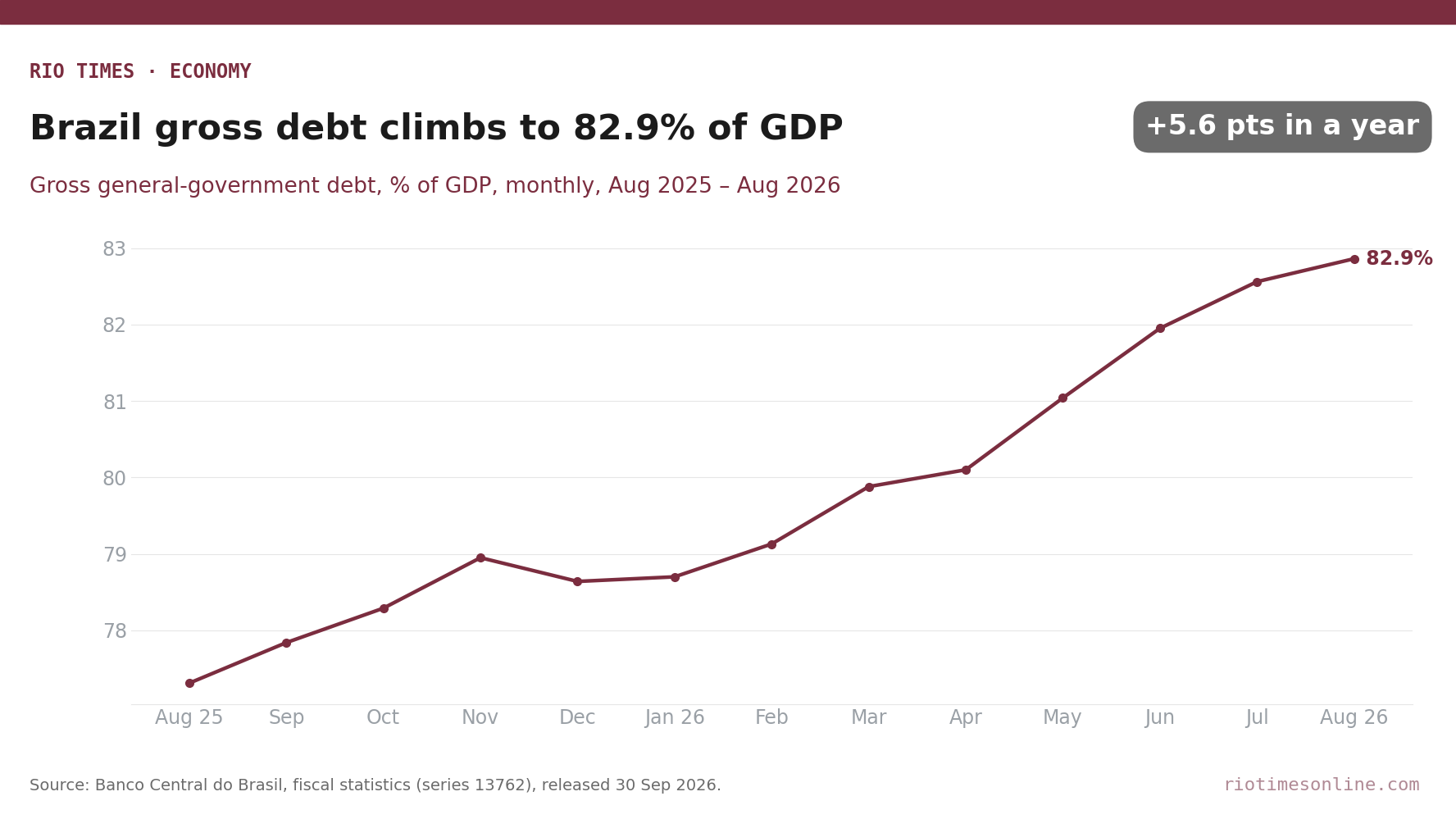
- —The numbers Gross general-government debt reached 82.9% of GDP in August, up from 82.6% in July and the highest since March 2021, central bank data show.
- —What it means for you Interest, not new spending, is driving the debt. August’s interest bill was R$105.9 billion (about US$20.4 billion), per the central bank.
- —Still open Whether the 2026 fiscal target is met, and what the next government does about interest costs, remain unanswered.
Brazil’s public sector posted a primary deficit of R$10.0 billion (about US$1.9 billion) in August, central bank data showed on Wednesday (30 September). Gross debt rose to 82.9 percent of GDP, its highest level since March 2021.
The figures land four days before Sunday’s presidential election. They show a deficit that is narrowing on the primary measure, while the debt keeps climbing because of interest. Dollar figures use R$5.20 per US dollar, the rate on 1 October.

Two institutions, two deficits
Two different bodies publish Brazil’s monthly fiscal numbers, and they measure different things. On Tuesday (29 September) the Tesouro Nacional, the national treasury, reported a central-government primary deficit of R$13.6 billion (about US$2.6 billion).
The treasury figure covers the federal government, social security and the central bank. A year earlier, the same measure showed a deficit of R$15.5 billion (about US$3.0 billion), Agência Brasil reported.
The central bank’s wider figure, the consolidated public sector, adds states, municipalities and state companies, excluding Petrobras and the state banks. That is where the R$10.0 billion (about US$1.9 billion) deficit comes from.
States and municipalities ran a surplus of R$2.7 billion (about US$519 million), and state companies added R$2.0 billion (about US$385 million). In August 2025 the consolidated deficit was R$17.3 billion (about US$3.3 billion), so the gap has narrowed.
Why the primary deficit hides the bigger number
The primary balance measures revenue minus spending before interest. In July the consolidated public sector ran a small primary surplus of R$1.4 billion (about US$262 million), as Brazil Gross Debt Hits 82.5% of GDP in July, Highest Since 2021 reported.
Interest is the larger force. Nominal interest costs reached R$105.9 billion (about US$20.4 billion) in August, up from R$74.3 billion (about US$14.3 billion) a year earlier.
The central bank partly blamed currency swap operations, which swung to a R$9.3 billion (about US$1.8 billion) loss. Including interest, the nominal deficit was R$115.9 billion (about US$22.3 billion) in August.
Over the 12 months to August, the nominal deficit reached 9.48 percent of GDP. The primary deficit over the same period was much smaller, at 0.62 percent of GDP.
Debt at a five-year high
Gross general-government debt, which covers federal, state and municipal governments and the INSS social security system, reached R$11.1 trillion (about US$2.1 trillion). That equals 82.9 percent of GDP.
The ratio rose 0.3 points from July, now shown at 82.6 percent in the central bank’s revised series. It is up 4.2 points since December, according to the central bank.
The central bank’s own series puts the last higher reading in March 2021, at 85.1 percent, during the pandemic.
Net public-sector debt, which subtracts government assets such as reserves, rose to 69.3 percent of GDP. It also rose in August, by 0.1 points, mainly because of interest and the primary deficit.
What the numbers mean before Sunday
On the stabilising side, the treasury reported that net revenue grew 3.5 percent above inflation in August, ahead of spending. Discretionary spending fell by R$5.6 billion (about US$1.1 billion), according to Agência Brasil.
The pressure points were transfers of R$4.9 billion (about US$942 million) to the public election campaign fund and higher pension payments. Both were reported by the treasury on Tuesday.
Whoever wins the election inherits that interest bill. A possible runoff on 25 October is explained in Brazil Election 2026 Runoff: How 25 October Works, What the Polls Show, and What a Second Round Changes.
What Is Not Yet Known
The August data do not say when the debt ratio will peak. That depends on interest rates, growth and the next government’s budget choices.
It is also unclear how the next government would bring interest costs down. Those costs depend largely on the central bank’s policy rate.
Sources: Banco Central do Brasil, fiscal statistics for August 2026, released 30 September 2026 (gross debt series, primary result series); Agência Brasil, report on the August public-sector accounts, 30 September 2026; Agência Brasil, report on the central-government result (Tesouro Nacional data), 29 September 2026.
LatAm Markets: Live Signals → — real-time movers, turnover leaders and FX across Latin America.
Read More from The Rio Times