IBOV 185,205.09 ▲ 3.05% IPSA 11,315.26 ▼ 1.14% IPC MEX 64,833.08 ▲ 0.49% MERVAL 3,106,216 ▲ 1.86% COLCAP 2,489.31 ▲ 0.77% BVL PERÚ 59,515.48 ▲ 0.34% USD/BRL5.09▼ 1.21% USD/MXN16.97▼ 0.03% USD/CLP937.36— 0.00% USD/COP3,154▼ 1.70% USD/PEN3.36▼ 0.20% USD/ARS1,511▼ 0.15% USD/UYU40.24▲ 1.21% USD/PYG5,885▲ 1.38% USD/BOB12.20▲ 4.46% USD/DOP58.47▼ 0.14% USD/CRC445.58▲ 1.89% USD/GTQ7.63▲ 2.07% USD/HNL26.83▲ 1.45% USD/NIO36.62▲ 0.71% USD/VES802.80▲ 0.33% USD/PAB1.00— 0.00% USD/BZD2.00— 0.00% USD/JMD 157.28 — 0.00% USD/TTD6.66▲ 0.93% EUR/BRL5.90▼ 1.80% BRENT 88.88 ▼ 0.03% WTI 83.11 ▼ 0.11% IRON ORE 161.91 — — COPPER 6.61 ▲ 0.03% GOLD 4,461 ▲ 1.78% SILVER 65.59 ▲ 1.26% SOY 1,184 ▲ 3.20% CORN 480.50 ▲ 10.02% WHEAT 655.00 ▲ 3.93% COFFEE 317.25 ▼ 5.51% SUGAR 16.43 ▼ 1.79% ORANGE JUICE 138.55 ▼ 0.47% COTTON 85.03 ▲ 2.33% COCOA 5,719 ▲ 3.18% BEEF 223.60 ▼ 3.93% CATTLE 339.10 ▼ 3.16% LITHIUM 75.20 ▲ 1.47% PETR4 41.64 ▼ 0.05% VALE3 72.97 ▲ 0.83% ITUB4 38.60 ▼ 1.03% BBDC4 16.85 ▲ 0.36% ABEV3 14.89 ▼ 0.80% BBAS3 19.37 ▲ 0.47% B3SA3 14.26 ▼ 0.21% WEGE3 47.59 ▲ 0.49% PRIO3 59.14 ▼ 0.19% SUZB3 41.33 ▲ 2.35% RENT3 34.68 ▼ 0.09% AZZA3 15.89 ▼ 2.63% CSAN3 3.22 ▼ 1.83% RAIZ4 0.25 — 0.00% PCAR3 2.75 ▼ 0.36% GMAT3 3.65 ▼ 1.08% PSSA3 48.13 ▼ 0.54% CVCB3 1.33 ▼ 2.92% POSI3 3.36 ▲ 2.44% SLCE3 13.34 ▲ 0.30% NATU3 8.14 ▼ 0.73% IBOV 185,205.09 ▲ 3.05% IPSA 11,315.26 ▼ 1.14% IPC MEX 64,833.08 ▲ 0.49% MERVAL 3,106,216 ▲ 1.86% COLCAP 2,489.31 ▲ 0.77% BVL PERÚ 59,515.48 ▲ 0.34% USD/BRL 5.16 ▲ 0.01% USD/MXN 17.06 ▼ 0.24% USD/CLP 913.98 ▲ 0.04% USD/COP 3,140 ▲ 0.03% USD/PEN 3.36 ▼ 0.66% USD/ARS 1,493 ▲ 0.10% USD/UYU 40.27 ▲ 1.24% USD/PYG 5,939 ▲ 1.68% USD/BOB 11.64 ▼ 0.76% USD/DOP 58.34 ▲ 1.25% USD/CRC 445.92 ▲ 0.89% USD/GTQ 7.62 ▲ 2.21% USD/HNL 26.79 ▲ 1.57% USD/NIO 36.62 ▲ 0.69% USD/VES 762.44 ▼ 0.13% USD/PAB 1.00 — 0.00% USD/BZD 2.00 — 0.00% USD/JMD 157.28 — 0.00% USD/TTD 6.70 ▲ 0.61% EUR/BRL 5.95 ▲ 1.01% BRENT 88.88 ▼ 0.03% WTI 83.11 ▼ 0.11% IRON ORE 161.91 — — COPPER 6.61 ▲ 0.03% GOLD 4,461 ▲ 1.78% SILVER 65.59 ▲ 1.26% SOY 1,184 ▲ 3.20% CORN 480.50 ▲ 10.02% WHEAT 655.00 ▲ 3.93% COFFEE 317.25 ▼ 5.51% SUGAR 16.43 ▼ 1.79% ORANGE JUICE 138.55 ▼ 0.47% COTTON 85.03 ▲ 2.33% COCOA 5,719 ▲ 3.18% BEEF 223.60 ▼ 3.93% CATTLE 339.10 ▼ 3.16% LITHIUM 75.20 ▲ 1.47% PETR4 41.64 ▼ 0.05% VALE3 72.97 ▲ 0.83% ITUB4 38.60 ▼ 1.03% BBDC4 16.85 ▲ 0.36% ABEV3 14.89 ▼ 0.80% BBAS3 19.37 ▲ 0.47% B3SA3 14.26 ▼ 0.21% WEGE3 47.59 ▲ 0.49% PRIO3 59.14 ▼ 0.19% SUZB3 41.33 ▲ 2.35% RENT3 34.68 ▼ 0.09% AZZA3 15.89 ▼ 2.63% CSAN3 3.22 ▼ 1.83% RAIZ4 0.25 — 0.00% PCAR3 2.75 ▼ 0.36% GMAT3 3.65 ▼ 1.08% PSSA3 48.13 ▼ 0.54% CVCB3 1.33 ▼ 2.92% POSI3 3.36 ▲ 2.44% SLCE3 13.34 ▲ 0.30% NATU3 8.14 ▼ 0.73%
since 2009
Thursday, September 3, 2026

Brazil Business

Domino’s Brazil Goes 100% Franchised as High Rates Bite

By · June 29, 2026 · 5 min read

Daily Brief

The morning intel from across Latin America. Free.

By subscribing you agree to our privacy policy. We never share your email.

Economy

Key Facts

The move. Domino’s Brazil is handing its final 22 company-owned restaurants to franchisees, completing a shift to a fully franchised model.
The reason. With the Selic benchmark rate at 14.25%, near a two-decade high, owning stores ties up costly capital, so the buildout moves to partners.
The owner. The chain is controlled by Vinci Compass, the Brazilian asset manager that also owns the Outback steakhouse chain in the country.
The footprint. About 220 stores today, with a plan to add roughly 150 and reach some 370 by 2028, focused on interior cities under 150,000 people.
The economics. Revenue was R$650 million (US$126 million) in 2025, with a 2026 target above R$750 million (US$145 million), up about 15%.
The catch. The capital-light pivot powers expansion, but its payoff depends on franchisees actually opening stores across smaller cities over the next three years.

Domino’s Brazil is giving up the last stores it still owns outright, betting that a fully franchised model is the only way to keep expanding while the country’s interest rates sit near their highest level in two decades.
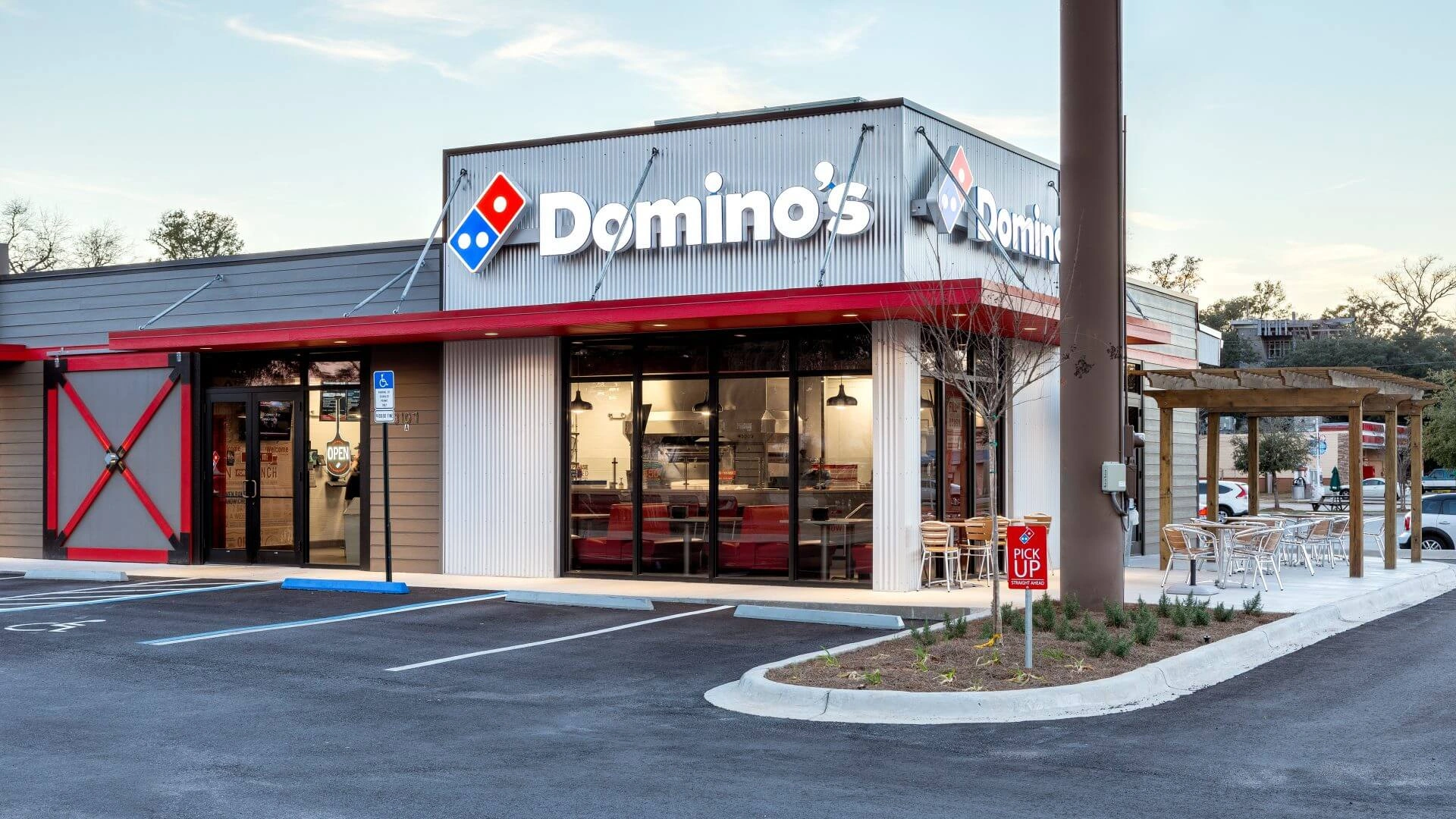
Domino’s Brazil Goes 100% Franchised as High Rates Bite. (Photo Internet reproduction)
One-stop reference
Company Intelligence
Every listed company in Latin America — financials, ownership and structure for 1,450+ companies across 26 exchanges, in one place.
Browse the directory →
RT
Ask Rio Times
Latin American markets, currencies and companies.
Open the full Ask Rio Times →

The chain, the largest pizza network in the country, is transferring its final 22 company-owned outlets to franchise partners, a step that completes its move to a fully franchised structure, according to trade-press coverage of its expansion strategy. The decision lands in an environment of stubbornly expensive credit, where tying up capital in company-run stores has become hard to justify.

Domino’s Brazil is controlled by Vinci Compass, the Brazilian alternative-asset manager that bought the operation in 2018 and also owns the Outback chain in the country. Under the new model, the manager keeps the master franchise and the supply chain while franchisees shoulder the cost of opening and running each restaurant.

Why Domino’s Brazil is going fully franchised

The logic starts with the cost of money in Brazil, which remains punishing even after a turn in the rate cycle. The benchmark Selic rate stands at 14.25% following three straight cuts in 2026, down from a near-two-decade high of 15%, yet it is still among the steepest policy rates in the world and makes every real of company capital expensive to deploy.

By pushing stores into franchisees’ hands, the company turns a capital-hungry business into one that earns royalties and supply-chain margin without funding the buildout itself. That is the same asset-light formula Domino’s uses worldwide, where independent owners run about 99% of its more than 22,000 restaurants.

The shift also fits a chain that has spent two years re-engineering itself for a high-rate market, stripping cost out of every new opening. It scrapped a central pasta factory so each store makes its own dough, and it swapped an imported oven for a locally built version that cut equipment costs several times over, lowering the bar for new franchisees, while an ordering app developed in-house now drives close to a quarter of the chain’s sales.

What it means for the chain and its rivals

The franchised model is meant to power an aggressive build-out into the Brazilian interior rather than the saturated big cities. From roughly 220 stores today, the company plans to add about 150 outlets over three years to reach some 370, concentrating on smaller cities of under 150,000 people where cheaper compact formats fit best.

Those compact formats are central to the math behind the expansion. New kiosk and small-store layouts cut the entry ticket to about R$400,000 (US$77,000), well below the more than R$1 million (US$193,000) an older, larger store once demanded.

The strategy is already showing up in the numbers the company reports. Domino’s Brazil booked revenue of R$650 million (US$126 million) in 2025 and is targeting more than R$750 million (US$145 million) this year, a gain of about 15%, with same-store sales rising for 11 straight quarters.

The contrast with its closest competitor makes the bet look deliberate rather than defensive. Pizza Hut, run in Brazil by International Meal Company, grew first-quarter revenue but saw its store count shrink, while Domino’s keeps opening units by leaning on partners rather than its own balance sheet.

Frequently Asked Questions

What is Domino’s Brazil changing?

It is moving to a fully franchised model by handing its last 22 company-owned stores to franchise partners. The owner, Vinci Compass, keeps the master franchise and the supply chain, while franchisees take on the cost of opening and operating each restaurant.

Why does a high Selic rate push franchising?

With the Selic benchmark at 14.25%, financing company-owned stores ties up expensive capital that earns less than the cost of money. Franchising shifts that investment onto partners, letting the chain grow on royalties and supply-chain sales instead of its own cash.

How fast is the chain growing?

The network plans to expand from about 220 stores to roughly 370 within three years, adding around 150 outlets aimed largely at interior cities under 150,000 people. Revenue reached R$650 million (US$126 million) in 2025, with a target above R$750 million (US$145 million) in 2026.

Connected Coverage

Brazil’s Corporate Debt Crisis Hits 10% of Credit

Brazil’s Tok&Stok Owner Files for Chapter 11

This article was produced by The Rio Times’ automated newsroom system. How we use AI · Report an error

Read More from The Rio Times

The Rio Times · Power Map
See who really holds power in Latin America
Click to open the Power Map

Rotate for Best Experience

This report is optimized for landscape viewing. Rotate your phone for the full experience.