Brazil Economy 2026: GDP, Interest Rate, Inflation, Outlook

BRAZIL · ECONOMY · 2026 OUTLOOK
Key Facts
- —Growth GDP rose 0.5% in the second quarter and 2.0% on a year earlier; economists expect 1.80% for 2026.
- —Interest rate The Selic, Brazil’s benchmark rate, is 13.75% after five straight cuts, and the next decision is on 4 November.
- —Inflation Consumer prices rose 4.58% in the 12 months to September, above the 4.5% ceiling of the target band.
- —The real The dollar closed at R$5.44 on 30 October, against R$4.98 on 23 October, two days before the runoff.
- —Prediction markets Traders on Polymarket, a US prediction-market platform, gave about 84% to no change in the Selic on 4 November (3 November 2026, 4:58 a.m. ET).
Brazil’s economy is growing slowly while inflation sits above target: GDP in the second quarter of 2026 was 2.0% higher than a year earlier, according to IBGE, the national statistics agency, and consumer prices rose 4.58% in the 12 months to September. The Selic, the central bank’s benchmark interest rate, stands at 13.75%.
Unemployment fell to 5.2% in July to September, the lowest for that quarter since the series began in 2012. The central bank’s rate-setting committee, the Copom, decides on the Selic on Wednesday 4 November 2026.
The vote has moved the markets since Luiz Inácio Lula da Silva, the president, won the runoff on 25 October, two days before his 81st birthday, with 51.79% of valid votes. For US investors, the question is whether the real, the Brazilian currency, steadies before the central bank meets.
Updated 3 November 2026 · Next: Copom decision, Wednesday 4 November
In Plain English
- Selic: the central bank’s benchmark interest rate, which sets the cost of borrowing in Brazil
- Copom: the central bank committee that votes on the Selic about every six weeks
- IPCA: Brazil’s official consumer price index, the measure of inflation the target applies to
- IBGE: the national statistics agency that publishes GDP, inflation and unemployment
- Focus survey: the central bank’s weekly poll of banks, funds and other institutions on growth, prices and the Selic
Sources: Banco Central do Brasil (Selic, Focus survey, PTAX), IBGE (IPCA), RT market data (market quotes). Checked Nov 5, 06:00 UTC.
Detail guides: Brazil interest rate · Brazil inflation rate · US dollar to Brazilian real · Brazil stock market · Brazil GDP
Is the Brazilian Economy Growing in 2026?
Yes, but slowly. IBGE reported on 1 September that GDP grew 0.5% in the second quarter, after 1.1% in the first quarter.
Compared with the second quarter of 2025, output was 2.0% higher, and the four quarters to June added up to 1.9%. Full-year growth in 2025 was 2.3%, according to IBGE’s release of 3 March 2026.
The central bank’s IBC-Br activity index, a monthly guide to GDP, rose 0.3% in August from July. The September reading is due on 17 November, and IBGE publishes third-quarter GDP on 2 December 2026.
For the size of the economy in US dollars, see our Brazil GDP guide. It also carries the IMF forecasts.
Brazil GDP Forecast for 2026 and 2027
The two sources differ because the Focus survey polls banks and funds every week, while the IMF publishes a fuller outlook twice a year. Both expect growth to slow in 2027.
The Focus answers run to 23 October, two days before the runoff, so they do not yet reflect the market move that followed. The IMF points to restrictive monetary conditions and less fiscal support.
What Is Brazil’s Selic Interest Rate Now?
The Selic is 13.75%. The Copom cut it by 0.25 percentage points on 16 September, the fifth cut in a row since March, after the rate sat at 15.00% from June 2025 to March 2026.
The next decision comes on Wednesday 4 November, with the statement due at 21:30 UTC (4:30 p.m. in New York). The one after that is on 9 December.
For the full mechanics, see our Selic explainer for foreign investors. It is written for readers who have never followed a central bank.
What Is Brazil’s Inflation Rate in 2026?
Inflation is 4.58% over 12 months. IBGE reported that the IPCA rose 0.82% in September, and the 12-month rate climbed from 4.22% in August.
The official target is 3.0% with a tolerance of 1.5 points either side, so 4.58% sits just above the 4.5% ceiling. The mid-month reading for October, the IPCA-15, rose 0.32%, and its 12-month rate was 4.62%.
Focus economists expect 5.19% for 2026 and 4.34% for 2027. IBGE publishes the full October IPCA on 12 November; for the weekly numbers, see our Brazil inflation forecast for 2026 and 2027.
How Low Is Unemployment in Brazil?
Unemployment was 5.2% in the three months to September, according to IBGE’s PNAD, the national household survey, down from 5.3% in the three months to August. A year earlier it was 5.6%.
It is the lowest rate for a July-to-September quarter since the series began in 2012. The Focus survey expects 5.2% at the end of 2026 and 5.73% at the end of 2027.
How High Is Brazil’s Public Debt?
Gross general government debt reached 82.9% of GDP in September, about R$11.1 trillion (about US$2.0 trillion at R$5.42 per US$, the central bank’s official daily rate, known as PTAX, on 30 October), according to the central bank. Net public sector debt, which subtracts the assets the state holds, was 70.0% of GDP.
In September the consolidated public sector ran a primary deficit of R$5.5 billion (about US$1.0 billion). The primary balance leaves out interest payments, and from January to September the deficit was R$94.3 billion (about US$17.4 billion), or 0.93% of GDP.
What Has the Election Done to the Real and Stocks?
The real weakened sharply after the runoff. The dollar closed at R$4.98 on Friday 23 October, and on Monday 26 October it closed at R$5.42, a rise of about 9% in one session.
On 30 October it closed at R$5.44, according to RT market data (RT market data, a financial data provider), against R$5.48 at the end of 2025. It traded at about the same level on 2 November, a holiday in Brazil.
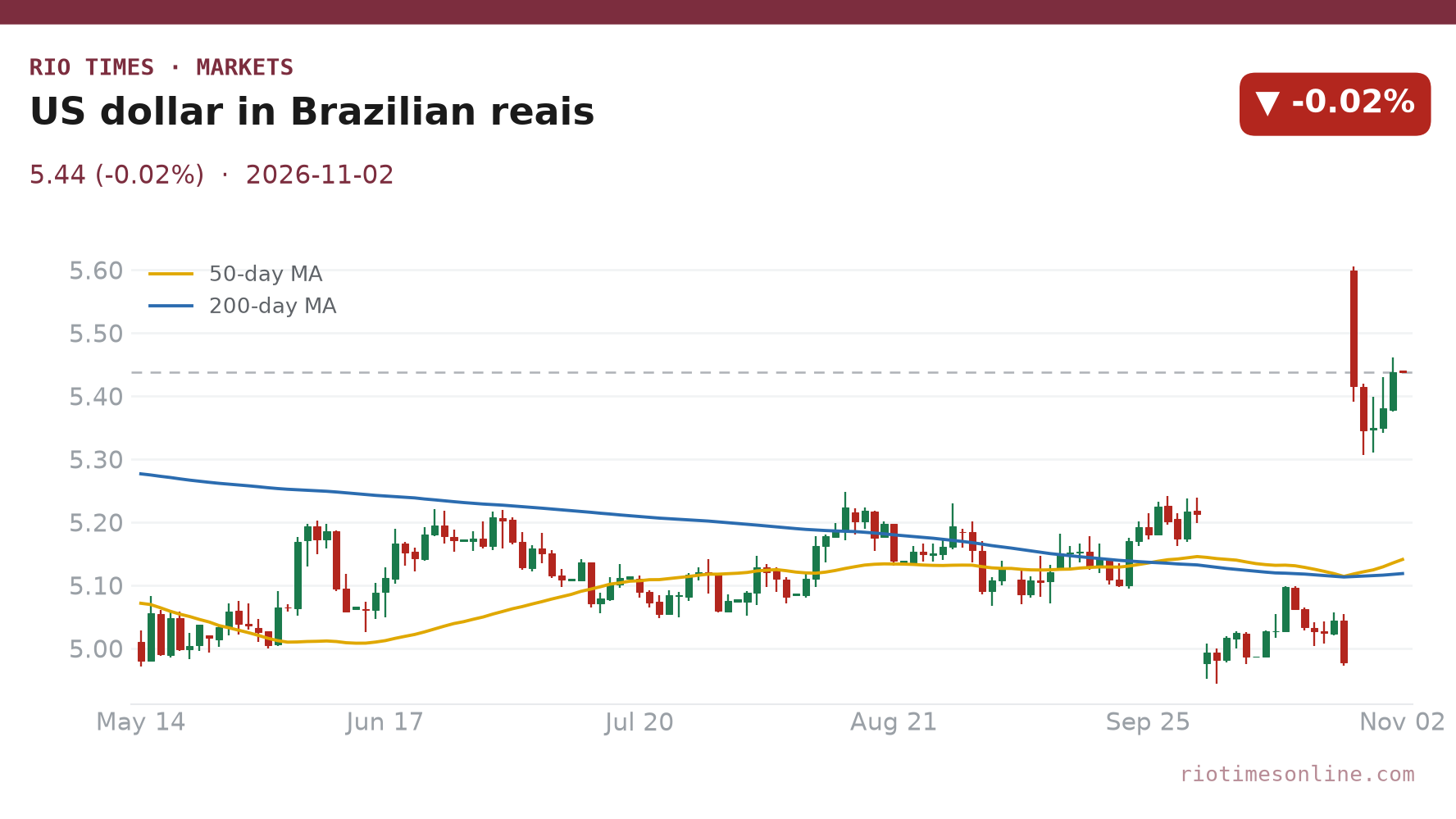
Over the past 52 weeks the dollar’s closing price ranged from R$4.89 on 11 May to R$5.59 on 22 December 2025. The Focus survey’s end-2026 forecast of R$5.05, taken on 23 October, is now well below the market.
The Ibovespa, Brazil’s main stock index, fell 13.88% on 26 October, from 205,083 points to 176,608. It closed at 167,922 on 30 October, which is 18.1% below its level of 23 October and still 4.2% above its close of 161,125 on 30 December 2025.
Brazil’s Trade Surplus and the US Tariff
Brazil ran a trade surplus of US$62.4 billion from January to September 2026, 34.8% more than a year earlier, according to the Ministry of Development, Industry, Trade and Services. Exports rose 10.4% to US$284.7 billion, and imports rose 5.0% to US$222.3 billion.
Through the fourth week of October the surplus reached US$69.8 billion, according to the ministry. It now projects US$84.4 billion for the full year, down from its earlier estimate of US$90 billion.
A 25% US tariff on Brazilian goods took effect on 22 July 2026, after a US trade investigation known as Section 301. The US Trade Representative, the White House trade office, lists exemptions in an annex, and we have not confirmed any change to the tariff since the vote.
What Prediction Markets Say
Prediction markets let traders buy contracts that pay US$1 if an outcome happens, so a price of 84 cents reads as an 84% chance. On Polymarket, the market on the central bank’s November decision, listed as “Bank of Brazil decision in November” (US$134,188 traded), gave about 84% to no change and 12.5% to a cut of 0.25 points.
Two weeks earlier the same market had favoured a cut at 86.5%. The December decision market (US$52,236 traded) gave 67.5% to no change and 25.0% to a 0.25-point cut.
Polymarket’s “Brazil Annual Inflation 2026” market (US$198,980 traded) gave 51.5% to a 2026 rate of 5.00% to 5.49%, and 29.4% to 5.50% to 5.99%. Prices were read on 3 November 2026 at 4:58 a.m. Eastern time, and they are bets, not forecasts.
Why we show this: prediction markets turn real-money bets into a live probability that moves within minutes of the news, which is why investors, campaigns and newsrooms in the United States now follow them closely. We show them next to polls and official results, never instead of them.
Brazil Economy Outlook to 2027
Focus economists see growth slowing to 1.31% in 2027, inflation easing to 4.34% and the Selic falling to 11.75%. The IMF projects growth of 1.9% for 2027.
The risks run both ways, because faster rate cuts could weaken the real and lift prices. Slower cuts would keep borrowing costs high and hold back investment.
What the Brazilian Economy Means for US Investors and Foreigners
For foreign investors, a Selic of 13.75% is a high yield, but the real now swings with politics. A weaker real makes Brazilian assets cheaper in US dollars, and it makes dollar earnings go further for residents paid abroad.
Prices are still rising slightly faster than the 4.5% ceiling of the target band, so rents and services may keep getting dearer. High interest rates also keep loans and credit cards expensive for anyone borrowing in reais.
Dates to Watch
What Is Not Known
No one yet knows whether the real will steady after the sharp move of 26 October, or whether the Copom will signal a pause on 4 November. It is also unclear whether the jump in September inflation will fade, which the next IPCA releases will show.
Dario Durigan has run the Finance Ministry since March, and Lula has not said who will lead it from January. We also have no official estimate of what the US tariff will cost Brazilian exporters over a full year.
More: Brazil coverage from The Rio Times.
Frequently Asked Questions
How is the Brazilian economy doing in 2026?
Brazil’s GDP grew 2.0% in the second quarter of 2026 from a year earlier, and unemployment was 5.2% in July to September. Inflation of 4.58% in September is above the 4.5% ceiling of the target.
What is Brazil’s GDP growth forecast for 2026 and 2027?
The central bank’s Focus survey of 26 October 2026 has 1.80% for 2026 and 1.31% for 2027. The IMF’s October 2026 outlook has 2.2% for 2026 and 1.9% for 2027.
What is Brazil’s Selic interest rate right now?
The Selic is 13.75% after a cut of 0.25 points on 16 September 2026, the fifth in a row. The next Copom decisions are on 4 November and 9 December.
What is Brazil’s inflation rate in 2026?
The IPCA rose 4.58% in the 12 months to September 2026, above the 4.5% ceiling of the target band. The Focus survey expects 5.19% for the full year.
How did the election affect the Brazilian real and stocks?
The dollar rose from R$4.98 on 23 October to R$5.42 on 26 October, and the Ibovespa fell 13.88% that day. On 30 October the dollar closed at R$5.44.
How high is Brazil’s public debt?
Gross general government debt was 82.9% of GDP in September 2026, and net public sector debt was 70.0%. The primary deficit from January to September was 0.93% of GDP.
For wider context, read our guide Brazil Explained 2026. Daily coverage sits in our Brazil news hub.
Sources: Banco Central do Brasil, Copom statement, 281st meeting, 16 September 2026; Banco Central do Brasil, Focus survey, bulletin of 26 October 2026; IBGE, quarterly national accounts, second quarter of 2026, 1 September 2026; IBGE, IPCA for September 2026 and IPCA-15 for October 2026; IBGE, PNAD Contínua, quarter to September 2026, 30 October 2026; Banco Central do Brasil, fiscal statistics for September 2026, 29 October 2026; Banco Central do Brasil, IBC-Br and PTAX series; IMF, World Economic Outlook, October 2026; Ministry of Development, Industry, Trade and Services, trade balance; Office of the US Trade Representative, Section 301 action on Brazil, July 2026; Superior Electoral Court (TSE), runoff results, 25 October 2026; Polymarket, Bank of Brazil decision in November and December, and Brazil Annual Inflation 2026; RT economic calendar, Ibovespa and USD/BRL data.
The big picture: Brazil explained: economy, politics, society and daily life in one read.
This article was produced by The Rio Times’ automated newsroom system. How we use AI · Report an error · Editorial responsibility: Matthias Camenzind, Editor-in-Chief
Expat Guide to Brazil
What The Rio Times publishes for foreigners who live in or move to Brazil.
Start here
- Florianópolis Rents by Neighborhood in 2026
- São Paulo Rents by Neighborhood in 2026
- Rio de Janeiro Rents by Neighborhood in 2026
- Brazil Taxes Nomads After 184 Days
City guides
Rio de Janeiro, São Paulo, Florianópolis, Salvador, Belo Horizonte, Fortaleza, Curitiba, Porto Alegre, Brasília
Coming up in Brazil
- Brazil Events Calendar: Carnival, Réveillon and Festivals 6 Nov
- Opeth Plays Espaço Unimed in São Paulo on 6 November 6 Nov
- São Paulo Grand Prix 2026: Interlagos Dates, Schedule, Tickets and Travel Guide 6 Nov
- Ana Carolina Plays Belo Horizonte on 7 November, Bringing 25 Anas Tour Home to Minas Gerais 7 Nov
Understand Brazil
Brazil runoff, Sunday, October 25: When is the Brazil runoff election. Latest: Brazil runoff polls, Flávio 51%, Lula 49%.