Brazil Election: Betting Markets Favour Flávio Bolsonaro, Polls Show a Tie
Brazil · Analysis
Key Facts
- —The election Brazil votes on Sunday 4 October, with a runoff on 25 October if nobody wins over half the valid votes.
- —What the markets say Polymarket, Kalshi, PredictIt and Smarkets all give Flávio Bolsonaro a 57% to 61% chance, while bookmakers see a near coin flip.
- —What the polls say Six September polls show a statistical tie, with a simple average giving Lula a runoff lead of about 1.5 points.
- —Where they differ Market prices imply Flávio will beat his poll numbers in the first round, as his father did in 2022.
- —Who sets the price Brazil has banned election contracts since May, so Brazilians are formally barred from the market that sets the price.
- —The first test Flávio’s share of valid votes on 4 October will show whether the market’s premium over the polls was justified.
Every major betting market now makes Flávio Bolsonaro the favourite to beat Lula, while the polls still describe a coin flip. The gap is really a bet that Brazil’s polls will understate the right again, as in 2022.
Thirteen days before Brazil’s first round, two very different instruments are measuring the same race and reaching different answers. Prediction markets from Polymarket to Kalshi give Flávio Bolsonaro roughly a 60% chance, while six national polls published this month show a statistical tie.
What the Betting Markets Say
A prediction market sells contracts that pay US$1 if an event happens and nothing if it does not. The price, quoted in cents, is read as the crowd’s estimate of the probability.
At least five platforms trade Brazil’s presidential race, and every one of them makes Flávio the favourite. The Rio Times read their public prices on 21 September.
Polymarket, a crypto-based market and the largest, priced a Flávio win, runoff included, at 58.7 cents and Lula at 40.5 cents. Kalshi, an exchange overseen by the US Commodity Futures Trading Commission, had Flávio at 61 cents and Lula at 41 to 42.
PredictIt, a long-running US political market, showed 59 cents for Flávio and 43 for Lula. Smarkets, a British betting exchange, quoted Flávio between 56.8% and 59.5% and Lula between 40% and 42.4%.
Manifold, a play-money site where users bet virtual currency, gave Flávio 59% and Lula 40% from 52 traders. Bookmakers see a closer race, with Oddschecker, a British odds-comparison site, showing best prices of 10/11 on Flávio and evens on Lula.
Those bookmaker odds imply roughly 52% for Flávio and 50% for Lula before the bookmakers’ margin is removed. Stripped of that margin, they point to about 51% against 49%.
| Platform | Type | Flávio | Lula |
|---|---|---|---|
| Polymarket | Crypto-based prediction market | 58.7% | 40.5% |
| Kalshi | US-regulated exchange | 61% | 41–42% |
| PredictIt | US political market | 59% | 43% |
| Smarkets | British betting exchange | 56.8–59.5% | 40–42.4% |
| Manifold | Play-money market | 59% | 40% |
| Bookmakers (Oddschecker best price) | Fixed odds | 10/11 (52%) | Evens (50%) |
Implied chance of winning the presidency, runoff included, on 21 September 2026. Ranges show buy and sell quotes. Sources: the platforms’ public data and Oddschecker.
The money is concentrated in one place. Polymarket’s contract has drawn about US$152 million in trading since it opened in September 2025.
Kalshi shows about US$4.5 million in volume on its Brazil presidency contracts. Polymarket’s 2022 market on the contest between Lula and Jair Bolsonaro traded only about US$334,000 in total.
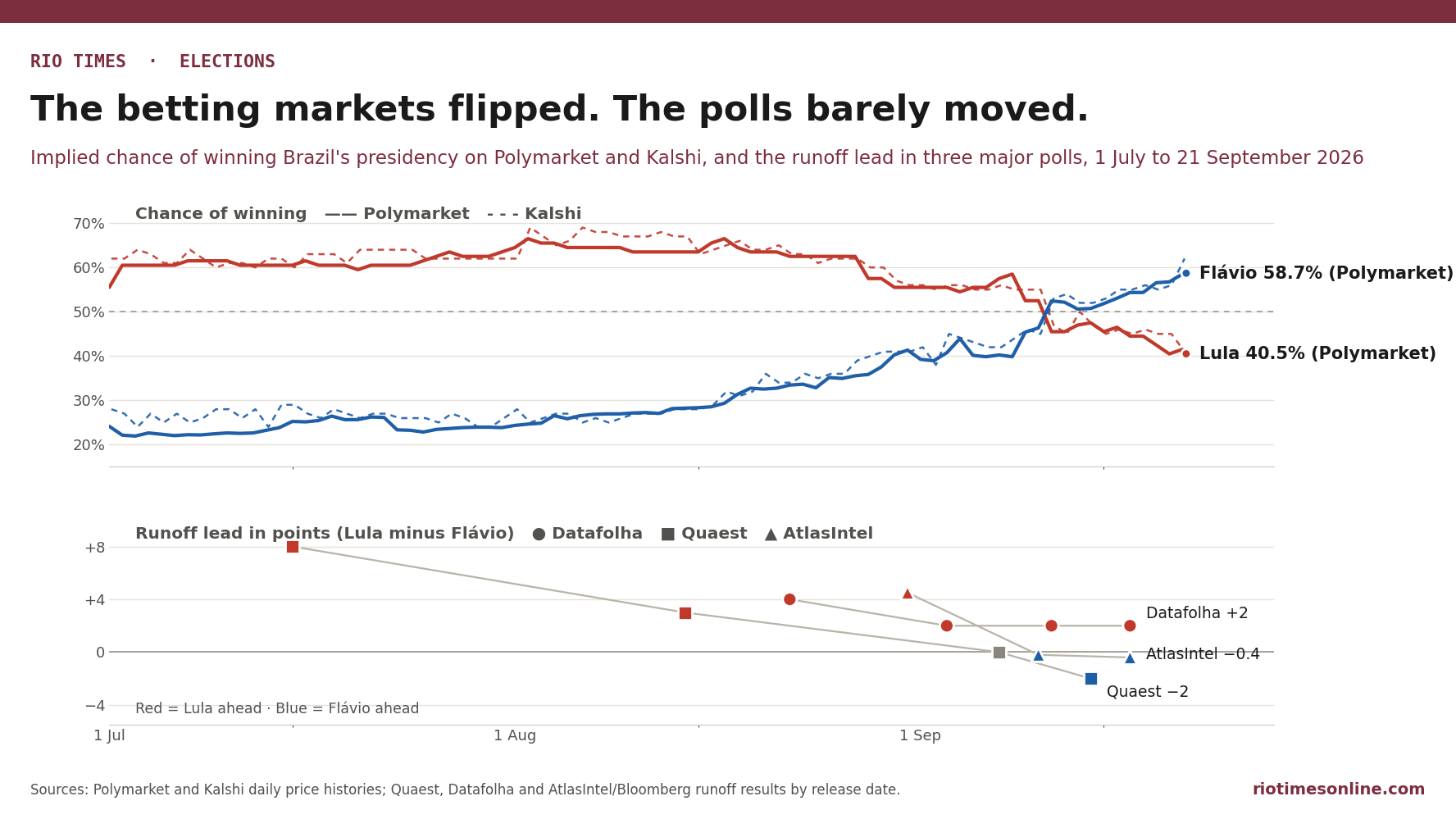
The swing has been fast on every platform. On Polymarket, Flávio traded near 22 cents in early July and Lula near 60 cents, and Lula peaked at 66.5 cents on 17 August.
Kalshi’s price history followed the same path, with Lula at 69 cents on 6 August and Flávio overtaking him on 11 September. Poder360, a Brazilian political news site, recorded Flávio ahead on Polymarket by 52% to 45% on 10 September.
One Signal or Several?
Five platforms agreeing sounds like strong evidence, but they are not independent readings. Traders who spot a gap between two platforms can buy on one and sell on the other, which pulls prices together.
That helps explain why Polymarket, Kalshi, PredictIt and Smarkets all sit within a few points of each other. Polymarket also holds far more money than the rest, which makes its price the hardest for any single trader to move.
Bookmakers work differently, which may explain their narrower gap. They set their own odds, build in a profit margin and adjust prices to limit their exposure, rather than matching bettors against each other.
Manifold’s users risk only virtual currency, so its 59% for Flávio is a weaker signal. It sits almost exactly on the real-money price, a reminder of how closely these markets echo each other.
Live Market IntelligenceBrazil — Live Market Board
Rio Times · Live Market Intelligence
Brazil — Live Market Board
+0.61%
186,356.68
+0.61%
63,375.93
-0.78%
11,297.95
-0.73%
3,004,554
-0.58%
2,547.60
-0.02%
59,344.04
+0.07%
| Instrument | Last | Change | YoY | Prev. | High | Low | Volume |
|---|---|---|---|---|---|---|---|
| IBOV | 186,356.68 | +0.61% | +21.85% | 185,229.17 | 168,310 | 167,142 | — |
| USD/BRL | 5.16 | +0.01% | -5.13% | 5.16 | 5.18 | 5.14 | — |
| SELIC | 14.00% | — | — | — | — | — | |
| PETR4 | 41.64 | -0.05% | +35.19% | 41.66 | 41.97 | 41.15 | 41,499,400 |
| VALE3 | 72.97 | +0.83% | +30.75% | 72.37 | 73.54 | 72.66 | 17,658,000 |
| ITUB4 | 38.60 | -1.03% | +4.57% | 39.00 | 39.34 | 38.39 | 29,487,800 |
| BBDC4 | 16.85 | +0.36% | +3.50% | 16.79 | 16.90 | 16.67 | 19,416,900 |
| BBAS3 | 19.37 | +0.47% | +0.73% | 19.28 | 19.44 | 19.16 | 11,069,200 |
| B3SA3 | 14.26 | -0.21% | +12.73% | 14.29 | 14.47 | 14.11 | 33,037,800 |
| ABEV3 | 14.89 | -0.80% | +21.91% | 15.01 | 15.07 | 14.81 | 16,453,100 |
| WEGE3 | 47.59 | +0.49% | +29.99% | 47.36 | 48.08 | 47.36 | 3,364,600 |
| PRIO3 | 59.14 | -0.19% | +50.67% | 59.25 | 59.81 | 58.74 | 3,325,600 |
| SUZB3 | 41.33 | +2.35% | -23.55% | 40.38 | 41.48 | 40.35 | 3,914,900 |
| RENT3 | 34.68 | -0.09% | +0.84% | 34.71 | 34.96 | 34.35 | 7,979,100 |
| AZZA3 | 15.89 | -2.63% | -53.76% | 16.32 | 16.42 | 15.82 | 1,330,300 |
| CSNA3 | 4.30 | +0.47% | -42.65% | 4.28 | 4.41 | 4.26 | 10,076,100 |
| GGBR4 | 24.69 | +2.19% | +51.38% | 24.16 | 24.85 | 24.18 | 7,047,600 |
| ENEV3 | 24.21 | -1.38% | +70.49% | 24.55 | 24.64 | 23.99 | 9,297,000 |
What the Polls Say
Brazilian law requires every published poll to be registered with the Superior Electoral Court, which organises and oversees elections. Registration makes a poll’s methods public, but it is not a quality check.
Datafolha, polling for the Folha de S.Paulo newspaper and TV Globo, found Lula at 46% and Flávio at 44%. It interviewed 2,002 people from 15 to 17 September, with a margin of error of two points.
AtlasIntel, polling 5,018 people online for Bloomberg from 11 to 16 September, had Flávio at 47.2% and Lula at 46.8%. Genial/Quaest, for Globo, put Flávio at 42% and Lula at 40%, the first time he had led its series.
BTG Pactual/Nexus found Lula at 47% and Flávio at 46%, and CNT/MDA found Lula at 47.3% and Flávio at 40%. Indexa, for the Estadão group’s Broadcast news service, put Lula at 43% and Flávio at 42%.
Across these six September polls, four put Lula ahead and two put Flávio ahead, and only CNT/MDA’s gap lies outside the margin of error. A simple average of all six gives Lula a lead of about 1.5 points.
The direction of travel matters as much as the level, and it favours Flávio. Quaest’s runoff moved from an eight-point Lula lead on 15 July to a two-point Flávio lead on 14 September.
AtlasIntel shows the same drift, from a 4.5-point Lula lead on 31 August to a narrow Flávio edge since. Datafolha is the exception, holding at 46% to 44% in all three of its September polls.
A 59% Chance Is Not a 59% Vote
A market price measures the probability of winning, not the size of the win. A 59% chance means traders think Flávio wins about six times in ten, even if only narrowly each time.
That is why a near-tie in the polls can coexist with a clear favourite in the market. A small but steady expected edge, held with confidence, is enough to push a price well above 50 cents.
On the first round, markets and polls actually agree. Polymarket and Kalshi both give Lula about a 69% chance of finishing first, in line with Datafolha, AtlasIntel and Quaest.
Kalshi also prices only about an 11% chance that anyone wins outright on 4 October. Both sides therefore expect the race to go to a runoff.
The real disagreement shows up in contracts on each man’s first-round share of valid votes. On Lula, the markets sit close to the polls, with a midpoint of roughly 43%.
On Flávio they do not. Polymarket gives an 87.5% chance that he takes 39% or more, and Kalshi’s contracts put his midpoint near 42%.
Stripping out blank, null and undecided answers, Datafolha’s latest survey works out at roughly 43% for Lula and 39% to 40% for Flávio. In effect, traders expect Flávio to beat Datafolha by two to three points, which is closer to what AtlasIntel shows.
Why Traders Lean Towards Flávio
One plausible reason is the memory of 2022, when Brazilian polls understated Jair Bolsonaro by a wide margin. Datafolha’s final first-round poll gave him 36% of valid votes, and he won 43.20%.
Ipec, another major pollster, had him at 37%, and even AtlasIntel, among the closest, had him at 41.1%. Lula’s share was overstated by less, with Datafolha at 50% against a result of 48.43%.
Traders who think that error was built into the pollsters’ methods will mark Flávio up. That is a bet on how polls are made, not on anything they currently show.

A second possible reason is momentum, since most series have moved towards Flávio since July. A market prices where a race seems to be heading, while a poll reports where it stood during fieldwork.
A third factor is rejection. In the same Datafolha survey, 47% of voters said they would never back Lula, and exactly the same share said so of Flávio.
With both men capped at similar levels, the runoff will turn on turnout and on the few voters still undecided. That leaves plenty of room for a confident market to disagree with a cautious poll.
Who Sets the Price in a Banned Market
Brazilians are formally barred from the market that prices their own election. Brazil’s National Monetary Council banned derivatives tied to political, electoral, sporting and entertainment events on 24 April, in force from 4 May.
The Finance Ministry’s Secretariat of Prizes and Bets then ordered Polymarket and 26 other prediction sites blocked. Polymarket began restricting Brazilian accounts in July, letting them only close existing positions, the business magazine Exame reported.
Kalshi and PredictIt were on the same list of 27 blocked platforms, alongside several Brazil-focused sites. B3, the stock exchange, has listed event contracts on the Ibovespa, the dollar and bitcoin since 27 April.
Elections are excluded from those contracts, because the new rule admits only economic and financial references. Brazilians have no legal market for contracts on the election itself.
Enforcement is incomplete, and the government knows it. Agência Pública, an investigative news agency, reported on 3 September that Polymarket kept promoting bets on the Brazilian race.
On 18 September the Attorney General’s Office asked the Finance Ministry for information to weigh action against the platform. The ministry says Polymarket is blocked, and that access by some users does not mean it is authorised.
No public data show how the positions split between Brazilian and foreign traders. What is clear is that the price is not a sample of Brazilian voters, which is what a poll tries to be.
Such markets can also be moved by a few large traders. In October 2024, Reuters linked part of a rise in Donald Trump’s Polymarket odds to four accounts holding more than US$30 million in bets.
News moves the price too, sometimes violently. On 13 May The Intercept Brasil released audio of Flávio pressing banker Daniel Vorcaro to finance “Dark Horse”, a film about his father.
Vorcaro had committed US$24 million to the film and paid about US$10.6 million, the news site Nexo Jornal reported. The transfers came before Brazil’s central bank liquidated his Banco Master in November 2025.
Polymarket’s price history shows Flávio falling from 43% to about 28% within three days. He then traded between roughly 22% and 33% from June until mid-August.
On 20 September Elon Musk, the owner of X, replied “Wow” to a post showing Flávio’s rise on Polymarket. Poder360 and other Brazilian outlets covered the comment widely, two weeks before the vote.
What History Says About Markets and Polls
The research does not settle the argument. Economists Joyce Berg, Forrest Nelson and Thomas Rietz found that the Iowa Electronic Markets beat polls 74% of the time.
Their 2008 study compared market prices with 964 polls across five US presidential elections. Political scientists Robert Erikson and Christopher Wlezien argued that polls do better once adjusted for the way leads usually shrink before election day.
Markets have had famous misses. Betfair prices implied only about an 11.5% chance of a Leave vote at 11 p.m. on Brexit night in 2016, a Cambridge study found.
On the eve of the 2016 US election, PredictIt gave Donald Trump about a 20% chance, CNBC reported. Markets had a notable hit in 2024, when Polymarket priced Trump at 60% less than three weeks before he won.
Brazil’s own record cuts both ways. The polls missed Jair Bolsonaro’s first-round strength in 2022, yet the final runoff polls came close.
Datafolha’s last runoff poll gave Lula 52% of valid votes, against an actual result of 50.90%. The miss was in the first round, which is exactly where the markets now expect a repeat.
How to Read the Next Five Weeks
The first round on 4 October will be the first real test of the market’s premium over the polls. The number to watch is Flávio’s share of valid votes, about 39% to 40% on Datafolha’s figures and nearer 42% in the markets.
If he lands near 40% or below, the polls will have read the country well and the market would likely reprice towards Lula. If he reaches 42% or more, the pollsters will face questions like those of 2022, and the market’s confidence will look earned.
Neither outcome settles the runoff on 25 October, when the voters of Cury, Caiado, Renan Santos and Zema will matter. Those four candidates together hold 15% in Datafolha’s first round.
Until then, every instrument agrees on the point that matters most. This is a close race, and a 60% favourite still loses roughly four times in ten.
More: Brazil election poll tracker, what expats need to know two weeks out and all Brazil coverage from The Rio Times.
Frequently Asked Questions
Is Polymarket legal in Brazil?
No. Brazil has banned contracts on political and electoral events since 4 May 2026, and the Finance Ministry ordered Polymarket and 26 other sites blocked.
Which betting sites cover Brazil’s election?
Polymarket, Kalshi, PredictIt, Smarkets and the play-money site Manifold all list the race, and British bookmakers offer odds. None may legally take election bets from Brazil, and the prediction sites among them are blocked there.
Who is leading Brazil’s presidential polls?
Lula leads the first round in Datafolha, AtlasIntel and Quaest, while the runoff is a statistical tie. Four of six September polls put Lula ahead in the runoff and two put Flávio Bolsonaro ahead.
What does a 60% chance on a betting market mean?
It means traders collectively think Flávio Bolsonaro is somewhat more likely than not to win. It does not mean he is expected to win 60% of the vote.
Were Brazil’s polls wrong in 2022?
In the first round, yes. Datafolha’s final poll gave Jair Bolsonaro 36% of valid votes and he won 43.20%, although the runoff polls came much closer.
When are Brazil’s election and runoff?
The first round is on Sunday 4 October 2026. If no candidate wins more than half of the valid votes, the runoff is on 25 October.
Sources: Polymarket, Brazil Presidential Election market, Kalshi, Brazil presidency market, Kalshi News on Flávio overtaking Lula, PredictIt, Brazil presidential market, Smarkets, Brazil presidential election, Manifold, 2026 Brazil presidential election winner, Oddschecker, Brazil presidential election odds, CNN Brasil on Kalshi and Polymarket odds, Seu Dinheiro on B3’s event contracts, CNN Brasil on the Datafolha poll of 15 to 17 September, Reuters on the AtlasIntel/Bloomberg poll, Valor on the Genial/Quaest poll, Poder360 on the BTG/Nexus poll, Estadão on the Indexa/Broadcast poll, Poder360 on the CNT/MDA poll, Poder360 on Polymarket’s Brazil odds, Poder360 on Elon Musk’s reaction, Reuters on Brazil’s prediction-market ban, Exame on Polymarket restricting Brazilian users, Agência Pública on Polymarket’s election bets, Yogonet on the Attorney General’s Office request, G1 on Flávio Bolsonaro and Daniel Vorcaro, Nexo Jornal on the Intercept Brasil audio, Reuters on the liquidation of Banco Master, CNN Brasil on Datafolha’s final 2022 first-round poll, Congresso em Foco on 2022 poll accuracy, Berg, Nelson and Rietz, International Journal of Forecasting, 2008, Erikson and Wlezien on markets and polls, Reuters on large Polymarket bets in 2024, CNBC on 2016 election betting, University of Cambridge working paper on Brexit betting, Finance Ministry on the events open to fixed-odds betting. Market prices and price histories were read from Polymarket and Kalshi public data on 21 September 2026.
This article was produced by The Rio Times’ automated newsroom system. How we use AI · Report an error
Read More from The Rio Times