Brazil Stocks Rise 0.4% as Petrobras Drops | Brazil Market Report, Nov 11
Key Facts
- The Ibovespa, Brazil’s main stock index, closed at 172,060, up 0.42% on the session, after a hard month.
- The index is still 17.7% below its 9 October peak of 209,067, and it is down 16.83% over 20 sessions.
- The real, Brazil’s currency, finished at 5.5827 per US dollar, a move of −0.01%, so it was essentially flat but still weak.
- Fiscal news and Wall Street helped reports of a planned 2027 spending adjustment worth tens of billions of reais came on a strong day in New York.
- The dollar is within 0.1% of its 12-month high of 5.59 and is up 11.04% over 20 sessions, which keeps the bounce fragile.
- Prediction markets: Polymarket prices no change in Brazil’s December interest-rate decision at 90.5% (US$69,649 traded, 7:45 p.m. ET, 11 November).
Today’s Focus
Brazil’s stock market eked out a gain on Wednesday 11 November. The Ibovespa, the main index of the São Paulo stock exchange, closed at 172,060, up 0.42%.
The real, Brazil’s currency, ended almost unchanged at 5.5827 to the US dollar, a move of −0.01%. That is a quiet number after a loud month.
The index is 17.7% below its 9 October peak of 209,067 and has lost 16.83% over 20 sessions. A 0.42% gain is a small bounce from a deep hole, not a recovery.
The main causes were a strong day on Wall Street and reports of a government plan for fiscal adjustment, meaning tighter public spending.
What matters today. A one-day gain does not repair a 16.83% fall over 20 sessions, and the real sits within 0.1% of its weakest level in 12 months.

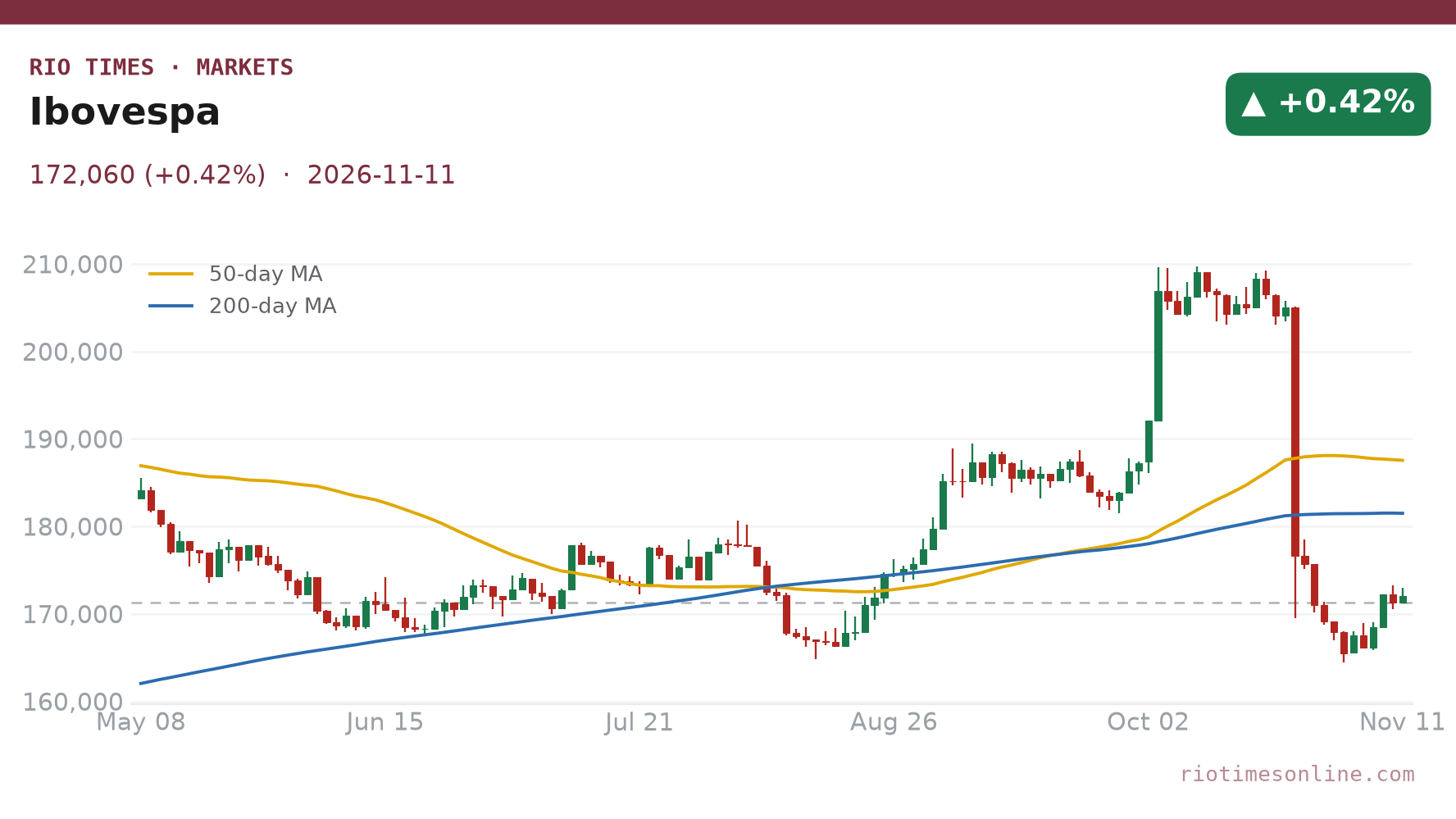
01 The session in one read
Brazil’s market did something modest on Wednesday, and after a brutal month that is news in itself. The Ibovespa rose 0.42% to 172,060, a rebound after a down day on Tuesday.
The real barely moved. It closed at 5.5827 per dollar, with the dollar down 0.01%, so a dollar still costs about as many reais as it did a day earlier.
Think of a ball dropped from a height: one small bounce does not mean it has stopped falling. The index is up 2.68% over five sessions, yet it is down 16.83% over 20 sessions.
The evidence for a lasting recovery is thin: only one up session in a row, a dollar that is up 11.04% over 20 sessions, and outside forces — a stronger US dollar index and higher US bond yields — that normally hurt Brazil. The evidence for a pause in the selling is better, because Wall Street rallied and the real held steady, so the variable to watch is whether the dollar breaks above 5.59.
02 The day’s numbers
| Measure | Level | Change | Read |
|---|---|---|---|
| Ibovespa close | 172,060 | +0.42% | Main index of Brazil’s stock exchange; one up session in a row |
| Session range | — | — | High and low not confirmed in our scan |
| US dollar vs real | 5.5827 reais per dollar | −0.01% | Almost flat; real still weak |
| 12-month high (index) | 209,067 on 9 October 2026 | — | Index sits 17.7% below it |
| 12-month low (index) | 153,294 on 5 November 2025 | — | Index sits 12.2% above it |
| 12-month high (dollar) | 5.59 on 22 December 2025 | — | Dollar is 0.1% below it |
| Key round numbers | 170,000 and 180,000 | — | Nearest floor and ceiling for the index |
The table shows an index in the middle of a long staircase. It is 12.2% above its 12-month low and 17.7% below its peak, so it is neither cheap nor expensive by the year’s own standard.
Over 60 sessions the index is still up 3.1%, so the recent drop is a sharp reversal inside a wider climb. That matters because a reversal can fade faster than a trend can build.
For the real, a weak currency means a dollar buys more reais. An expat paid in dollars gains, while a Brazilian shopping abroad or a company repaying dollar debt pays more.
The dollar has risen 11.04% against the real over 20 sessions and 7.9% over 60 sessions. At 5.5827 it is 14.1% above its 12-month low of 4.89, set on 11 May 2026. Rio Times · Live Market Intelligence
Live Market IntelligenceBrazil — Live Market Board
Brazil — Live Market Board
Instrument Last Change YoY Prev. High Low Volume
IBOV
172,060.43
+0.42%
+9.07%
171,336.99
—
—
—
USD/BRL
5.58
-0.01%
+5.92%
5.58
5.58
5.58
—
SELIC
13.75%
—
—
—
—
—
PETR4
43.55
-3.11%
+31.17%
44.95
44.52
43.30
65,089,600
VALE3
64.43
-0.57%
-0.94%
64.80
65.47
64.16
12,171,000
ITUB4
41.72
+1.26%
+4.25%
41.20
42.09
41.55
19,415,700
BBDC4
14.33
-1.44%
-26.48%
14.54
14.82
14.33
45,613,900
BBAS3
16.89
-1.23%
-28.04%
17.10
17.31
16.89
29,418,100
B3SA3
14.80
+2.21%
+9.39%
14.48
14.92
14.59
40,245,900
ABEV3
15.85
+0.38%
+16.63%
15.79
15.88
15.74
21,260,300
WEGE3
51.61
+1.30%
+12.12%
50.95
52.00
50.95
9,826,200
PRIO3
61.47
+2.42%
+52.53%
60.02
61.99
60.50
18,937,900
SUZB3
53.80
-1.21%
+15.57%
54.46
54.64
53.71
7,203,500
RENT3
30.24
+1.51%
-30.08%
29.79
30.77
29.93
8,008,800
AZZA3
15.37
+4.34%
-46.54%
14.73
15.45
14.74
3,535,400
CSNA3
4.52
+3.20%
-45.61%
4.38
4.52
4.38
15,203,500
GGBR4
25.25
-2.25%
+33.60%
25.83
25.81
24.98
5,425,100
ENEV3
27.38
+1.22%
+41.94%
27.05
27.66
27.05
7,114,000
03 Why it moved — a fiscal pledge and Wall Street relief
The first cause, with medium confidence, was news of a planned fiscal adjustment. The government is reported to be preparing a 2027 package worth tens of billions of reais, plus a spending freeze if public accounts fall below the fiscal target floor.
The second cause, also medium, was Wall Street. The S&P 500 rose 1.31%, the Nasdaq rose 1.60%, and the VIX, the market’s fear gauge, fell 10.12% to 17.49.
The day before had been rough. US consumer prices came in hotter than forecast, which fed talk of tighter Federal Reserve policy, and the [Copom minutes](https://www.bcb.gov.br/publicacoes/atascopom) — the central bank’s record of its rate meeting — raised worries.
The Selic, the central bank’s benchmark interest rate, was left at 13.75% on 4 November.
The usual drivers actually disagreed with the move. The US dollar index rose 0.60% and the US 10-year Treasury yield stayed near 5% (the US bond market was shut for Veterans Day), both of which normally weigh on emerging markets.
The best-supported explanation, with medium confidence, is a local one: the fiscal pledge plus bargain-hunting after a 16.83% fall over 20 sessions. Oil, tracked by USO, a US oil fund, was flat at +0.01%, so it did not push either way.
04 The day’s movers
| Driver | Level / Move | Change | Note |
|---|---|---|---|
| Petrobras (PETR4) | R$43.55 | −3.11% | State oil company; third-quarter results, dividends below hopes |
| Magazine Luiza (MGLU3) | R$7.66 | +17.48% | Retailer; the day’s biggest gainer in our scan |
| Hapvida (HAPV3) | R$4.63 | +8.94% | Health insurer |
| US dollar index | 102.84 | +0.60% | Stronger dollar normally hurts emerging markets |
| US 10-year Treasury yield | 4.98% (Tue) | holiday, no close | Higher cost of money in the US; a headwind |
| S&P 500 | 7,619 | +1.31% | Wall Street rally lifted global risk appetite |
| VIX fear gauge | 17.49 | −10.12% | Calmer nerves help riskier markets such as Brazil |
| Oil (USO fund) | 141.47 | +0.01% | Flat; no push from the oil price |
| Gold (GLD fund) | 365.17 | −1.13% | Safe-haven demand eased |
Petrobras was the heaviest drag. The state-controlled oil company fell 3.11% to R$43.55 after reporting third-quarter results, with dividends below what investors had hoped for.
Magazine Luiza, the retailer, jumped 17.48% to R$7.66 and Hapvida, a health insurer, rose 8.94%. Vale, the iron-ore giant, slipped 0.57%.
The outside forces split in two: Wall Street and the fear gauge helped, the dollar index and US yields hurt.
Falling gold alongside a falling VIX tells the same story — investors felt a little braver. That kind of mood lifts markets such as Brazil first, because they are seen as riskier.
05 The regional scoreboard
| Index | Country | Change |
|---|---|---|
| IPC | Mexico | +0.16% |
| IPSA | Chile | −0.43% |
| COLCAP | Colombia | — |
| Merval | Argentina | — |
| BVL | Peru | — |
Latin America did not move as one. Mexico’s IPC, the main index of its stock exchange, gained 0.16%, while Chile’s IPSA lost 0.43%. We could not verify the Colombian and Argentine closes in time, so the table leaves them blank.
Currencies tell the same split. Colombia’s peso traded weaker, with the dollar around 3,300 pesos, while the Mexican peso (18.6105 per dollar, dollar −0.08%) and the Chilean peso (982.8, dollar −0.14%) edged firmer.
For a reader in Mexico City or Santiago, Brazil’s steady real is a small comfort. For Bogotá, a weaker peso makes dollar debt and imports dearer.
06 The technical picture
The nearest support for the Ibovespa is the round 170,000 level, just below the close. Below that sits the 12-month low of 153,294 from 5 November 2025.
Resistance starts at the round 180,000 level, then the 9 October peak of 209,067. For the dollar, the ceiling is the 12-month high of 5.59, and the round 5.50 level is the nearest support.
Here is what our own price history since 2007 says, and history is not a forecast. After the seven earlier independent cases in which the Ibovespa fell at least as much as 16.8% in 20 sessions, it was higher 20 sessions later in 4 of 7 cases, or 57%, with a median gain of 5.1%.
The worst of those cases saw a further fall of 19.8% and the best a gain of 13.0%. For the dollar, after 16 earlier jumps of at least 11.0% in 20 sessions, it was higher again in only 5 of 16 cases, or 31%, with a median fall of 2.3%.
07 What to watch
- Brazil inflation: Official consumer-price inflation is due on 12 November, with a consensus of 0.26 against 0.82 before, and 4.74 over twelve months against 4.58 before; a hot print would revive worries about the Selic.
- US bond auction: A US 30-year bond auction on 12 November will test demand for long-term US debt; higher yields would pressure the real.
- The 5.59 line: A dollar close above 5.59 per real would be a new 12-month high, while a hold below it keeps the bounce alive.
- Fiscal detail: Whether the adjustment pledge becomes concrete measures decides if the risk premium keeps shrinking; the index needs to hold 170,000.
- Calendar: Brazil’s October car sales (forecast −0.8% against +2.3% before) and auto production (forecast +1.8% against −1.1%), the September service-sector growth reading (previous +0.6%) and the Thomson Reuters Ipsos consumer sentiment index for November (previous 54.07) were due on 11 November; no actual figures were available when we closed.
Background: Brazil Rail Stock Jumps 8% on Takeover Talk.
Background: Brazil Stocks Slip 0.5% as Real Weakens 1.4%.
What Prediction Markets Say
Polymarket, where users bet real money, lists a market on the Bank of Brazil’s December decision, with US$69,649 traded as of 7:45 p.m. ET, 11 November 2026. It prices no change at 90.5%, a 0.25-point cut at 6.3%, a 0.5-point or larger cut at 1.4%, a 0.25-point rise at 0.7% and a 0.5-point or larger rise at 0.5%.
These prices are bets, not polls. They show traders expect the central bank to hold its benchmark interest rate, the Selic, steady next month.
Why we show this: prediction markets turn real-money bets into a live probability that moves within minutes of the news, which is why investors, campaigns and newsrooms in the United States now follow them closely. We show them next to polls and official results, never instead of them.
More: Brazil news, every day from The Rio Times.
Frequently Asked Questions
How did Brazil’s stock market close?
The Ibovespa, Brazil’s main stock index, closed at 172,060, up 0.42%. It remains 17.7% below its 9 October peak of 209,067.
Why is the Brazilian real weak?
The dollar is up 11.04% against the real over 20 sessions, driven by US inflation worries, Copom concerns about inflation and political uncertainty. On Wednesday it closed at 5.5827 per dollar, a move of −0.01%.
Is this a good time to buy Brazilian stocks?
This is not investment advice. In our own history, after seven similar 20-session falls, the index was higher 20 sessions later in 4 cases, with a worst case of a further 19.8% fall.
What are the Ibovespa and the Selic?
The Ibovespa is the main stock index of the São Paulo exchange, tracking its most-traded companies. The Selic is the central bank’s benchmark interest rate, currently 13.75%.
Market data: The Rio Times; exchange figures from B3
This article was produced by The Rio Times’ automated AI newsroom. Editorial responsibility: Matthias Camenzind, Publisher and Editor-in-Chief. The Rio Times also runs Ask Rio Times, which answers from 100,000+ of our own articles, the daily Latin America Power Map, and prediction-market odds on elections and markets.. How we use AI · Report an error
LatAm Markets: Live Signals → — real-time movers, turnover leaders and FX across Latin America.
Brazil runoff, Sunday, October 25: Brazil runoff: date, poll closing times and when results start. Latest: Brazil runoff polls, Flávio 51%, Lula 49%.
Get The Rio Times delivered to your inbox — market intelligence, daily briefs, and breaking analysis across Latin America.
Start for US$1