Brazil Stocks Fall 2.68% as Banks Slide | Brazil Market Report, Oct 28
Key Facts
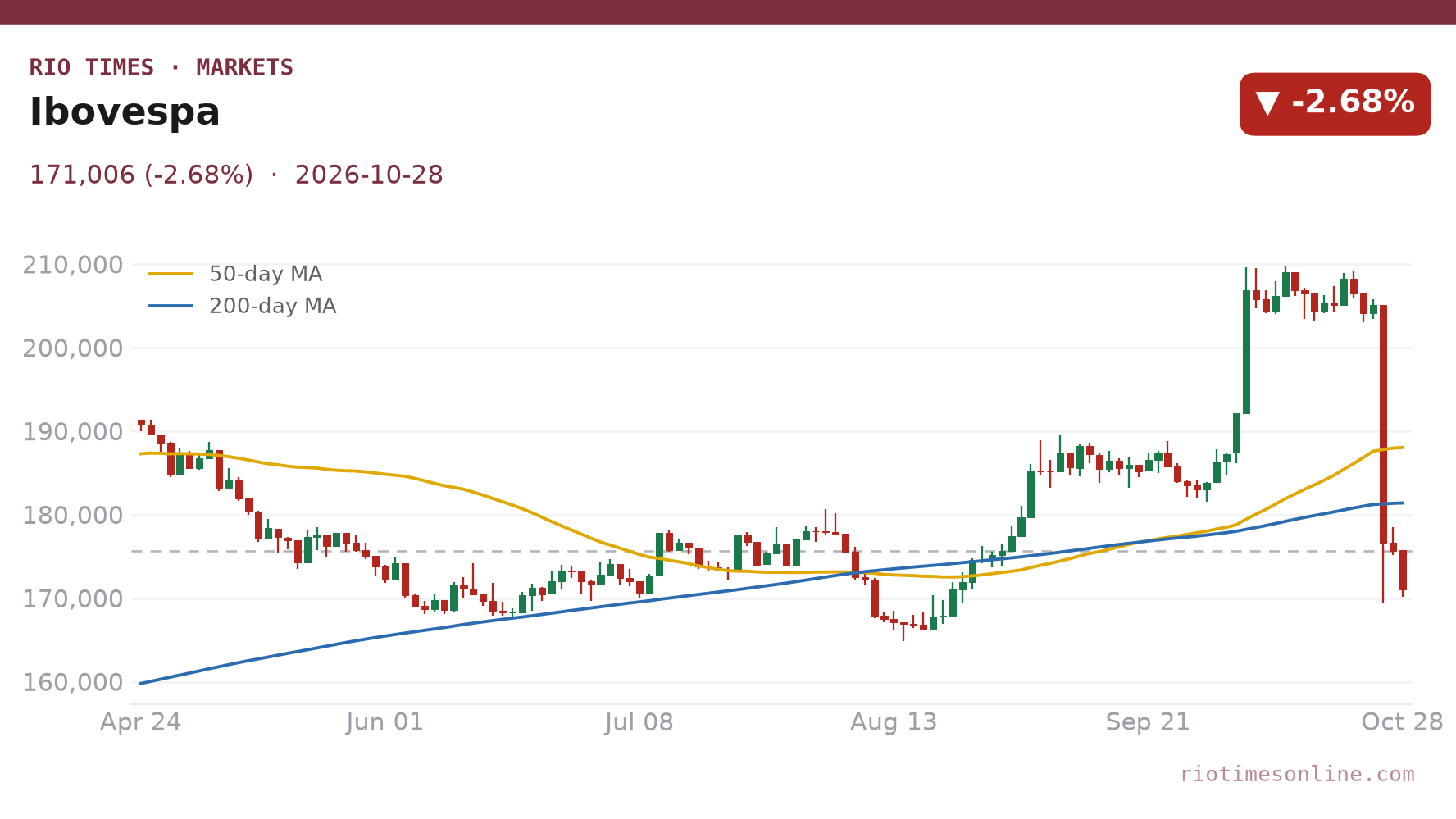
- Brazil’s main stock index, the Ibovespa, fell 2.68% to 171,006 points on Wednesday, its third straight loss since the 13.88% crash on 26 October.
- Bank shares led the slide: Bradesco and Itaú, two of Brazil’s largest private banks, fell about 6.7% and 3.4%; Santander Brasil, the local unit of Spain’s Santander, fell about 5.9%.
- The real ended almost flat at about R$5.35 per US dollar while the S&P 500, the main US stock index, rose 0.28% to 7,744.
- For US investors: the iShares MSCI Brazil ETF (EWZ), a US-listed Brazil fund, lost 1.98% to US$33.62, and shares of Vale, the iron-ore miner, fell 3.12% in New York.
- Prediction markets: Polymarket, a prediction market, puts 69.0% on an unchanged Brazilian interest rate in November, as of 28 October 2026, 8:47 pm ET.
Today’s Focus
Brazil woke up on Wednesday hoping for calm and went to bed with another red screen. The Ibovespa, the main index of the São Paulo exchange (B3), fell 2.68% to 171,006 points.
The damage was in the banks. Bradesco, Santander Brasil, Itaú and Banco do Brasil all dropped between 3% and 7%, while the US stock market rose and the real barely moved.
The index now sits about 17% below the 205,000 level where it opened on Monday 26 October, the first session after President Luiz Inácio Lula da Silva won re-election.
What matters today. Brazil’s banks are the market’s read on credit and fiscal risk after the election, so their sell-off matters more than the headline index move.

01 The session in one read
The Ibovespa closed at 171,006 points on Wednesday 28 October, down 2.68% from 175,710 on Tuesday. It was the third session since the election, and all three have ended lower.
Bank stocks did most of the damage: Bradesco fell about 6.7%, Santander Brasil about 5.9%, and Itaú and Banco do Brasil about 3.4% each. Vale, the iron-ore miner, lost about 2.6%, while Petrobras, the state-controlled oil company, slipped only 0.5%.
What stood out was the contrast with Wall Street. The S&P 500 gained 0.28% to 7,744 on the day the US Federal Reserve, the US central bank, left interest rates unchanged, so this was not a global sell-off.
Brazil fell 2.68% while the S&P 500 rose 0.28% and the VIX, Wall Street’s fear gauge, dropped 3.48% to 16.91. That points to local factors, not to a worldwide retreat from risk.
We could not confirm a single trigger for the bank sell-off. The variable to watch is whether the Lula team gives clear signals on spending and the central bank’s independence.
02 The day’s numbers
| Measure | Level | Change | Read |
|---|---|---|---|
| Ibovespa | 171,006 | −2.68% | Third lower close since the election |
| USD/BRL | 5.3498 | +0.07% | Real little changed |
| S&P 500 | 7,744 | +0.28% | Wall Street rose after the Fed hold |
| VIX volatility | 16.91 | −3.48% | Fear gauge easing |
| US 10-year yield | 5.02% | +0.36% | Dollar rates stay high |
The Ibovespa’s 2.68% fall left it about 17% below the level where it opened on 26 October. The dollar edged up 0.07% to R$5.3498, so the real barely moved.
Higher US yields (the 10-year Treasury at 5.02%) remain a headwind for emerging markets. Rio Times · Live Market Intelligence
Live Market IntelligenceBrazil — Live Market Board
Brazil — Live Market Board
Instrument Last Change YoY Prev. High Low Volume
IBOV
171,006.10
-2.68%
+19.56%
175,710.05
178,526
175,157
—
USD/BRL
5.34
-1.32%
-0.84%
5.42
5.42
5.30
—
SELIC
13.75%
—
—
—
—
—
PETR4
53.31
-1.06%
+77.70%
53.88
53.70
52.83
43,239,500
VALE3
62.88
-2.33%
+1.98%
64.38
64.43
62.80
24,652,300
ITUB4
41.42
-0.67%
+11.30%
41.70
42.60
41.15
28,160,700
BBDC4
15.69
-1.63%
-13.88%
15.95
16.30
15.67
65,766,400
BBAS3
17.59
+0.69%
-15.59%
17.47
18.31
17.51
67,844,600
B3SA3
15.27
+1.33%
+21.71%
15.07
15.78
15.20
75,282,000
ABEV3
15.40
+0.20%
+26.75%
15.37
15.68
15.31
27,307,400
WEGE3
45.78
+2.81%
+10.06%
44.53
47.08
45.06
9,823,200
PRIO3
69.21
-2.71%
+87.14%
71.14
70.98
69.15
6,663,200
SUZB3
47.14
-0.55%
-3.79%
47.40
47.84
46.10
7,151,800
RENT3
31.14
-1.67%
-20.73%
31.67
32.68
31.02
19,092,400
AZZA3
16.72
+1.15%
-42.24%
16.53
17.42
16.72
4,875,400
CSNA3
4.76
-4.99%
-47.09%
5.01
5.14
4.76
14,327,900
GGBR4
24.87
-2.28%
+36.28%
25.45
26.20
24.79
7,507,900
ENEV3
26.79
+0.45%
+49.78%
26.67
27.35
26.30
12,263,000
03 Why it moved: banks take the hit
Brazil’s big lenders fell in unison, and the selling hit the largest names hardest. Bradesco dropped about 6.7%, Santander Brasil about 5.9%, Itaú about 3.4% and Banco do Brasil about 3.4%.
The backdrop is the market reset that began after Lula’s win on 25 October, when the index fell 13.88% on Monday. We could not confirm why banks led Wednesday’s fall.
Outside the banks, Vale fell about 2.6%, while Petrobras held up better at −0.5% on a day when oil prices rose. WEG, a maker of electric motors, gained about 2.3% and was the biggest major winner.
The Fed’s decision came late in the session. It held the policy rate at 3¾% to 4%, with two of its twelve voters preferring a quarter-point increase, a reminder that US rates may stay high for longer.
04 The day’s movers
| Driver | Level / Move | Change | Note |
|---|---|---|---|
| Bradesco (BBDC4) | Large private bank | −6.7% | Weakest big bank |
| Santander Brasil (SANB11) | Local unit of Spain’s Santander | −5.9% | Second-weakest big bank |
| Itaú (ITUB4) | Largest private bank | −3.4% | Dragged the index |
| Banco do Brasil (BBAS3) | State-controlled bank | −3.4% | Credit-risk worries |
| Vale (VALE3) | Iron-ore miner | −2.6% | New York shares −3.12% |
| Petrobras (PETR4) | State-controlled oil company | −0.5% | Oil prices rose |
| WEG (WEGE3) | Electric-motor maker | +2.3% | Biggest gainer here |
Banks are the heaviest weights in the Ibovespa, so a drop of 3% to 7% across the sector explains most of the day’s fall. The moves are as of the B3 close, around 5:00 pm in São Paulo.
For US investors, the two ways to trade Brazil showed the same pattern: the iShares MSCI Brazil ETF (EWZ) fell 1.98% and Vale’s New York shares dropped 3.12%. Petrobras’s US shares lost 1.21%.
05 The regional scoreboard
| Index | Country | Change |
|---|---|---|
| Ibovespa | Brazil | −2.68% |
| IPC | Mexico | −0.76% |
| IPSA | Chile | −0.82% |
| Merval | Argentina | −1.30% |
| COLCAP | Colombia | −0.03% |
Brazil was the clear laggard in Latin America, and its fall of 2.68% dwarfed the losses elsewhere. Mexico’s IPC slipped 0.76% and Chile’s IPSA 0.82%.
Argentina’s Merval fell 1.30%, partly in sympathy with Brazil, while Colombia’s COLCAP was almost unchanged at −0.03%.
06 The technical picture
The Ibovespa closed at 171,006, near the bottom of its 170,162 to 175,711 range for the day, so sellers kept control into the close. The intraday low on Monday 26 October was 169,516, a level traders now watch as the line below which the post-election slide could extend.
A close back above Tuesday’s 175,710 would be the first sign that buyers are returning. Until then the index is in a correction, roughly 17% below its pre-election level.
What Prediction Markets Say
On Polymarket, a prediction market, traders put the chance that Brazil’s central bank leaves its benchmark interest rate, the Selic, unchanged at its November meeting at 69.0%. They see a 28.0% chance of a cut of 0.25 percentage points and 1.6% for a rise of 0.25 points. About US$117,000 has been traded on this market, as of 28 October 2026, 8:47 pm ET.
Prices on prediction markets are bets, not polls or forecasts by officials.
Why we show this: prediction markets turn real-money bets into a live probability that moves within minutes of the news, which is why investors, campaigns and newsrooms in the United States now follow them closely. We show them next to polls and official results, never instead of them.
07 What to watch
- Lula’s first fiscal signals: Any statement on spending rules, taxes or the next economy minister can move bank shares quickly.
- Bank results: As the large lenders publish results, investors will look for signs that credit quality is slipping.
- USD/BRL near R$5.35: A move back toward Monday’s R$5.42 would signal renewed stress for the real.
- US rates: With the 10-year Treasury yield at 5.02% and the Fed split 10 to 2, dollar rates will keep shaping flows into Brazil.
Background: Brazil Stocks Slip 0.51% as Real Gains 1%.
Background: Brazil Stocks Plunge 13.88% After Lula Win.
More: Brazil news, every day from The Rio Times.
Frequently Asked Questions
Why did the Ibovespa fall 2.68% on Wednesday?
Bank shares led the fall, with Bradesco down about 6.7%. The decline follows the post-election repricing of Brazil’s fiscal risk, but we could not confirm a single trigger.
What is the Ibovespa?
It is the main stock index of Brazil’s B3 exchange in São Paulo. It tracks the most traded Brazilian companies, such as Petrobras, Vale and Itaú.
Did the Brazilian real weaken?
Barely. The dollar rose 0.07% to R$5.3498, so the real was almost flat.
How did Brazil do compared with the US?
Much worse. The Ibovespa fell 2.68% while the S&P 500 rose 0.28%, and the Brazil ETF EWZ lost 1.98%.
Market data: RT; exchange figures from B3
This article was produced by The Rio Times’ automated newsroom system. How we use AI · Report an error · Editorial responsibility: Matthias Camenzind, Editor-in-Chief
LatAm Markets: Live Signals → — real-time movers, turnover leaders and FX across Latin America.
Brazil runoff, Sunday, October 25: When is the Brazil runoff election. Latest: Brazil runoff polls, Flávio 51%, Lula 49%.
Get The Rio Times delivered to your inbox — market intelligence, daily briefs, and breaking analysis across Latin America.
Start for US$1