Antifascist Fan Clubs Multiply in Brazilian Soccer Stands
RIO DE JANEIRO, BRAZIL – Since the emergence of the first anti-fascist political organizations, dating from the period when Benito Mussolini was elected Prime Minister of Italy in 1922, fascism and political positioning to combat extreme right-wing ideals go hand-in-hand.
In soccer, Corinthian democracy flourished when it called for more rights in times of dictatorship, in the same decade that English labor unions formed part of hooliganism as a way of contesting the authoritarian measures adopted by ruler Margaret Thatcher.

It was expected that the rise and election of Jair Bolsonaro, a politician of ultra-right speech and with a close relationship with soccer, would also motivate the growth of anti-fascist groups of fans in the Brazilian stands during the last years.
There are around 60 antifascist soccer fan clubs representing Brazilian clubs from all regions, according to a virtual survey conducted by the columnist.
They do not see themselves as organized fan clubs – some even manage to be present inside the stadium – but these are collectives that use their soccer club in the background to bring political discussions with a bias against homophobia, racism, machismo, and capitalism.
Nine Brazilian clubs had their anti-fascist representatives analyzed: Internacional, Athletico Paranaense, Palmeiras, Fluminense, Vasco da Gama, Cruzeiro, Santa Cruz, Paysandu and Ferroviário do Ceará.
With the exception of the ‘Ultras Resistência Coral’, a Ferroviário fan club founded in 2005 and holding the title of the oldest antifascist fan club in Brazil, all the other movements were founded from 2014, when Bolsonaro was elected the most voted congressman in Rio de Janeiro and had already announced that he would be a candidate for the presidency in the next elections.
The greatest fan base is Inter, with 115 members, while the smallest, Fluminense, said it had eight. An average of 25 percent of the fans are women, while the average age of members is around 28.
The data, collected up to September 2019, is viewed as surprising by sports anthropologist José Paulo Florenzano: “It’s a grouping whose life experience allows sport and politics to be combined in a more conscious way. And it’s also a telling figure of space conquered by women in the stands,” says the PUC-SP professor, pointing out that the female representation in these groupings is greater than in other nuclei of Brazilian soccer fan clubs.
The way fan clubs carry the anti-fascist argument varies according to reality. In Porto Alegre, the ‘colorados’ of the Anti-fascist Inter pressured their team’s board of directors with demonstrations for cheaper tickets, an action in which they were successful with the support of ‘O Povo do Clube’ (‘The People’s Club’), an institutional movement of fans of the southern Brazilian club that has achieved relevance within the ‘colorado’ politics.
Due to the decrease in price, the anti-fascist collective is able to be present in the most popular sector of Beira-Rio, alongside the Guarda Popular (“Popular Guard”), one of the organized fan clubs.
“When we want to be together, we meet in the section with no chairs, which is only accessible to us because we mobilize,” says the collective. The southern Brazilians, like the other movements, prefer to remain anonymous. The choice is motivated by the fear of exposing themselves to groups that use violence to confront anti-fascists.
Outside the stadium, Inter fans take action with black and feminist movements and for workers’ rights. Fans take part in the protests by Quilombo Lemos, an urban area in Porto Alegre occupied by blacks who are suffering repossession suits brought by a nearby Franciscan shelter.
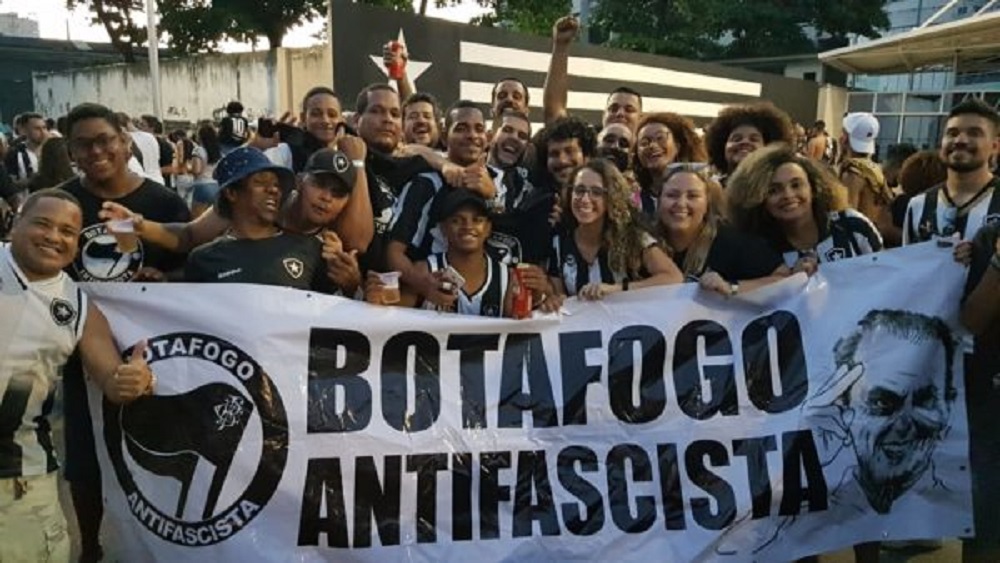
The action is similar to that of ‘Palmeiras Antifascista’, which is also concerned with out-of-game militancy and carries out activities in regions far from the center of São Paulo to “plant the seed of anti-fascism,” like a soccer championship organized in the neighborhood of Grajaú recently together with Coringão Antifa, the collective of the greatest rival.
Inside the stadium, the fans of Palmeiras wear banners in honor of Marielle Franco, to the black players in the history of Palmeiras and against the privatization of Pacaembu, guidelines that highlight the fight against machismo, racism and soccer commodification.
“These are ways of doing a basic job because placing difficult names and slogans will not work. We need to use mediation to convince people,” said the fans.
Palmeiras fans also claim to confront fans in the stands when they judge that their behavior is racist, macho or homophobic. The support group actually emerged in 2014 when the supporters “began to feel the presence of fascists in the stands more intensely”, the founding cause being an argument in the stands at a Palmeiras game with a fan wearing an Irriducibili jersey, the openly fascist fan club of the Italian team Lazio.
In Rio de Janeiro, Fluminense Antifascista (“Antifascist Fluminense”) and Esquerda Vascaína (“Vasco da Gama Leftists”) are two references among the left-wing football fan clubs. The Fluminense fan club is the only one among the collectives consulted who seek a rapprochement with political parties.
“We don’t want to be partisan, but we can’t stay out of the debate about club business or the price of Maracanã tickets. That’s why the bureaucratic axis is so important,” the supporters justify.
At the São Januário stadium, the Vasco da Gama fans are reporting threats coming from the club’s largest organized fan club, Força Jovem (“Youth Force”), when they posted stickers at Vasco matches in favor of candidate Fernando Haddad during the second round of the Elections.
No attacks were carried out. The Esquerda Vascaína was the only one among the fan clubs that shut out support for another candidate besides the presidential leftist in the duel against Bolsonaro; in this case, they also announced a vote for Tarcísio Motta, Vasco’s PSOL candidate for the Rio de Janeiro government, who finished third in the first round.
Both joined in the protests #EleNão (“#Not Him”), where the aim was to repudiate Bolsonaro’s extreme-right candidacy, during the 2018 election period.
In order to have an influence on the Fluminense politics, Flu Antifascista sent a letter to the current president, Mário Bittencourt, early this year, demanding a reinforcement of the women’s soccer club and further social actions coming from the institution, in addition to other commitments.
Fans say Bittencourt has agreed to the written requests, but that it is still “too early to evaluate”. The proximity of the fans to the club’s institutional side is something desirable also by the Vasco da Gama fans, who seek to influence the elections for president and board of Vasco da Gama.
In general, the anti-fascists have distant and neutral relations with organized fan clubs, marked by specific incidents such as the one involving Esquerda Vascaína and Força Jovem. The proximity is much greater among anti-fascist fans, even if they are from rival clubs. “Before we were Palmeiras, we were anti-fascists,” sums up a member of Palmeiras.
As the dates of creation show, the phenomenon involving these collectives is recent and, therefore, the articulation goes little beyond the geographical limits and the fan clubs are not established as soccer fans or political collectives.
“For many outsiders, we don’t seem to act because we don’t advertise,” said the Fluminense fans. Still, a note of repudiation against Bolsonaro published on Facebook echoes more than the actions of fans outside and inside stadiums, which suggests that the militancy is more on the virtual field than in reality.
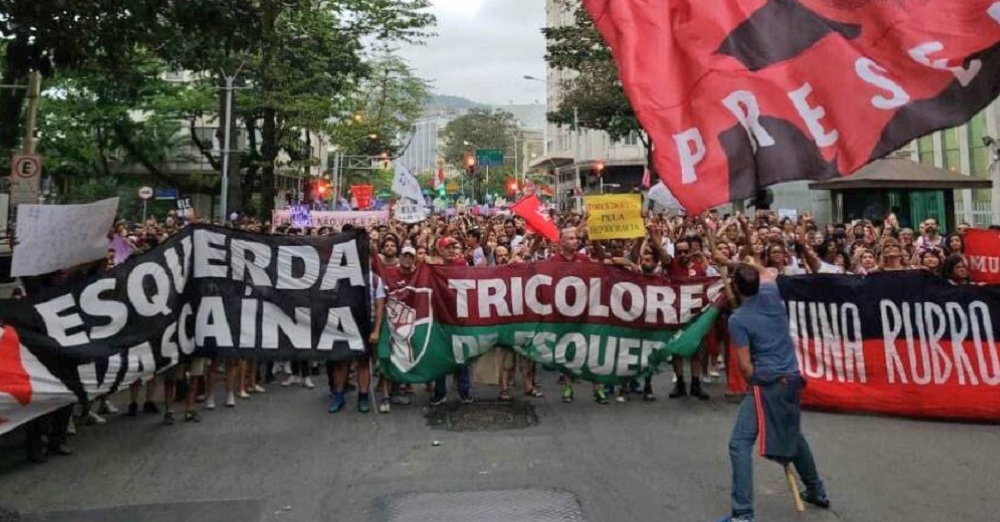
“We face the difficulties of being more physically present, due to tickets, bureaucracies, and fear of confrontation. But we need to get around that and get out of the bubble,” admit fans of Palmeiras.
“We need a larger national front, the size of the task ahead of us. We won’t be able to discuss everything on our own,” explained the Colorados, who also preferred to remain anonymous.
Source: El Pais
More: Brazil news in English, every day from The Rio Times.
This article was produced by The Rio Times’ automated newsroom system. How we use AI · Report an error · Editorial responsibility: Matthias Camenzind, Editor-in-Chief