How the Brazilian Carnaval Band Olodum Became a Massive Social Movement
By Vince de Jong & Marijne Scherjon
RIO DE JANEIRO, BRAZIL – The most significant carnival in the world takes place in Salvador da Bahia, Brazil. During a massive street party lasting six days, dozens of bands on big trucks named Carnaval “blocos” (“blocks”) parade through the streets. Every year, more than two million people come to Salvador to be part of Brazil’s biggest festival.
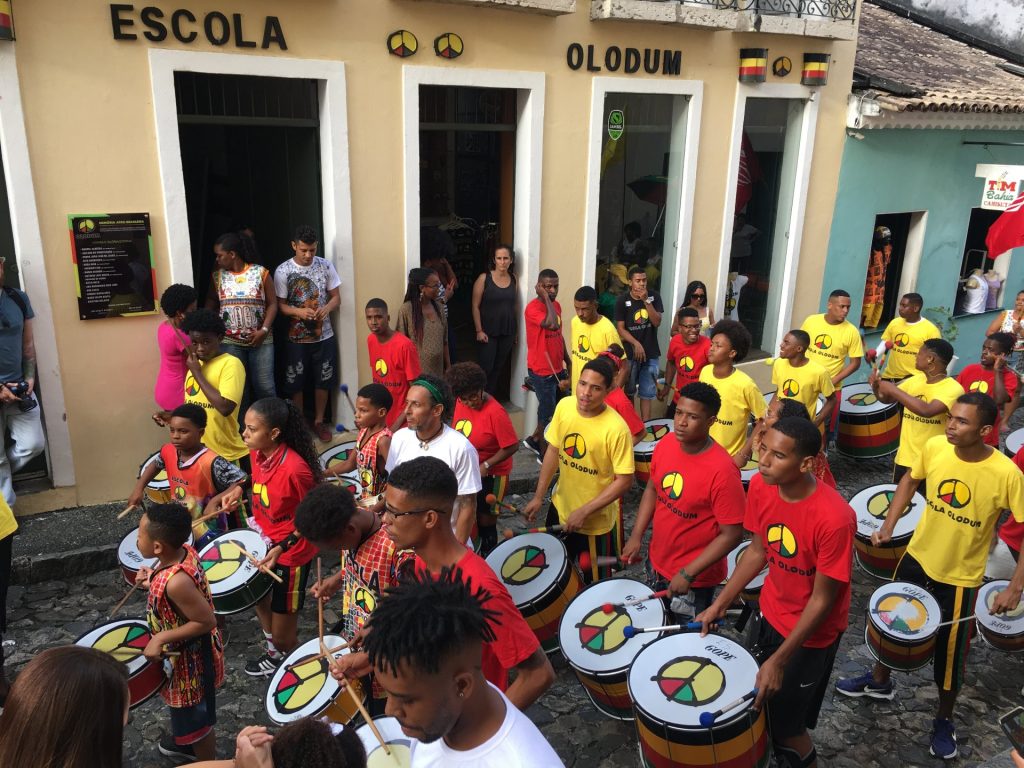
However, 40 years ago, the Afro-Brazilians living in Pelourinho — the historical city center of Salvador — were not allowed to participate. To ensure their access to the festival, a group of musicians and artists founded “Olodum”: a bloco that aimed to highlight African heritage during the massive yearly parades and uplift the Afro-Brazilian community of Pelourinho through music, art, and dance.
In “Casa do Olodum” (House of Olodum), located in one of the small alleys of the city center, we sit down with Lucas di Fiori, one of the four main singers of Bloco Olodum. He explains how Olodum turned from a local carnaval band into a world-famous Afro-Brazilian music group and became a social movement that, until today, is fighting for the rights of marginalized people in Brazil.
From a local Carnaval organization to the most important Afro-Brazilian music group
Every year the musicians and artists of Bloco Olodum choose a theme for the upcoming carnaval, with matching songs. Most of the lyrics are about the history of Afro-Brazilians, the beauty of their culture, and the daily struggles in contemporary Brazil.
“Guinea-Bissau, Star of the African Revolution” (1982) and “‘Samba, Soccer, and Joy: Roots of Brazil” (2013) are examples of such themes. When we ask Lucas di Fiori about performing at Carnaval, his face lights up. He can hardly describe how it feels to be on stage during the yearly parades. “With millions of people in the streets, there is so much energy! To perform feels like scoring a goal in the World Cup!”
Since Olodum’s first parade in 1980, this bloco quickly grew into one of the most important Afro-Brazilian music groups. They developed their unique sound: a fusion of Brazilian samba, Jamaican reggae, and African percussion — this unique sound, combined with their strong messages and colorful symbols, spread like wildfire.
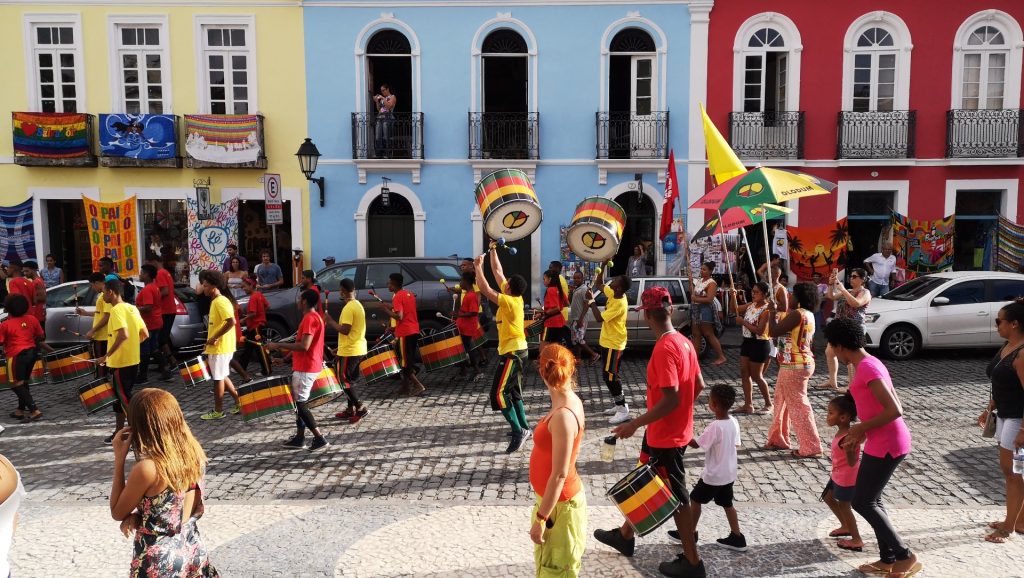
Global success brings attention to local circumstances
In 1987, Olodum scored a national hit with the carnival song “Faraó Divindade do Egito”, still one of their most popular songs. The rest of the world got to know Olodum after “The Obvious Child”, a musical collaboration with Paul Simon.
Their most significant international success was the feature on “They Don’t Really Care About Us” by Michael Jackson in 1996. In the video, Michael Jackson is surrounded by hundreds of Olodum percussionists in the streets of Salvador’s city center, Pelourinho. He is shouting at police officers and addressing the adverse living conditions of the residents while wearing an Olodum t-shirt.
Lucas di Fiori explains how this international fame brought much attention to the local circumstances in Pelourinho. Together with a progressive mayor, the organization was able to develop a few social projects and founded a school to provide access to cultural education for the children of Pelourinho. Lucas di Fiori says that without Olodum, Pelourinho would never have become the safe and successful hotspot that it is today. “Olodum is Pelourinho and Pelourinho is Olodum: it is impossible to separate the two.”
The story of Lucas di Fiori
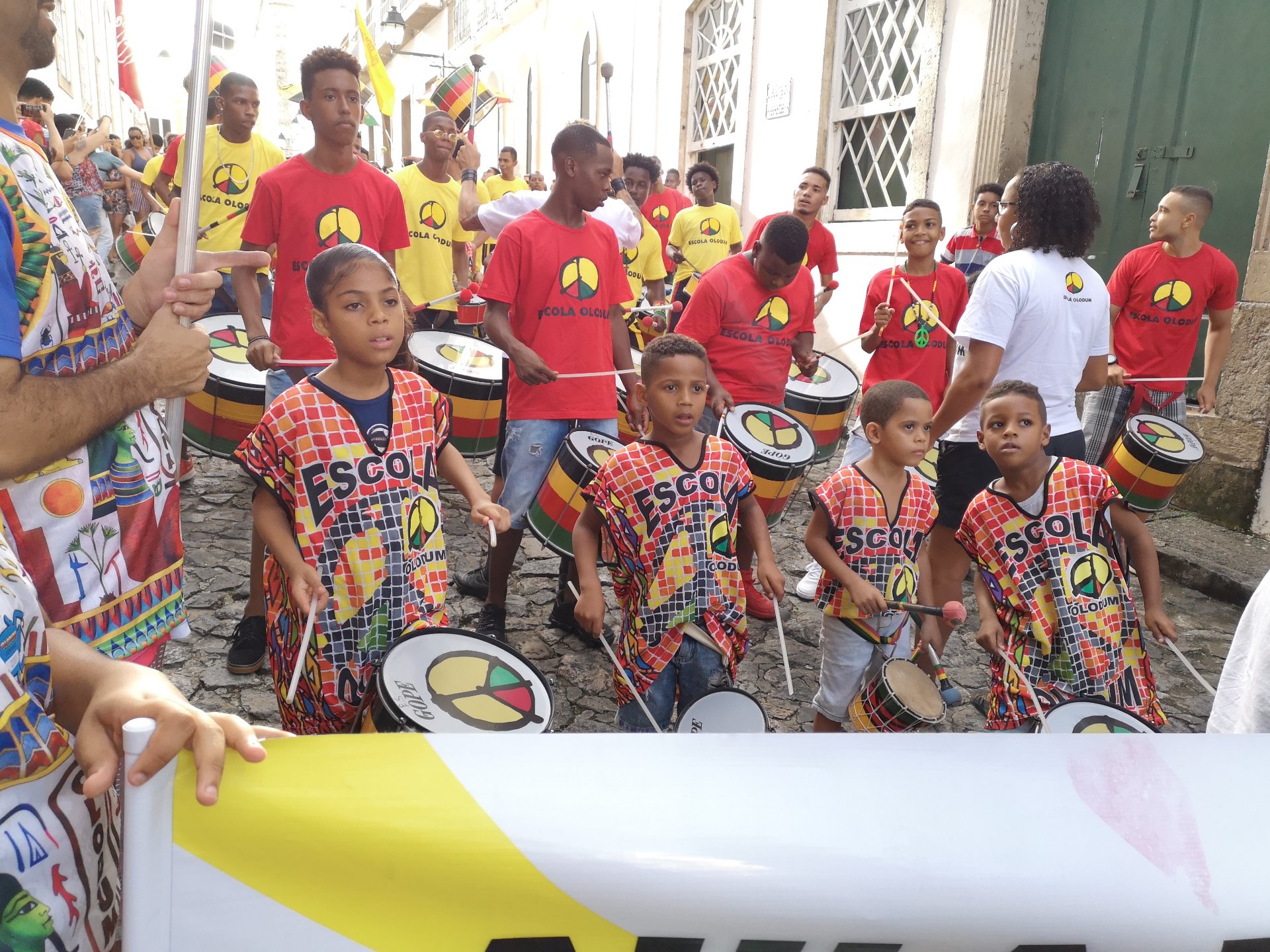
Up until today, an army of Olodum percussionists marches through the small alleys of Pelourinho every week. The loud, colorful drums draw a lot of attention and attract many youths. Like other children growing up in Salvador, nine-year-old Lucas di Fiori was fascinated by the sound of percussion and dreamt of becoming a famous player. Still unaware of his vocal talents, he joined Escola Olodum, where free percussion courses were provided.
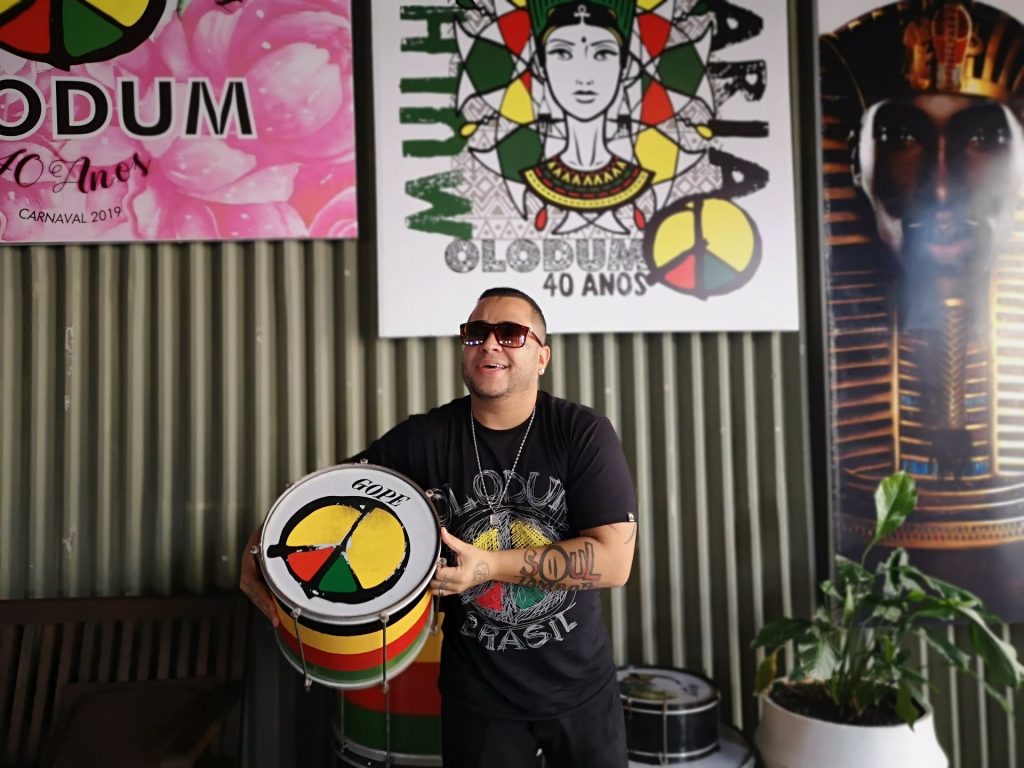
However, in the Olodum School, he learned a lot more than playing the drums. Through different activities in afro dance, leadership, music, and citizenship, Lucas di Fiori started to feel more confident, aware of his roots and discovered his greatest talent: singing.
At a rapid pace, he went from student to teacher to one of the four famous Olodum “cantores” (singers). Lucas di Fiori has become a role model for many young Afro-Brazilians and is determined to encourage more inspiring individuals. “We need to see more Afro-Brazilians in top positions to establish a more equal country.”
The story of Lucas demonstrates the results of Olodum’s strong vision and innovative method. Using music to attract and educate youths, mostly impoverished Afro-Brazilians, and teach them about their roots. Boost their self-esteem, enhance their potential, and train them into inspiring role models who can pass these ideas onto the next generation.
Expanding territory and becoming a social movement
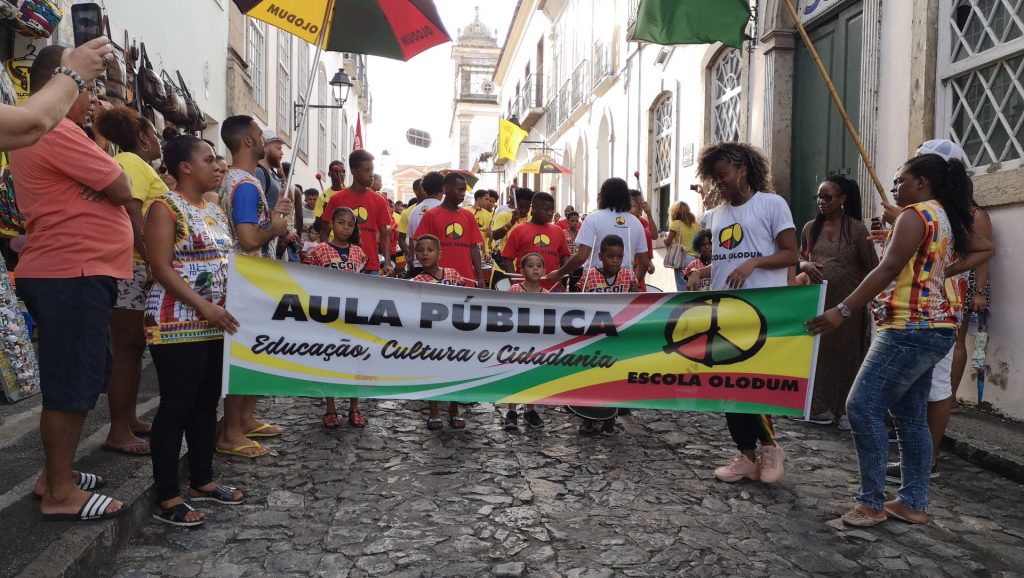
Although the lives of most Afro-Brazilians have improved over the last 40 years, there is still a long way to go. Racial discrimination, socio-economic inequality, police brutality; in Brazil, skin color is still a significant determinant for life chances. Olodum has, therefore, spread its wings to the suburbs of Salvador, where most social problems now tend to concentrate. They have partnerships with public schools in many of these neighborhoods. Approximately 300 children are enrolled in their programs.
While the appreciation of, and respect for, Afro-Brazilian culture is still one of Olodum’s main objectives, the organization has developed a broad scope. Everybody, regardless of culture, color, religion, or sexual orientation, is welcome to join their activities. Next year, on their 40th anniversary, the Carnaval theme will be “A history of women”, which has been chosen due to the high rate of violence against women in Salvador and the rest of Brazil. Over the years, Olodum has evolved into a social movement that fights against racism, inequality and stands up for all marginalized people in Brazil.
The story of Olodum
The story of Olodum is filled with inspiration, which is the main reason the movement continues to grow. Due to their innovative method of blending education with arts, Olodum was able to develop actions to fight social discrimination and uplift the Afro-Brazilian community. They changed the lives of many individuals, including that of Lucas di Fiori, who is now determined to inspire the next generation.
“Education is the key to a more equal and balanced society.”
According to Lucas di Fiori, Olodum is a model that can change circumstances for underprivileged communities in cities all over the world. He dreams that Olodum continues to grow, spreading their ideas, and developing programs for children around the globe.
More: Brazil news in English, every day from The Rio Times.
This article was produced by The Rio Times’ automated AI newsroom. Editorial responsibility: Matthias Camenzind, Publisher and Editor-in-Chief. The Rio Times also runs Ask Rio Times, which answers from 100,000+ of our own articles, the daily Latin America Power Map, and prediction-market odds on elections and markets.. How we use AI · Report an error
Brazil runoff, Sunday, October 25: Brazil runoff date. Latest: Brazil runoff polls, Flávio 51%, Lula 49%.