Bolsonaro Refuses to Hold a Meeting with Indigenous Leader Raoni, Says G1
RIO DE JANEIRO, BRAZIL – Brazilian media outlet G1 reports today that at their meeting in Osaka at the G20, French president Emanuel Macron is said to have asked Jair Bolsonaro to hold a meeting with him and Raoni Metuktire, a well know indigenous leader in Brazil.
“No,” the Brazilian president is said to have replied quickly, explaining that Raoni “does not represent Brazil and does not even represent the indigenous community from which he came.”

Leader of the Kayap ethnic group, the 87-year-old chief has gained international visibility in recent decades in his struggle to preserve the indigenous peoples and the Amazon.
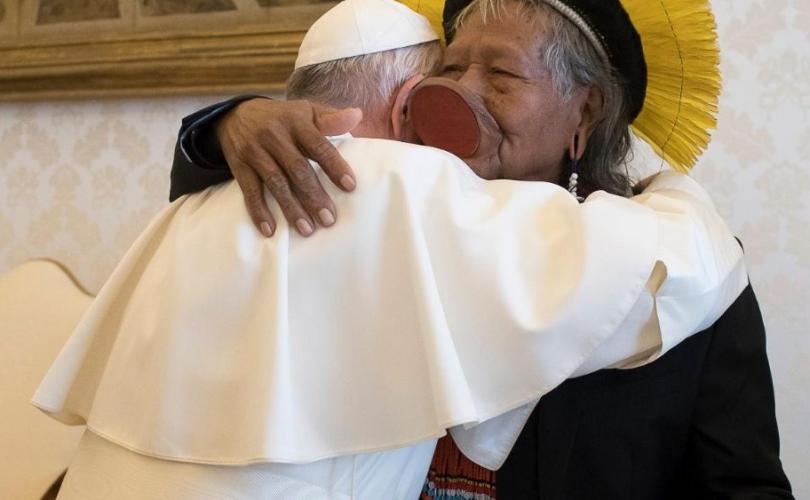
In May, he met with Macron to promote his fight against deforestation in the Amazon and to protect the Xingu Indigenous National Park — a reserve where several indigenous peoples live — from loggers and agribusiness. Pope Francis also welcomed Raoni.
G1 says this conversation took place last Friday, June 28th, when Bolsonaro assured Macron that Brazil would honor the Paris Agreement, of which it is a signatory. The president’s commitment has been singled out as fundamental to the signing of the Mercosur and European Union agreements.
Shortly after the election, Bolsonaro considered leaving the climate agreement, which has increased tension in relations with countries like France and Germany where there is a strong demand for compliance with environmental standards.
It was after this refusal to meet Raoni that President Bolsonaro invited Macron to fly over the Amazon from Boa Vista to Manaus, about an hour and a half of flight, where he would “not find any point of deforestation.”
Upon disclosing the dialogue with the president of France, “which started out tense, but became lighter as it progressed,” an advisor from the Planalto Palace said that Brazil will not change its environmental policy, but intends to show that it is complying with the agreements signed and with legislation such as the Forest Code.
“The president will not lower his head and will not accept anyone’s authority,” said the presidency spokesman, Otávio Rego Barros.
According to him, Brazil will maintain its policy in defense of the environment “without radicalizing.”
Environment minister Ricardo Salles, on the other hand, believes that Brazil can improve its communication on the environmental issue, mainly targeting public opinion in European countries.
He said that if there is a negative image in Brazil out there, it is a result of a campaign by NGOs that, according to him, “we’re getting much funding and now they don’t get it anymore.”
Spokesman Rego Barros was on the same line: “There is a criticism of minister Salles because he has risked saying what no one had before,” he said.
“The versions don’t correspond to the facts,” said Salles.
In the debate that led to the signing of the Mercosur-European Union agreement, Brazil managed to include what it calls a safeguard for the precautionary clause provided for in the agreement.
The first is that if a country refuses to import Brazilian products due to an allegation of non-compliance with environmental legislation, it will have to prove this non-compliance in a judicial proceeding; secondly, the refusal will be valid only for that country and will not be extended to other European countries.
In the talks, the Brazilian delegation heard from one of the negotiation leaders: “We know that you comply with the environmental norms, but the image of the Brazilian products with the European public opinion is negative.”
(Source: G1)
More: Brazil news in English, every day from The Rio Times.
This article was produced by The Rio Times’ automated newsroom system. How we use AI · Report an error · Editorial responsibility: Matthias Camenzind, Editor-in-Chief
Brazil runoff, Sunday, October 25: Brazil runoff start time and results schedule. Latest: Brazil runoff polls, Flávio 51%, Lula 49%.