Brazil Produced 79 Million Tons of Solid Waste in 2018
RIO DE JANEIRO, BRAZIL – Of this amount, 92 percent (72.7 million) was collected – an increase of 1.66 percent compared to 2017, which shows that collection increased at a slightly faster rate than generation.
Despite this, 6.3 million tons of waste was not collected in cities.

The data are part of the Solid Waste Panorama of the Brazilian Association of Public Cleaning and Special Waste Companies (ABRELPE), released yesterday, November 8th.
Compared to Latin American countries, Brazil is the leader in waste production, representing 40 percent of the total output in the region (541,000 tons/day, according to the UN Environment Program).
“The numbers shown place Brazil in a much lower position than other countries at the same level of income. Our deficit is very large and we really need urgent measures to not only restore this deficit but also to move toward better solid waste management practices,” said Carlos Silva Filho, the organization’s president.
Urban solid waste corresponds to all types of solid waste – resulting from industrial, domestic, hospital, commercial, agricultural, services and sweeping activities, and, in some cases, waste collection – produced in cities and collected by local services.
The growth trend in the country’s solid urban waste production should be continued in the coming years. Estimates based on the historical series show that Brazil will reach an annual production of 100 million tons by 2030.
“The generation of solid waste is growing, but this is not being matched by the provision of the infrastructure needed to deal with all this waste. What we see is that the waste generated in Brazil is increasing, but proper disposal, recycling, and retrieval are not keeping up with this increase,” said Silva Filho.
According to the study, there is a considerable pool of people who are not covered by regular door-to-door collection services: one in every 12 Brazilians does not have a regular waste collection on their doorstep.
According to the president of ABRELPE, one of the reasons behind this is the shortage of resources in municipalities. “We have two problems, one is unawareness of the significance of proper solid waste management to protect the environment and to prevent diseases, there is no such clear perception in society and the government”.
“The second factor, which is worse, is the fact that as this is a municipal service and municipalities are heavily indebted, they do not have the resources to pay for this entire process,” Silva Filho says.
The stagnation or reversal of some indices is exacerbated by the lack of resources for funding urban cleaning services which, in 2018, recorded a drop of 1.28 percent of investments, in addition to the loss of almost five thousand direct/formal jobs.
On average, only R$10.15 (US$2.53) per inhabitant/month was invested by municipalities in the provision of all urban cleaning services.
According to the study, the country uses the landfill as an environmentally sound form of disposal (59.5 percent of the volume). However, more than 3,000 municipalities are still discarding their waste in inappropriate locations.
In 2018, 29.5 million tons of solid urban waste was sent to controlled dumps or landfills, which do not provide the required systems and measures to protect public health and the environment from damage and degradation.
Considering countries in the same income bracket (middle-high income countries, according to the World Bank classification), Brazil has much lower rates, as the average for appropriate disposal in this range of countries is 70 percent.
ABRELPE emphasizes that selective collection is far from being universalized, and that recycling rates have been stagnant for almost a decade.
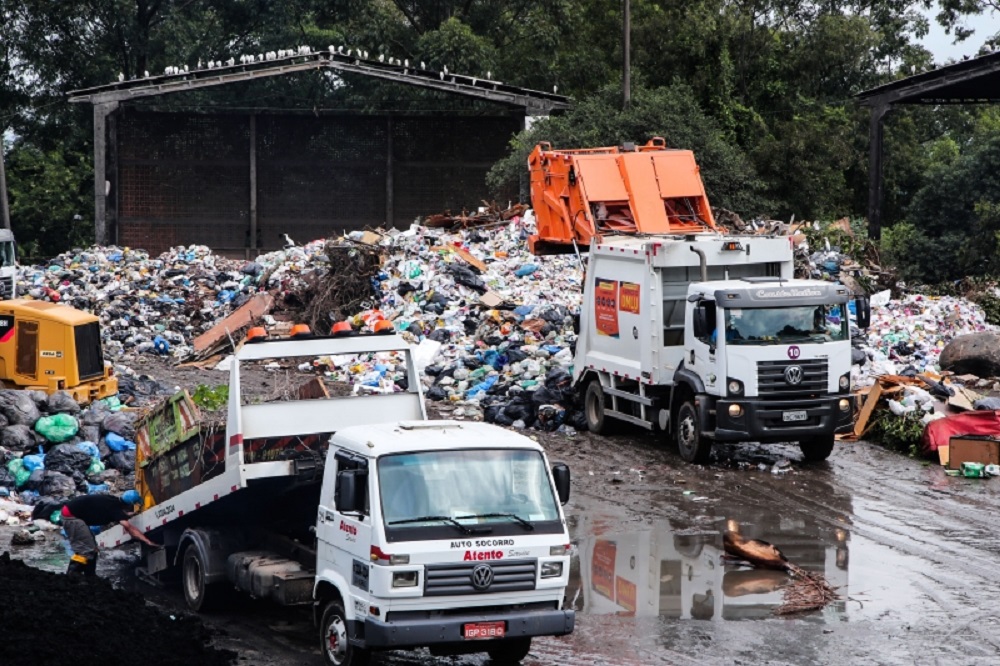
According to the organization, while the world is talking about circular economy and more advanced alternatives for waste disposal/reuse, the country still keeps dumps in all regions and has to cope with a public behavior problem: Brazilians are still learning to dispose of garbage and to separate waste with potential for recycling.
“Regarding recycling, for this to happen, the first stage begins with citizens, who must be made aware of the need to separate garbage at home, to be educated on how to separate it correctly and the vast majority of Brazilian society is not. From the moment that there is no such preparation inside the home, the whole chain of recycling is impaired,” said the president of ABRELPE.
More: Brazil news in English, every day from The Rio Times.
This article was produced by The Rio Times’ automated newsroom system. How we use AI · Report an error · Editorial responsibility: Matthias Camenzind, Editor-in-Chief