Brazil Signs Military Cooperation Agreement with United States
RIO DE JANEIRO, BRAZIL – Jair Bolsonaro’s government signed on Sunday, March 8th, an unprecedented military agreement with the United States, to try to expand Brazil’s access to the American defense market, the largest in the world.
The bilateral agreement is considered the main practical outcome of Bolsonaro’s trip to Florida this week and is a further enhancement of Brazil’s designation as a privileged ally outside NATO (the western military alliance), a status granted to the country in March last year during the Brazilian president’s visit to Washington.

Bolsonaro intends to capitalize politically on the treaty, to spread the idea that his relationship with Trump has paid off. He knows that extra-NATO ally status means nothing without specific agreements like this one, but he did not want to give any public statements after the agreement was signed.
Negotiated by the U.S. Department of Defense and the Brazilian Ministry of Defense, the treaty known as RDT&E (Research, Development, Testing, and Evaluation) is a path to joint development projects between the two countries’ armed forces.
Bolsonaro attended the ceremony for the signing of the agreement at the headquarters of the Southern Command, which oversees the US Armed Forces in Latin America and the Caribbean. He was the first Brazilian president to visit the military facility.
Minister Fernando de Azevedo e Silva (Defense) was delegated the task of making a public speech about the agreement, alongside US Commander Craig Faller. “This has been a very profitable trip in the defense aspect for Brazil and our Armed Forces,” said the Brazilian minister.
Neither of the two answered questions from journalists.
The US military officer classified the agreement as historic and said that officials from both countries had discussed “mutual threats affecting democracy and the principles we share” during the meeting.
The Venezuelan crisis was mentioned by Faller as an example of this “regional threat,” but he did not go into detail about what could be done together with Brazil.
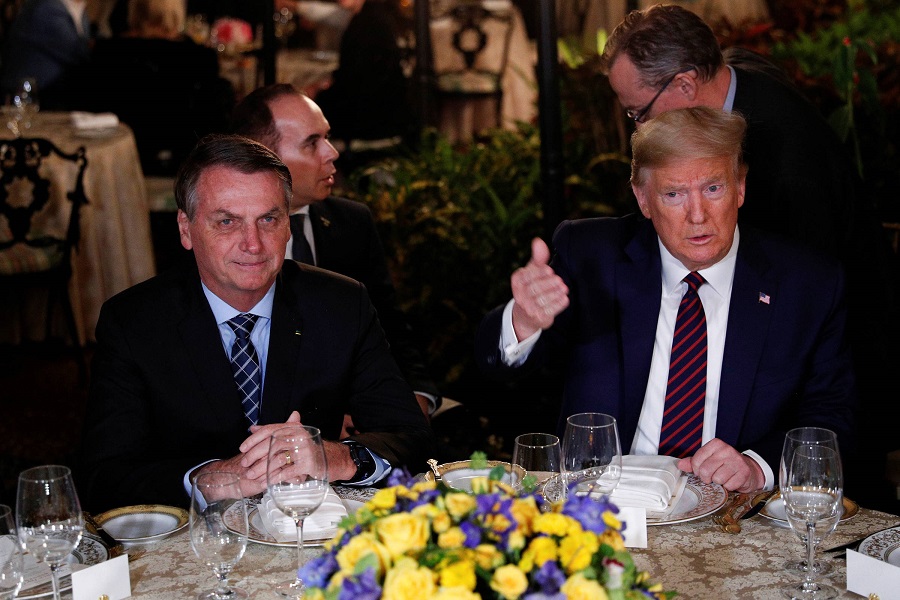
Members of the White House expected Saturday’s dinner between Bolsonaro and President Donald Trump to be used to discuss pressures on the government of Nicolás Maduro.
Americans hope to increase the squeeze on the Venezuelan dictator but are also unclear about what to do jointly with the Brazil.
The RDT&E sealed on Sunday could expand the access of the Defense Industrial Base to the American market, as well as the signing of other pacts in the defense sector, thereby reducing bureaucratic proceedings in trading products between Brazil and the United States.
The logic is simple: the partnerships will enable Brazilian companies to be natural candidates to enter global production chains led by Americans.
Celebrated by Bolsonaro’s government, the agreement began to be negotiated in 2017, during Michel Temer’s administration, and still requires the approval of the two countries’ Congress to become effective.
The Planalto is expected to proceed quickly, but Bolsonaro is still on a collision course with Congress, which will significantly slow down its pace of work as a result of the October municipal election campaigns that start in July.
Once in effect, the RDT&E will allow both governments to sign project agreements and companies from both countries can be selected and contracted to run programs, which will always be managed by Brazilian and American authorities.
Funding for the projects is essentially public – but this does not prevent the potential for private risk investments.
The US accounts for 39 percent of the world’s military spending and invests in the purchase of equipment, research, and development. The main American fund in the defense area had assets of US$96 billion last year.
Brazil, on the other hand, is experiencing an increase in military spending under Bolsonaro, with its share of investments growing from those projected for 2020, but in a much smaller proportion than the Americans.
Even its total spending (R$109.9 billion in 2019), the 11th highest in the world, does not account for a mere two weeks of US spending.
More: Brazil news in English, every day from The Rio Times.
This article was drafted with automated assistance and reviewed before publication. How we use AI · Report an error
Read More from The Rio Times