Amid Brazil’s Worst Crisis in History, Airline Industry Sees Hope in Year-End Vacations
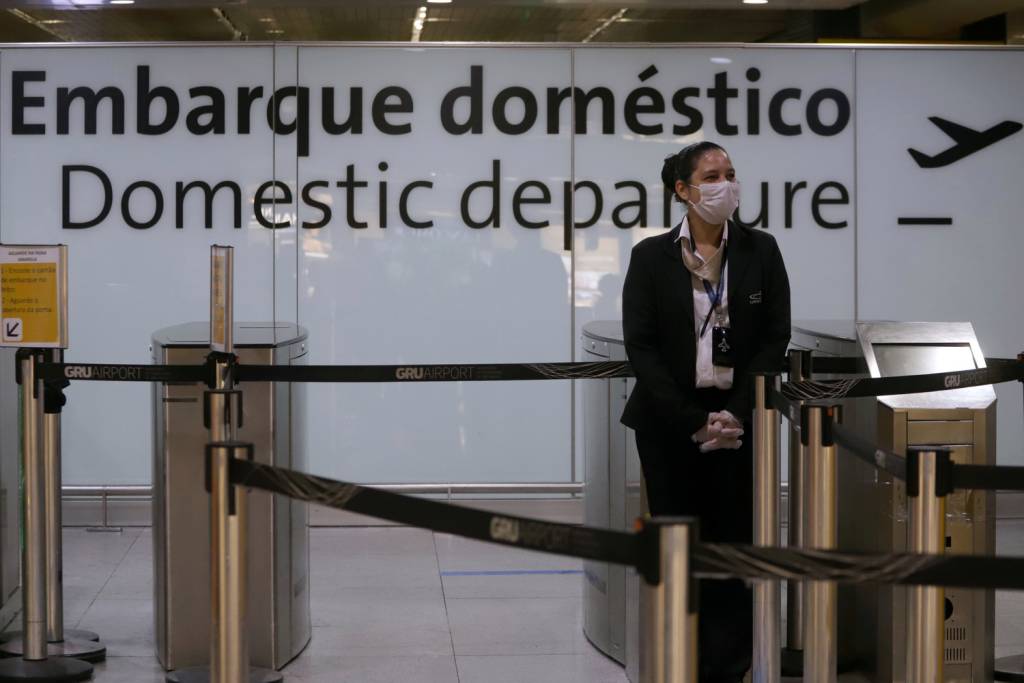
RIO DE JANEIRO, BRAZIL – With a cap on her hair, a mask on her face and a face shield, Jane Lima, 48, walks in quick steps towards domestic departures at Terminal 2 of Guarulhos airport in São Paulo.
It is Friday, the eve of the ‘Nossa Senhora Aparecida’ national holiday on Monday, October 12th, and although the coronavirus pandemic has chased away the vast majority of travelers in recent months, the lobby is relatively busy.
“I thought people would be keeping a greater distance,” laments the doctor who was returning to Aracajú, after coming to the São Paulo capital for her daughter’s emergency medical appointment.

“Despite all the hygiene protocols, it’s very scary to fly in an aircraft with 200 people. I came because there was no other choice. My daughter has Down Syndrome and also has an immunodeficiency disease. She didn’t even come because she is in the risk group, I brought only the exams. I have to be extra careful,” she says.
There are many Brazilians who, like Jane, are afraid of being infected with Covid-19 when stepping into an airport filled with strangers, lining up at check-in, and spending a few hours inside a closed plane with dozens of people. They want distance from airports, which explains part of the lack of passengers.
Economic uncertainty also deters the willingness to spend savings on traveling at such a peculiar time. In April, at the start of the health crisis, when quarantine and isolation rules were tighter in the country and virtually all borders were closed, demand for domestic flights dropped by 93 percent compared to 2019, and the supply of aircraft seats also dropped by over 91 percent, according to the National Civil Aviation Agency (ANAC).
Passenger transport on Brazilian companies to the international market saw an even higher drop, of 98.1 percent. In April, at the worst moment, only eight percent of previously scheduled flights took off.
Six months later, the pace of domestic flight resumption has been slowly growing each month, in line with the relaxation of quarantine rules in several cities in Brazil. Yet, it is still a long way from the pre-pandemic figures. In October, Brazil is expected to resume 1,000 daily flights within its territory, half the usual domestic air traffic. Traditional middle-class tourism scheduled for the end of the year is expected to lend a small boost to the domestic market.
“What research shows is that in the process of emerging from the pandemic and the loosening of isolation rules, the trend will be to take short trips within the country. At first, people will not want to fly to Europe with all the risk of new city closures or having a health issue because of Covid. They will want to go somewhere from where they may return on the same day,” says Eduardo Sanovicz, president of the Brazilian Association of Airline Companies (ABEAR).
Worst year in the history of aviation
Historic flight declines in Brazil and around the world, which forced planes to remain grounded, have plunged the airline industry into an unprecedented crisis. The International Air Transport Association (IATA) declared that, in financial terms, “2020 will be the worst year in the history of aviation.” The association estimates that airlines should suffer a total loss of at least US$84.3 billion.
“It is the worst crisis in the sector. It is not even close to others like the September 11 attacks or the 2008 financial crisis. In Brazil’s case, I think the airlines have just started to leave the ICU, from the worst liquidity crisis for companies”, says aviation specialist Ricardo Fenelon, former director of ANAC.
Sanovicz, from ABEAR, agrees that the worst seems to have passed, but considers that the recovery path will still be tough, given that companies will not survive with a small network in the air. “It’s a very high-cost sector with very tight margins. These companies are highly exposed to exchange rate fluctuations, to the price of kerosene, these have been hard months”, he explains.
Faced with a perfect storm, sector giants Azul, Gol, and LATAM Brasil exhausted their cash, reduced salaries, made personnel and cost cuts, and renegotiated contracts with aircraft lessors and banks to keep their operations running. At the start of the crisis, a Provisional Measure (MP) of the Jair Bolsonaro government also helped mitigate the impacts of the pandemic.
Among the main points in the measure, two were critical: the first stipulated a longer period (of one year) for the reimbursement of tickets and the second allowed airlines to defer payment of some taxes, such as air navigation fees. The National Bank for Economic and Social Development (BNDES) also announced a rescue package for airlines. However, six months later, the measure has yet to materialize.
“Gol and Azul renegotiated with their creditors and LATAM Brasil had access to financing of over US$2 billion because of its bankruptcy protection plan, but all are still faced with a long resumption process. The flights that have been resumed have a much lower occupancy rate than before the crisis,” says Ricardo Felon.
International market stagnated
If on the one hand domestic flights are starting to grow monthly, the international market is still slow. IATA estimates that the figures will only return to the pre-pandemic levels in 2024. “Excluding exceptions, in general Brazilians cannot fly to the United States, to several countries in Europe and to other countries in the region, such as neighboring Argentina and Chile. The borders are closed to Brazil,” says Fenelon.
The impact of these restrictions is ultimately greater for companies more exposed to the international market. In the case of Brazil, the most affected is LATAM, insofar as around 50 percent of the company’s turnover comes from international flights. “But Gol and Azul are also affected because they cover some destinations abroad and also have partnerships with international flights,” says the president of ABEAR.
Sanovicz also points out that Brazil is experiencing yet another international problem, that of its image. “Brazil is free to host tourists, but the way the Bolsonaro government handled the pandemic and the image created [of a country with the second-highest number of deaths by Covid-19 and who downplays the dangers of the disease], interfere with this ability to welcome people,” he says. The country today totals some 154,000 deaths from the disease and over 5.2 million confirmed cases since the start of the pandemic, according to data from the Ministry of Health.
Climate of unease
It is still too early to estimate when the sector will operate again as before. According to experts, the recovery will depend on when the pandemic will end and how the companies will restructure over the months. More debt and labor relations negotiations should be conducted at this time of severe turbulence.
One airline crew member, who chose to remain anonymous, told EL PAÍS that the atmosphere among employees is one of unease and anxiety over the prospect of further cuts. “We don’t know when all this will end, the flow is still poor and we have many planes on the ground,” he said.
For IBEAR’s Fenelon, not even the announcement of a vaccine against Covid-19 is a guarantee that the lost demand will be restored: “Even with the vaccine, we should not recover next year. Each company will have to restructure its offer and cost. I can’t conceive that an airline with 100 planes will be able to operate only 50, it’s not feasible”, he says.
With no flights, companies lose revenue and still have to face high costs to keep airplanes grounded. Both the former director of ANAC and the president of ABEAR do not believe in yet another bankruptcy of a Brazilian airline in the near future, as was the case with AVIANCA, but they are certain that aviation will never be the same after the pandemic.
Source: El País
More: Brazil news in English, every day from The Rio Times.
This article was produced by The Rio Times’ automated newsroom system. How we use AI · Report an error
Read More from The Rio Times
- São Paulo Nightlife Tonight: Sophy Sings Marilyn Monroe, September 23, 2026
- ArtRio 2026 Closes in Rio de Janeiro, Brazil, With About 50,000 Visitors, Down From About 55,000 in 2025
- Brazil Market Moves: NG.CASH Raises US$15 Million, Franklin Templeton Lists Five Funds on the São Paulo Stock Exchange, and a Dollar Bitcoin Future Opens