IBOV 171,031.73 ▲ 1.85% IPSA 11,338.38 ▲ 0.89% IPC MEX 65,729.18 ▲ 2.14% MERVAL 2,913,184 ▲ 1.35% COLCAP 2,459.23 ▲ 0.61% BVL PERÚ 58,698.13 ▲ 2.60% USD/BRL5.14▼ 0.14% USD/MXN16.90▼ 0.36% USD/CLP914.28— 0.00% USD/COP3,038▼ 1.18% USD/PEN3.35▼ 0.06% USD/ARS1,499▲ 0.12% USD/UYU40.20▲ 1.58% USD/PYG5,996▲ 1.55% USD/BOB11.43▲ 0.41% USD/DOP58.82▲ 0.20% USD/CRC450.05▲ 3.34% USD/GTQ7.62▲ 2.21% USD/HNL26.81▲ 0.31% USD/NIO36.62▲ 0.61% USD/VES778.00▼ 0.13% USD/PAB1.00— 0.00% USD/BZD2.00— 0.00% USD/JMD 157.28 — 0.00% USD/TTD6.71▲ 0.79% EUR/BRL6.00▼ 0.64% BRENT 88.88 ▼ 0.03% WTI 83.11 ▼ 0.11% IRON ORE 161.91 — — COPPER 6.61 ▲ 0.03% GOLD 4,461 ▲ 1.78% SILVER 65.59 ▲ 1.26% SOY 1,184 ▲ 3.20% CORN 480.50 ▲ 10.02% WHEAT 655.00 ▲ 3.93% COFFEE 317.25 ▼ 5.51% SUGAR 16.43 ▼ 1.79% ORANGE JUICE 138.55 ▼ 0.47% COTTON 85.03 ▲ 2.33% COCOA 5,719 ▲ 3.18% BEEF 223.60 ▼ 3.93% CATTLE 339.10 ▼ 3.16% LITHIUM 75.20 ▲ 1.47% PETR4 41.64 ▼ 0.05% VALE3 72.97 ▲ 0.83% ITUB4 38.60 ▼ 1.03% BBDC4 16.85 ▲ 0.36% ABEV3 14.89 ▼ 0.80% BBAS3 19.37 ▲ 0.47% B3SA3 14.26 ▼ 0.21% WEGE3 47.59 ▲ 0.49% PRIO3 59.14 ▼ 0.19% SUZB3 41.33 ▲ 2.35% RENT3 34.68 ▼ 0.09% AZZA3 15.89 ▼ 2.63% CSAN3 3.22 ▼ 1.83% RAIZ4 0.25 — 0.00% PCAR3 2.75 ▼ 0.36% GMAT3 3.65 ▼ 1.08% PSSA3 48.13 ▼ 0.54% CVCB3 1.33 ▼ 2.92% POSI3 3.36 ▲ 2.44% SLCE3 13.34 ▲ 0.30% NATU3 8.14 ▼ 0.73% IBOV 171,031.73 ▲ 1.85% IPSA 11,338.38 ▲ 0.89% IPC MEX 65,729.18 ▲ 2.14% MERVAL 2,913,184 ▲ 1.35% COLCAP 2,459.23 ▲ 0.61% BVL PERÚ 58,698.13 ▲ 2.60% USD/BRL 5.16 ▲ 0.01% USD/MXN 17.06 ▼ 0.24% USD/CLP 913.98 ▲ 0.04% USD/COP 3,140 ▲ 0.03% USD/PEN 3.36 ▼ 0.66% USD/ARS 1,493 ▲ 0.10% USD/UYU 40.27 ▲ 1.24% USD/PYG 5,939 ▲ 1.68% USD/BOB 11.64 ▼ 0.76% USD/DOP 58.34 ▲ 1.25% USD/CRC 445.92 ▲ 0.89% USD/GTQ 7.62 ▲ 2.21% USD/HNL 26.79 ▲ 1.57% USD/NIO 36.62 ▲ 0.69% USD/VES 762.44 ▼ 0.13% USD/PAB 1.00 — 0.00% USD/BZD 2.00 — 0.00% USD/JMD 157.28 — 0.00% USD/TTD 6.70 ▲ 0.61% EUR/BRL 5.95 ▲ 1.01% BRENT 88.88 ▼ 0.03% WTI 83.11 ▼ 0.11% IRON ORE 161.91 — — COPPER 6.61 ▲ 0.03% GOLD 4,461 ▲ 1.78% SILVER 65.59 ▲ 1.26% SOY 1,184 ▲ 3.20% CORN 480.50 ▲ 10.02% WHEAT 655.00 ▲ 3.93% COFFEE 317.25 ▼ 5.51% SUGAR 16.43 ▼ 1.79% ORANGE JUICE 138.55 ▼ 0.47% COTTON 85.03 ▲ 2.33% COCOA 5,719 ▲ 3.18% BEEF 223.60 ▼ 3.93% CATTLE 339.10 ▼ 3.16% LITHIUM 75.20 ▲ 1.47% PETR4 41.64 ▼ 0.05% VALE3 72.97 ▲ 0.83% ITUB4 38.60 ▼ 1.03% BBDC4 16.85 ▲ 0.36% ABEV3 14.89 ▼ 0.80% BBAS3 19.37 ▲ 0.47% B3SA3 14.26 ▼ 0.21% WEGE3 47.59 ▲ 0.49% PRIO3 59.14 ▼ 0.19% SUZB3 41.33 ▲ 2.35% RENT3 34.68 ▼ 0.09% AZZA3 15.89 ▼ 2.63% CSAN3 3.22 ▼ 1.83% RAIZ4 0.25 — 0.00% PCAR3 2.75 ▼ 0.36% GMAT3 3.65 ▼ 1.08% PSSA3 48.13 ▼ 0.54% CVCB3 1.33 ▼ 2.92% POSI3 3.36 ▲ 2.44% SLCE3 13.34 ▲ 0.30% NATU3 8.14 ▼ 0.73%
since 2009
Sunday, August 23, 2026

IBGE: Christmas Season 2019 Retail Sales Better Than 2018 but Worse Than 2017

By · February 13, 2020 · 3 min read

Daily Brief

The morning intel from across Latin America. Free.

By subscribing you agree to our privacy policy. We never share your email.

RIO DE JANEIRO, BRAZIL – Christmas in 2019 was stronger for retail than 2018, but poorer than 2017, according to Isabella Nunes, manager of the Monthly Trade Survey at the Brazilian Institute of Geography and Statistics (IBGE). “In 2018, Black Friday anticipated purchases, which got in the way of Christmas. This year it was more widely distributed…”, said Isabella Nunes.

Despite the apparent rebound in retail sales in late 2019, the economy has not yet outperformed the 2017 Christmas.
Despite the apparent rebound in retail sales in late 2019, the economy has not yet outperformed the 2017 Christmas. (Photo: internet reproduction)
One-stop reference
Company Intelligence
Every listed company in Latin America — financials, ownership and structure for 1,450+ companies across 26 exchanges, in one place.
Browse the directory →
RT
Ask Rio Times
Latin American markets, currencies and companies.
Open the full Ask Rio Times →

The volume sold at retail grew 2.6 percent in December 2019 compared to the same month the year before. In December 2018, the increase was 0.7 percent. In the same period in 2017, sales grew 4.0 percent.

Five of the eight activities of the Brazilian retail trade saw an increase in sales in December 2019 compared to December 2018. The IBGE points out that December 2019 had one business day more than the same month in the previous year.

The growth occurred in ‘Other’ items for personal and household use (12.9 percent), Furniture and home appliances (18.6 percent), Pharmaceutical, medical, orthopedic, perfume and cosmetics (7.1 percent), Office equipment and supplies, information technology and communication (1.4 percent) and Books, newspapers, magazines, and stationery (1.5 percent).

The most intense negative influence was recorded on hypermarkets, supermarkets, foodstuffs, beverages, and tobacco (-2.9 percent). There were also drops in Fuels and lubricants (-1.0 percent) and Fabrics, clothing, and footwear (-0.1 percent).

Considering the expanded retail trade, which includes vehicles and construction material activities, the sales volume rose 4.1 percent in December 2019 compared to December 2018. Vehicles, motorcycles, parts, and components grew 9.3 percent, while construction material increased 5.1 percent.

Supermarkets

The meat price shock contributed to the poor sales performance of supermarkets last December, according to Isabella Nunes, manager of IBGE’s Monthly Trade Survey. The volume sold by the sector fell 1.2 percent compared to November. Compared to December 2018, there was a 2.9 percent drop.
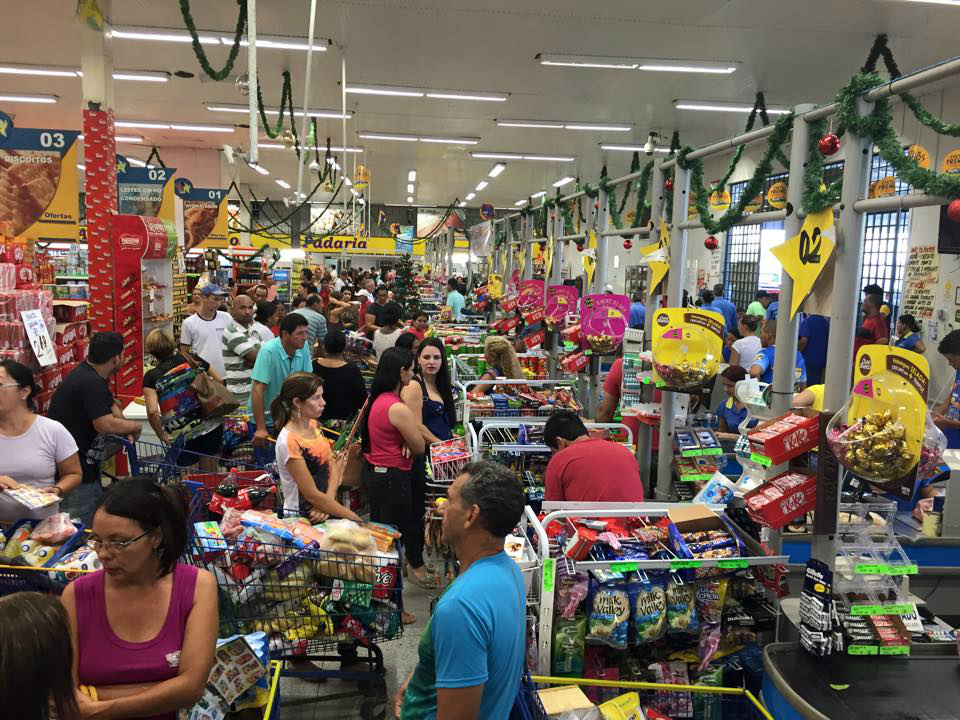
Supermarkets' nominal revenues grew 0.3 percent in December compared to November, but the result is offset by food inflation as measured by the Broad Consumer Price Index (IPCA), thus reaching the result of the volume sold.
Supermarkets’ nominal revenues grew 0.3 percent in December compared to November, but the result is offset by food inflation as measured by the Broad Consumer Price Index (IPCA), thus reaching the result of the volume sold. (Photo: internet reproduction)

“The drop in supermarkets impacted the overall result (of retail), but it was one-off since it was offset by a very high IPCA (National Broad Consumer Price Index), because of meat,” Nunes said.

Supermarkets’ nominal revenues grew 0.3 percent in December compared to November, but the result is offset by food inflation as measured by the Broad Consumer Price Index (IPCA), thus reaching the result of the volume sold.

“It is an activity that has a very strong replacement effect,” Isabella said. “There was an impact of prices in supermarkets. Families did not buy less, they replaced it with other items (at lower prices)”, she explained.

In addition to food inflation, the supermarket sector has been affected by a stable worker’s income, added the IBGE researcher.

The volume sold was fluctuating close to stability between September and November. The labor market rebound, which is still closely linked to informality, does not increase the worker’s average income or consumption capacity, said Isabella Nunes. “The casual worker has a lower income than the formal one,” she explained.

With the loss of momentum over the past four months, the supermarket sector has not helped the global retail average as much in 2019. The sector’s sales grew 0.4 percent last year, after more consistent growth in 2017 (1.5 percent) and 2018 (3.8 percent).

Source: Estadão Conteúdo

This article was produced by The Rio Times’ automated newsroom system. How we use AI · Report an error

Read More from The Rio Times

The Rio Times · Power Map
See who really holds power in Latin America
Click to open the Power Map

Rotate for Best Experience

This report is optimized for landscape viewing. Rotate your phone for the full experience.