Analyst: Political Unrest, Pandemic Could Lead to Drop in Foreign Investment in Brazil
RIO DE JANEIRO, BRAZIL – For an emerging country such as Brazil, the ability to regain control of the economy after a crisis is very important for foreign investors to view the domestic market positively.

The injection of foreign capital is typically directed to productive capital, such as plant construction, infrastructure, mergers and acquisitions: investments that help in the country’s long-term development.
In this context, according to Robert Wood, an economist specializing in Latin America at The Economist Intelligence Unit (EIU), the Economist Group’s research and analysis division, although the Ministry of Economy has an active privatization agenda, and this seems to be the right path for the economy’s rebound, on its own it will not be enough to put Brazil on track and drive a rebound.
Wood took part in the panel mediated by Fernando Ferreira, chief strategist at XP Investments, and Rachel de Sá, economist at XP Investments, and entitled “How the world sees Brazil today” during Expert 2020 on Thursday, July 17th.
Political instability and reforms
The economist said the attention of foreign investors is focused on the economic impacts of the pandemic and how the federal government will deal with them. According to Wood, a healthy rebound in the country includes “political and social stability and predictable rules for the game”.
In addition to privatization plans and concessions in the infrastructure sector, there are some positive points, such as low interest rates, with the SELIC base rate at 2.25 percent per year, something unprecedented in the country’s history.
“But in the past year, investors have nurtured some concerns, including where the Bolsonaro government’s public policies will drive the country. We have seen that deforestation of the Amazon recently and environmental preservation is a very sensitive issue for foreign investors,” he said.
In another Expert 2020 panel, Marina Silva, ex-minister of the environment, also noted that the environmental issue is perceived as a setback in the eyes of foreign investors.
She said that in past administrations the economy and agribusiness were growing and deforestation was declining, which allowed foreign investors to relax and invest in Brazil, but this “virtuous cycle” was broken in the current government.
Wood said that according to EIU projections, Foreign Direct Investment (FDI) in Brazil this year will be 40 percent lower than in 2019. Data from the United Nations Conference on Trade and Development (UNCTAD) show that FDI in Brazil grew 26 percent last year compared to 2018, to US$75 billion (R$375 billion).
Wood pointed out that political tensions, when added to the slowdown in the reform agenda, may also delay a healthy rebound.
“The Pension Reform was welcomed. Without this step last year, the scenario would be even more uncertain. At the start of this year, however, there were political troubles, with tensions between Congress and the Executive and it has become clear that it will be difficult to pass the other reforms swiftly, which has caused a certain despondency,” he explained.
He recalled that next on the agenda would be the tax reform, but that the government’s delay in presenting the proposal left investors less optimistic.
“The proposals are positive and try to strengthen public accounts. But now the agenda meets the local cycle of state elections and it will be another obstacle,” he said, referring to the municipal elections adjourned to November 15th and 29th, respectively, because of the pandemic.
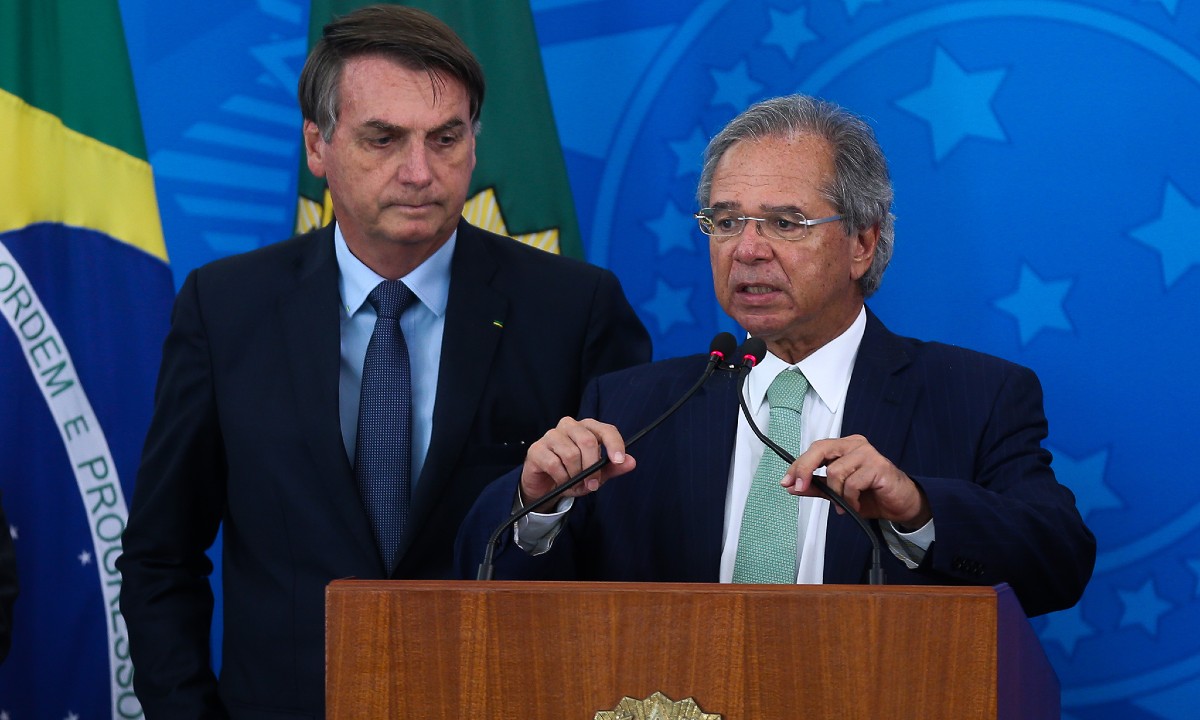
Notwithstanding this analysis, the Minister of Economy Paulo Guedes announced on Thursday evening, July 16th, during the Expert 2020, that the government’s proposal for tax reform is ready and will be delivered to Congress next Tuesday.
In the fiscal sphere, investors will monitor whether the government will maintain the stimulus given to companies and families. “There are still ‘coronavoucher’ installments to be paid. After that step, we don’t know what the effects will be. It is possible that with the end of the aid the Brazilians will wait to see what will happen, consuming less than expected and putting even more pressure on the public debt,” he said.
Recently, the now ex-secretary of the National Treasury, Mansueto de Almeida, stated that the emergency aid must not become permanent. According to him, not to “wean” companies and families, which have become dependent on government benefits, would be a shot in the foot.
“It would increase uncertainty and we would enter a scenario of reversing the drop in interest rates, with increased country risk, and the potential increase in the tax burden to make the fiscal adjustment. Brazilians, who pay the taxes, would be the losers,” said the Secretary.
With the increase in spending due to the pandemic, the general government’s gross debt projection has increased from 77.9 to 98.2 percent of GDP this year, according to the Ministry of Economy; the damage to public accounts is expected to reach R$850 billion, the largest deficit in history.
The situation does not please the Minister of Economy, Paulo Guedes, who won the market’s approval with the pledge to restore the balance of public accounts.
The Minister, a disciple of Milton Friedman, the liberatarian economist who symbolizes the defense of the minimum state, has had to yield, as have other liberal governments, to measures that raised the degree of state intervention in the country. But he has made it clear that he wants to return to his plan A soon.
Low expectations
Considering all the aforementioned factors, Wood said that expectations for Brazil are not very optimistic. While some countries should start a more solid rebound as early as 2021, it is not yet possible to say how or when the economic activity will resume in Brazil.
In March, the EIU revised Brazil’s GDP growth projections downwards. “The GDP contraction projection was 5.5 percent for Brazil when we were just starting to understand the gravity of the situation. A few months later, we recently corrected it for a sharper drop of 7.5 percent, precisely because we believe some factors are still lacking for a full rebound,” he says.
The World Bank released a report in early June pointing to an eight percent contraction in Brazil’s GDP in 2020. The International Monetary Fund (IMF) has even more pessimistic projections, with the decline in economic activity reaching 9.1 percent. The Central Bank, on the other hand, believes that the GDP will tumble by around 6.4 percent this year.
Finally, Wood believes that even amid the crisis there is an understanding that the scenario will not affect Brazil in isolation.
“It is a global crisis. Everyone is on the same boat and looking for solutions to overcome this moment. Investors are aware of it and are lending a helping hand to emerging countries understanding that this year will be particularly difficult.” he said.
Source: InfoMoney
More: Brazil news in English, every day from The Rio Times.
This article was produced by The Rio Times’ automated newsroom system. How we use AI · Report an error · Editorial responsibility: Matthias Camenzind, Editor-in-Chief