Analysts: Dollar to Reach R$4.40, Could Continue High Until Economy Grows Rapidly
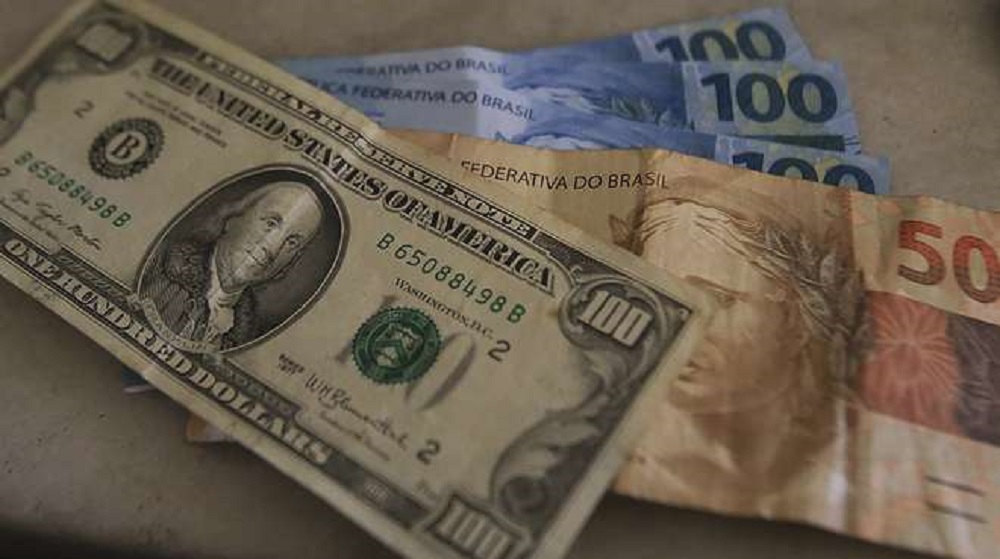
RIO DE JANEIRO, BRAZIL – Whether it be a day of encouragement or of risk aversion in world markets, the dollar continues to hit a peak every session in nominal terms, showing that the bullish US currency is here to stay. In Wednesday’s session, the dollar traded above R$4.35, renewing an intraday record high after closing last Tuesday at a new record high of R$4.3269.
As a result, in 2020 alone, the currency’s appreciation has exceeded eight percent – and analysts and economists expect that the Brazilian real will not yet find the strength to climb. On the contrary, the dollar may appreciate even further.

Credit Suisse, which last week pointed out that the dollar could reach R$4.30 on weak national economic figures and a reflection of the coronavirus, pointed out in a new report that the US currency could trade between R$4.25 and R$4.45 in the short term.
Alvise Marino, a strategist at the Swiss bank, points out as the main reason behind this outlook the gains with carry trade (a combination of taking a short position in a currency with a lower interest rate and another position bought in a currency with a higher interest rate) that have become iincreasingly lowerl since Brazil’s interest rates are historically low.
Moreover, it points out that there is a strong perception among investors, observed through the positioning of investors in the exchange market, that the Central Bank will interfere in the market should the dollar reach new peaks. However, Credit holds a cautious view on potential interventions by the monetary authority, a view shared by Morgan Stanley.
“Although the dollar is at record highs, the Central Bank’s likelihood for action remains low,” Morgan strategists point out, while inflation expectations remain low. The latest Focus, released on Monday, significantly reduced projections for the Broad Consumer Price Index (IPCA) for 2020 from 3.40 to 3.25 percent for the sixth consecutive week. “The signals from the authorities suggest that they are comfortable with the dollar at current levels,” adds the bank’s staff.
The last time the Central Bank acted more forcefully was in November 2019. At the time, the Central Bank auctioned the dollar twice on November 26th, on the grounds that the Brazilian real was dysfunctional and disconnected from other currencies. More interventions followed and, on November 28th there was a US$1 billion cash auction, which helped to boost the real’s price by over one percent in intraday trading.
However, for the time being, economists do not expect action of this magnitude, since it occurred because of the currency’s high volatility, according to the monetary authority.
Are there chances of the dollar dropping again?
According to Credit Suisse, the change in the Monetary Policy Committee’s (COPOM) discourse could cause the dollar to lose strength in the short term, trading at around R$4.25. In the bank’s assessment, despite the cut in benchmark SELIC from 4.5 to 4.25 percent on February 5th, the Committee suggested less flexibility in monetary policy and made investors understand the message as an end to the cut cycle. At first, this could lead to a rise in the Brazilian real, as carry trade gains, although low, have not diminished further.
However, with the minutes of the meeting that amplified questions about whether the end of the cycle will actually occur or whether there is room for further cuts, following January’s IPCA data on Friday and lower than expected retail sales on Wednesday, the Brazilian real finds no grounds for a climb. On Wednesday, for instance, the Brazilian currency recorded its fourth-worst performance among emerging markets, despite the relief abroad due to lower concerns over the coronavirus.
“The IPCA and retail sales did not allow the total elimination of another cut in the SELIC this year and this is one of the factors that helps to keep the dollar high,” says the director of Wagner Investments, José Faria Júnior, who alerts to the potential of the US currency reaching R$ 4.40.
According to Faria, the real is proportionally weaker in comparison to other currencies, due to the absence of greater flow into the country and weaker commodities prices, with oil and iron ore exports being particularly impacted by the coronavirus outbreak. “Thus, a rebound in commodities with some additional flow could drive the dollar down,” he says. In the medium and long term, however, the trend remains bullish for the US currency.
In addition, Matheus Soares, a Rico Investments analyst, points out in a report that the flow of foreign investors could return without high interest rates, if Brazil shows the strength to grow again. The latest poor economic data do not help the inflow of investors from abroad. “The market expects an increase of 2.3 percent [of GDP] this year and 2.5 percent in 2021. The issue is that in recent years growth has not been as expected, and since foreigners have more options besides Brazil, they will only come here when the economy grows consistently,” he says.
Meanwhile, in the US, services and industry data have positively surprised market estimates, while the published annual results also point to a healthy economic environment: almost 80 percent of the companies listed in the S&P500 have reported their 2019 numbers, with approximately 60 percent of them exceeding the profit projections.
Source: Infomoney
More: Brazil news in English, every day from The Rio Times.
This article was drafted with automated assistance and reviewed before publication. How we use AI · Report an error · Editorial responsibility: Matthias Camenzind, Editor-in-Chief