Disney+ Could Rank Second in Streaming in Brazil
RIO DE JANEIRO, BRAZIL – Three weeks to go before Disney+ reaches Brazil on November 17th. But the Brazilian market is already looking forward to the launching of one of the world’s largest entertainment companies’ streaming platform.
Consultants and market analysts bet that the service will quickly take second place among available subscriptions in the country, behind only the market leader, Netflix.
With a somewhat aggressive strategy of removing its own content – Marvel, Pixar, Star Wars and National Geographic – from all other streaming platforms, Disney has a more favorable starting point than its competitors, precisely because it has a robust and widely known catalog. New movie releases are also planned for the platform – the unreleased Mulan, for instance, will premiere directly on the platform here on December 4th.

Local production is encouraging news for the Brazilian audiovisual market, which has been poorly treated over the past two years.
“There are many talks in this respect because the market halted with the Audiovisual Sector Fund and the ANCINE blocked funding,” explains Stenna group CEO and founder, Carolina Vargas, 15 years working with producers and distributors of entertainment content.
“Disney doesn’t need the Sector Fund to create original productions. Nevertheless, it will take a couple of years for new local content to reach the platform. So I see a major growth in the launching, but I don’t know if it will sustain the growing rise they’re projecting.”
The growing rise refers to the overwhelming number of subscriptions the Disney platform has seen in the United States and 28 other countries. In less than a year, there are now 60 million subscribers, according to the company – by way of comparison, Netflix has approximately 190 million subscribers in 190 countries.
Technology
The position of Disney’s Latin American President Diego Lerner, revealed in rare interviews so far, nevertheless agrees with that of analysts who claim that Brazilians are highly attached to technology, even though they have lagged behind more developed countries such as the United States and Oceania countries.
“Technologically, Brazil is one of the audiences with the highest adherence to content consumption,” explains strategic entertainment and content consultant Patricia Weiss, who has been involved in the topic for 20 years. “It doesn’t matter if you are going to accumulate a number of subscriptions. Those with a minimum of purchasing power will sign up. Brazilian consumers will pay even less then on cable TV, which is still very expensive. Hence the trend in recent years of transferring content to digital platforms.”
However, Vargas says she is concerned about product delivery to the final client, an issue that Netflix has been addressing for almost ten years in Brazil. “To deliver regional content, outside the major centers, a considerable internet flow is required. Some services in operation do not work properly in the Northeast. Disney will need this flow. The regional provider is the one who delivers, and they are direct competitors of platforms because they sell programming content to the region. So what do they do? They block traffic from other platforms.”
In her opinion, the final consumer experience will be different in the diverse regions. “Regional services are growing. Here in Brazil there is a power war because of this. There are over a thousand cities where the major Internet operators buy or rent bandwidth from local providers, which in turn, when together, have a market share that reached almost 40 percent in August, inconveniencing the big ones.”
The cost-benefit ratio of internet quality is another issue, Weiss points out. When compared to other markets, data traffic is still very expensive in the country. “Brazil features technology quality in relation to much money from consumers. I strongly believe that Brazil needs to evolve in this cost-benefit relation. But the more companies are in operation, such as Disney, the better for Brazilians. Because this presence also develops market and consumer criteria. If they see more and more different things, they will choose better.”
Catalog
The power of the Disney brand is also boasted by the company as an asset over its competitors, particularly because of decades and decades of building images, content, entertainment inside and outside movie theaters and screens – one does not need to check research to notice that the dream of many Brazilians is “to go to Disney”.
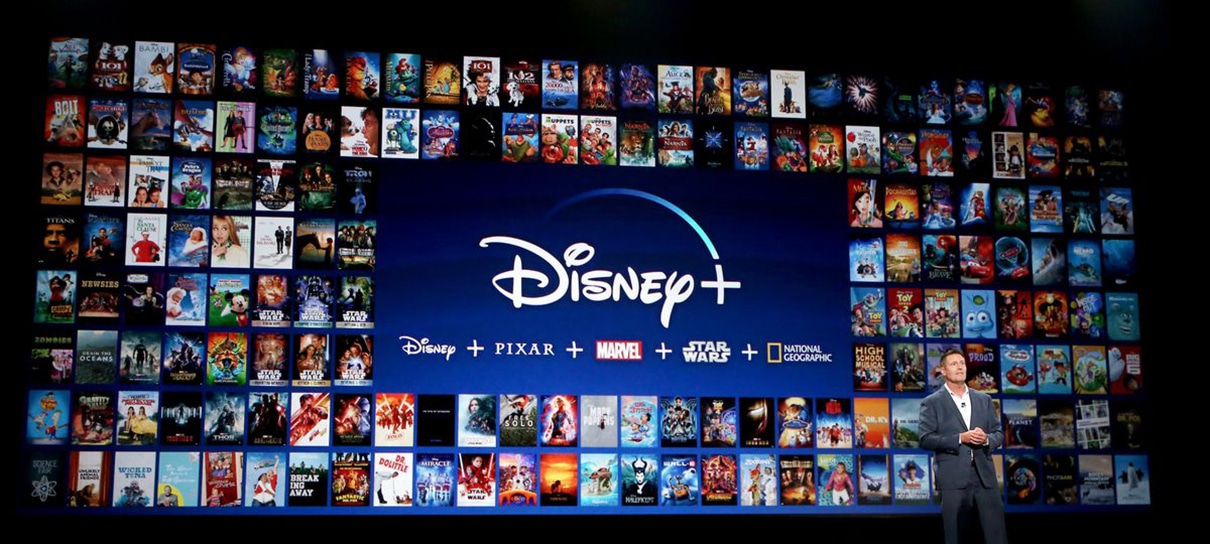
Nevertheless, the competition driven by Netflix has anticipated the moment in which large companies like Disney (but also Warner) would offer their own streaming platforms, and began to invest heavily in their own production. Many of the best modern series are produced directly for the Internet, such as Fleabag (Amazon), The Crown (Netflix), The Morning Show (Apple TV+), and others. This trend softens the impact of content removal, according to sources.
“Pay-TV is the most threatened at the moment, because looking at the price, one can hardly compare”, explains Weiss. “Consumers will not necessarily choose between one platform and another. The video content consumer market, even if of low quality, is very big. Brazilians will buy it.”
According to Rafael Pallarés, president of the digital video committee of IAB Brazil and general director for LATAM at Magnite (a global technology platform that enables the sale of digital advertising in several media), the power of Disney’s catalog offers users the positive possibility of building their own content portfolios.
“Studies in the United States suggest that most people are unwilling to pay more than US$20 (R$110) in monthly subscriptions, which means an average of two and a half services in each household,” he explains. “The limit per household in Brazil is lower. Coming with a strong catalog, they will find a privileged position. As they are focusing on building user bases, they take their catalog from other services and this forces a decision,” he says. “In companies that have a very large content production, the trend is to do this. This segment is very fragmented, there are many players involved, there are more levels than in cable TV.”
According to Stenna’s Carolina Vargas, other platforms, particularly Netflix, have a more frequent content update than Disney, which can be a differential in terms of competition. “Disney has had the same content for so many years. What’s new? There is much wonderful content, but very expensive… Star Wars is gone… it will be there too, of course, but what about it? Apart from the euphoric fans, there’s another edge. Based on our work from time to time with ANCINE and pay TVs against piracy, I believe that the mass of the Brazilian consumer will not pay for another platform.”
“Netflix has done a good resumption of international content, with Korean, Indian productions, which are successful here too,” she continues. “It’s not easy to sustain streaming by selling directly to the end consumer. In this sense, I believe that between having something specific for children and something that can reach the whole family, consumers would rather pay the R$21,90 to reach the whole family.”
Netflix itself, however, accepts the strong competition which exists now (in the USA) and the coming years. In a recent interview to The Hollywood Reporter, co-CEO Reed Hastings said that the company wants to beat Disney in animated films for the family. “But this will take a while,” he said.
Competition
For Rafael Pallarés, of IAB Brazil and Magnite, the migration to the streaming environment is relentless. “This impacts all generations, it is a trend of consumption not only of content on-demand but there is also a demand for live streaming.”
Analyst Patrícia Weiss also explains that platforms learn from each other’s trajectories in a booming market with several business model options.
“Disney+ has a reference in streaming that is Netflix’s trajectory. At Disney, the DNA of the business is not just fun, but entertainment in general. It was the one that invented the first successful brand entertainment case. HBO explained to the world what TV should be, in a matter of language. The best consumer experience, no matter the genre, is still Apple. Prime Video, we realized still needs to evolve. It still doesn’t seem to be from Amazon, even in the combustion of content production, which is relatively slow.”
Source: O Estado de S. Paulo
More: Brazil news in English, every day from The Rio Times.
This article was produced by The Rio Times’ automated newsroom system. How we use AI · Report an error · Editorial responsibility: Matthias Camenzind, Editor-in-Chief
Brazil runoff, Sunday, October 25: When is the Brazil runoff election. Latest: Brazil runoff polls, Flávio 51%, Lula 49%.