Analysis: Brazilian Inflation Remains Low, yet Supermarket Prices Rise. Why?
RIO DE JANEIRO, BRAZIL – Last week was marked by events ranging from the administrative reform to the holiday crowds and the search for the Covid-19 vaccine. But among all of this, one statement attracted economists’ attention: President Jair Bolsonaro’s request that supermarket owners be “patriots” and not raise prices on their shelves.
The request is the clearest reflection of a trend that has been the target of complaints from Brazilians for months. The rise in food prices, although official inflation is still far below the Central Bank’s target, is evidenced in the villain of the moment, rice, the price of which has skyrocketed by more than 20 percent in a year and even doubled in some places.
The food prices pushed part of the rise in the IPCA in August, which stood at 0.24 percent. However, in all, the inflationary index remains under control: the accumulated rate stands at 2.44 percent over the past 12 months.

The Central Bank inflation target for 2020 is of four percent, with a tolerance of 1.5 points. Nothing compared to numbers already seen in Brazil – the record was in March 1990, when inflation in a month reached 80 percent, according to the IBGE ( Brazilian Institute of Geography and Statistics).
“The IPCA is an index comprising foodstuffs, but also other items, such as housing, transport, clothing, and education. This gap between the index and people’s ‘real life’ is that, for many people, food has a greater impact and weighs more heavily in their pockets,” says Auberth Venson, of the economics department of the State University of Londrina.
The August inflation was pushed by the rise in food prices, but the general index does not explain by itself the rise in prices on shelves.
Venson notes that food weighs less than 20 percent in the basket of items measured by the IPCA. The influence of each item in the index is based on an attempt to standardize Brazilian citizens. In practice, the share of the salary spent on food is greater than that for the poorest, the IBGE shows, and may exceed 20 or 30 percent, while it is less than ten percent for the wealthiest.
“Thus, deflation on education and clothing and the deceleration of housing have mitigated the increase in food prices,” points out the Exame Research report on the August IPCA.
Nevertheless, the rise in food prices is already starting to be reflected in the IPCA metrics, which reflects the trend of recent months. When the price hikes measured by the IPCA are broken down individually, foodstuffs are among the top 23 and rule the list that includes all sectors, from housing to clothing.
The product that increased the most in 2020 according to the IPCA variable was not rice, but mango. The rise in that fruit stood at 62 percent, followed by onions (50 percent) and zucchini (47 percent). Rice comes close to the 20th place, with a rise of 19 percent. Many different types of beans are also among the 30 products that increased the most, as well as UHT milk (23 percent), soybean oil (19 percent), and lettuce (18 percent).
It should be noted that this is a national survey. The variation is tremendous between locations. Tomatoes, for instance, (one of the favorite villains of other years among price hikes), rose 12 percent on average in Brazil, but dropped 14 percent in Campo Grande, capital of Mato Grosso do Sul.
There are also products for which the price measured by the IPCA dropped, which balances the general measurement. Filet mignon and avocado dropped by almost 20 percent in 2020. Overall, meat prices dropped just under two percent, but items such as sausages, industrialized meats, chicken, and fish increased.
Beans, rice, vegetables, fruits, milk, and wheat are among the top price hikes, but prices have surprisingly dropped for meat.
Moreover, an economic concept explains the gap between the IPCA and the supermarket shelf: the rise in prices of items does not necessarily mean there is inflation. Inflation is measured when there is a great amount of money in the market and a demand that does not keep up with consumption, leading to a trend of change in prices over the long term, rather than a temporary rise or drop.
“There may be a problem in the future because we have low interest rates [the Treasury’s Selic rate stands at two percent per year]. If the government spends a lot and there is a strong economic rebound, inflation will be a concern again. But that’s still far from happening in a recession scenario like the one we’re experiencing,” says economist Juliana Inhasz, professor at INSPER.
During the crisis, the economy is poorly heated, with the Central Bank’s Focus bulletin’s average projection of a 5.31 percent drop in Brazil’s gross domestic product in 2020.
From the dollar to China: what drives prices up
Each item has a specific explanation for its pricing – the weather, higher or lower rainfall, the market conditions for that product in Brazil and abroad. But, in general, four factors impact the rise in products: the bullish dollar, the price of gasoline, the positive moment of Brazilian exports, and, finally, the emergency aid.
The dollar increased 32 percent in 2020 alone. As a result, it becomes more expensive to import all kinds of supplies. For Brazil, this mainly impacts the price of some pesticides, farming equipment and, in the food industry, industrialized food, and other raw materials.
A classic example is wheat, which Brazil imports from countries like Argentina – the combination of high demand and a high dollar is sure to push up the price.
In addition, Brazil is also selling more: the depreciated real makes Brazilian exports cheaper on the foreign market. From January to July, Brazilian agribusiness exported 17 percent more in volume and profited nine percent more than in the same period in 2019. The figures are based on the Confederation of Agriculture and Livestock of Brazil.
There is particular attention to high demand from China, which has been driving agribusiness. The country imported almost 40 percent of all that the Brazilian agribusiness sold abroad in the period. Next came the European Union (16 percent) and the United States (six percent).
For farmers in the countryside, their production is now leaving the field at higher prices. In the monthly calculation performed by the Center for Advanced Studies in Applied Economics (CEPEA), of USP’s College of Agronomy, the ESALQ, which comprises bags of rice, cassava, wheat, beans, meat, eggs, and other products, the trend is for prices to rise for most of them.
“Although the food and beverage sector is very broad, export items such as meat, corn and soy can be driven to the foreign market to the detriment of the local market. The import of wheat and its derivatives can be impacted,” says economist George Sales, professor at FIPECAFI, a private foundation linked to USP’s School of Economics, Management and Accounting.
The price of gasoline also interferes because it impacts food transport. While the world was experiencing the worst of the pandemic in recent months, the price of oil collapsed on the international market, which caused the price of gasoline to drop by over ten percent.
Nevertheless, oil has begun to rebound in recent weeks with the global economic reopening. And when the price is high on the external market, Petrobras sells the oil here with a lag because of the dollar. Moreover, the discounts passed on by the state-owned company are not always applied at the gas stations – this week Petrobras decided to reduce the refinery price of gasoline by five percent.
And what does the emergency aid have to do with all this?
The R$600 (US$120) aid paid by the government since April has placed a portion of the money in circulation. It was not enough to increase inflation, because there was an overall drop in family income at the same time.
But the aid is principally received by low-income families, and so is used mainly for food, which puts pressure on prices in this sector.
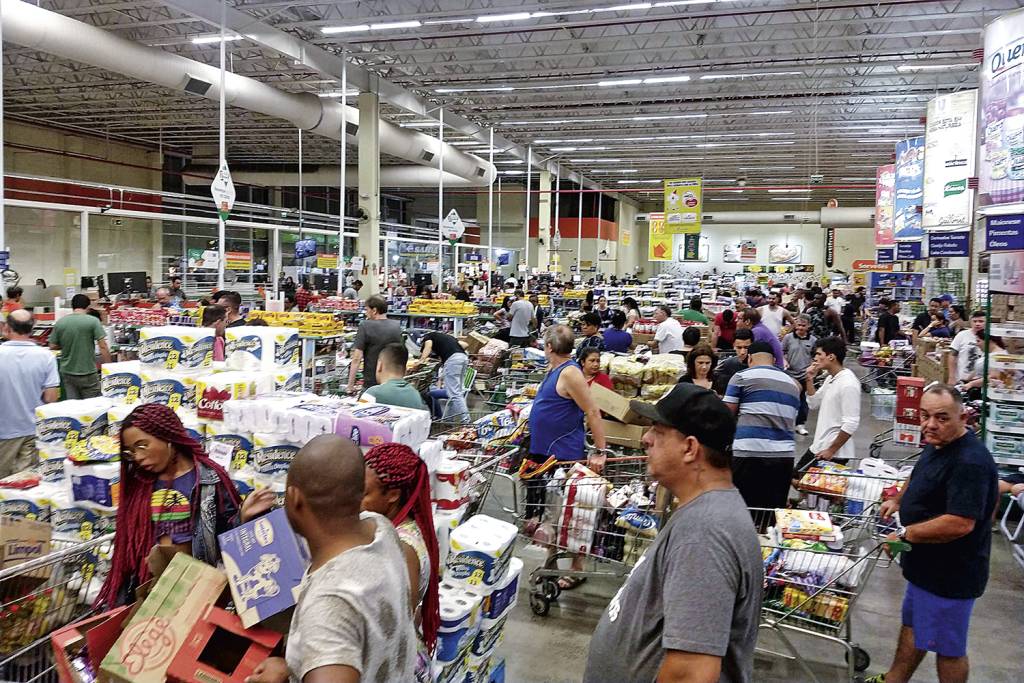
Because they are essential items, supermarket products perceive the crisis the least. At the start of the pandemic, there was still a concentrated demand with the “race to the markets” to stock food, but now the trend is for normalization, says INSPER’s Inhasz.
Altogether, the trend is for inflation to remain low for some time. But from the pandemic to the dollar, this set of factors should continue to impact the price of food in the medium term.
Source: Exame
More: Brazil news in English, every day from The Rio Times.
Live Market IntelligenceBrazil — Live Market Board
Rio Times · Live Market Intelligence
Brazil — Live Market Board
+0.10%
204,324.80
+0.10%
69,889.73
-0.51%
10,681.27
-0.92%
3,017,221
—
2,517.61
-0.43%
57,021.19
-0.49%
| Instrument | Last | Change | YoY | Prev. | High | Low | Volume |
|---|---|---|---|---|---|---|---|
| IBOV | 204,324.80 | +0.10% | +21.85% | 204,120.12 | 168,310 | 167,142 | — |
| USD/BRL | 5.16 | +0.01% | -5.13% | 5.16 | 5.18 | 5.14 | — |
| SELIC | 14.00% | — | — | — | — | — | |
| PETR4 | 41.64 | -0.05% | +35.19% | 41.66 | 41.97 | 41.15 | 41,499,400 |
| VALE3 | 72.97 | +0.83% | +30.75% | 72.37 | 73.54 | 72.66 | 17,658,000 |
| ITUB4 | 38.60 | -1.03% | +4.57% | 39.00 | 39.34 | 38.39 | 29,487,800 |
| BBDC4 | 16.85 | +0.36% | +3.50% | 16.79 | 16.90 | 16.67 | 19,416,900 |
| BBAS3 | 19.37 | +0.47% | +0.73% | 19.28 | 19.44 | 19.16 | 11,069,200 |
| B3SA3 | 14.26 | -0.21% | +12.73% | 14.29 | 14.47 | 14.11 | 33,037,800 |
| ABEV3 | 14.89 | -0.80% | +21.91% | 15.01 | 15.07 | 14.81 | 16,453,100 |
| WEGE3 | 47.59 | +0.49% | +29.99% | 47.36 | 48.08 | 47.36 | 3,364,600 |
| PRIO3 | 59.14 | -0.19% | +50.67% | 59.25 | 59.81 | 58.74 | 3,325,600 |
| SUZB3 | 41.33 | +2.35% | -23.55% | 40.38 | 41.48 | 40.35 | 3,914,900 |
| RENT3 | 34.68 | -0.09% | +0.84% | 34.71 | 34.96 | 34.35 | 7,979,100 |
| AZZA3 | 15.89 | -2.63% | -53.76% | 16.32 | 16.42 | 15.82 | 1,330,300 |
| CSNA3 | 4.30 | +0.47% | -42.65% | 4.28 | 4.41 | 4.26 | 10,076,100 |
| GGBR4 | 24.69 | +2.19% | +51.38% | 24.16 | 24.85 | 24.18 | 7,047,600 |
| ENEV3 | 24.21 | -1.38% | +70.49% | 24.55 | 24.64 | 23.99 | 9,297,000 |
This article was produced by The Rio Times’ automated newsroom system. How we use AI · Report an error · Editorial responsibility: Matthias Camenzind, Editor-in-Chief