Four Brazilian States Could Enter Covid-19’s ‘Uncontrolled Acceleration’ Stage
RIO DE JANEIRO, BRAZIL – The latest study of the coronavirus epidemic in Brazil by the Ministry of Health shows that the country is currently facing a “very high” national risk from the novel coronavirus.
If in general Brazil is still experiencing the initial transmission stage of Covid-19, at least four states -São Paulo, Rio de Janeiro, Ceará, and Amazonas – are on the verge of entering the harshest stage of the epidemic: that of uncontrolled acceleration of the disease, when there is a spiral of cases and a heavy overload of the health system.

The alert by the Ministry’s officials is based on the calculation of a high incidence of infection in relation to the population in these locations, a figure that exceeds the national rate. And it adds to the structural challenges the country has been facing in its race against time to expand the health system before the arrival of the most acute stage of the disease.
In the most recent report published by the Ministry of Health on the epidemiological situation in Brazil, released on Saturday, April 4th, the portfolio assesses the risks to the Brazilian Unified Health System (SUS) and draws a harsh picture of the Brazilian ability to deal with the most acute stage of the epidemic at this time.
The country is facing a shortage of specialized health professionals, hospital beds are not yet sufficient for an acute stage, there are no test providers to significantly increase testing capacity in the next 15 days, and at least two or three more weeks of studies would be required to achieve some robustness and apply drugs such as chloroquine on a large scale for the treatment of Covid-19.
Therefore, the Ministry of Health recommends that states and municipalities maintain their social distancing measures at least “until the supply of equipment (beds, protective equipment, ventilators, and laboratory tests) and health teams (doctors, nurses, other medical professionals, and others) are available in sufficient numbers.
The portfolio notes for the first time that isolation measures are working in the country. It mentions the case of São Paulo, whose rate of transmission of the virus stood between three and six and dropped to close to two. “After the implementation of extended social distancing measures, this rate is close to R0=2 (in São Paulo),” the document points out, quoting the index that calculates the virus’ reproductive potential.
Minister Luiz Henrique Mandetta’s support for the measures adopted by São Paulo is his main point of friction with President Jair Bolsonaro, who advocates the return to business activities in the country, with the isolation of only the elderly and people in the risk group.
The controversy has tarnished the Brazilian President’s image and increased popular support for the Minister.
Hospital structure
The assessment in the report released on Saturday was conducted by the health authorities 37 days after they found the first Covid-19 case and began to provide more direct responses to the epidemic in the country.
At present, Brazil records a total of 9,056 cases and 359 deaths, according to data on Friday, April 3rd. But Minister Mandetta himself acknowledges that the number is understated given the limited testing capacity.
The portfolio is trying to increase the capacity to detect a more realistic number of infections in the country and announced the increase of available tests to 22 million, but the suppliers of these items have no stock for the next 15 days, he said.
As for the ability to assist the most critical cases of Covid-19 in Brazil, the situation is also dramatic. There is a lack of health professionals trained both in the clinical management of critically ill patients, and in trained professionals who work in health posts to guide mild cases of influenza.
“ICU and inpatient beds are not properly structured and not enough in number for the most acute stage of the epidemic”, the portfolio alerts in the document. And even drugs with promising evidence for treatment – such as the association of colonic and azithromycin – still need at least two or three weeks of studies to be safely administered on a large scale.
The virus’s behavior
The Ministry of Health draws attention to the high transmissibility and mortality of the novel coronavirus, which already has repercussions on hospitalizations for severe acute respiratory syndrome in the country and has a higher occurrence than other viruses monitored, such as Influenza.
“SARS-CoV-2 has unusual behavior and represents a high risk for the Unified Health System”, warns the portfolio. The epidemic goes through four stages: localized transmission (in which Brazil is currently located), uncontrolled acceleration (in which four states are starting to enter), deceleration and control.
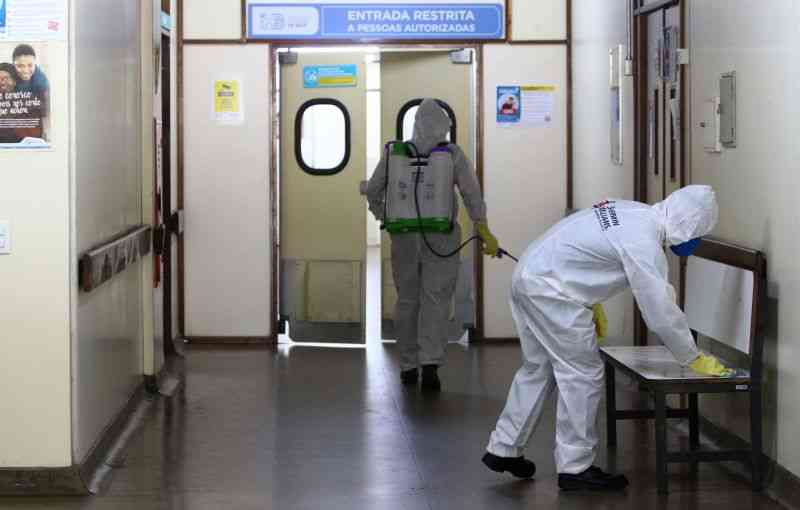
The Ministry has repeatedly recommended that social distancing measures be respected to allow time for the health system to be expanded and to provide conditions to attend to a high number of patients. Although it does not specify a precise forecast, the Ministry expects that a period of greater occurrence of the disease “will occur within a few weeks”.
Faced with the gravity of the situation and insufficient supplies, the Ministry of Health now recommends that the population should wear masks, even if they are made at home with cloth, as a social barrier to try and reduce the spread of the virus.
“This fact alone illustrates the severity of the situation and the need to maintain the extended social distancing measures that have been implemented by several state and municipal governments. This is the only tool available at the moment to control the disease,” the Minister said.
Source: El País
More: Brazil news in English, every day from The Rio Times.
Editorial responsibility: Matthias Camenzind, Editor-in-Chief · Editorial standards · Report an error