NASA Study Finds Amazon Dryer, More Vulnerable, Sooner than Previously Predicted
RIO DE JANEIRO, BRAZIL – The increase in deforestation and fires in the Amazon, combined with the high concentration of greenhouse gases, is making the atmosphere over the rainforest drier, increasing the demand for water and leaving ecosystems more vulnerable to fires and drought itself. This situation, predicted by scientists to occur within a few decades, is happening now. This is shown in a new study conducted by NASA, the US space agency.

The work was based on data collected on the ground and from satellite image analysis to determine the so-called vapor pressure deficit (VPD). Thus, scientists were able to track the amount of moisture in the atmosphere and how much of it is required to maintain forest cycles.
“We observed that in the last two decades, there has been a significant increase in dryness in the atmosphere as well as in the atmospheric demand for water above the rainforest,” said JPL’s Armineh Barkhordarian, lead author of the study at NASA’s Jet Propulsion Laboratory (JPL), in a press release.
“In comparing this trend to data from models that estimate climate variability over thousands of years, we determined that the change in atmospheric aridity is well beyond what would be expected from natural climate variability,” added the lead author of the work published in Scientific Reports journal, of the Nature group.
Barkhordarian said that elevated greenhouse gas levels are responsible for approximately half of the increased aridity. The rest is the result of ongoing human activity, most significantly, the burning of forests to clear land for agriculture and grazing. The combination of these activities is causing Amazon’s climate to warm.
The study pointed out that the most significant and systematic process of atmospheric dehydration occurs in the southeast region of the Amazon, where the so-called Arc of Deforestation is spread – exactly where most of the deforestation and agricultural expansion occurs.
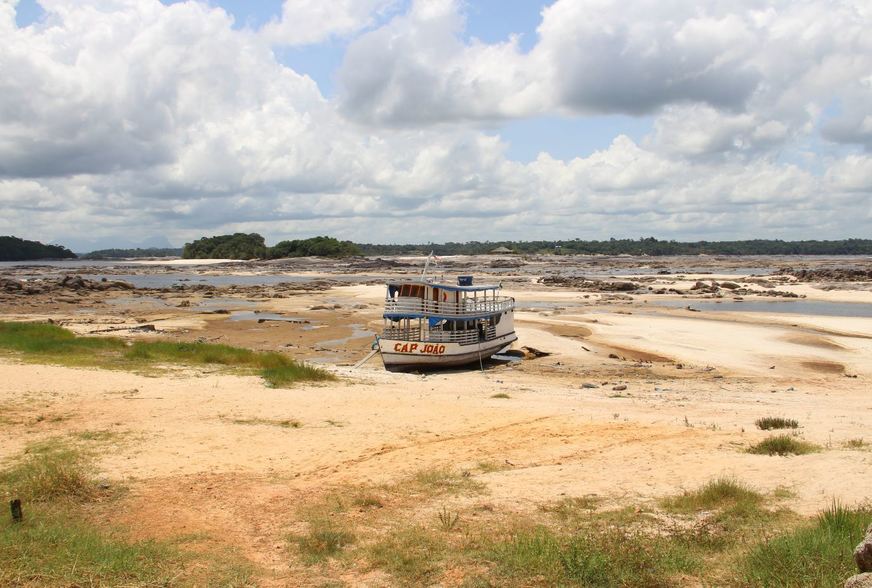
Episodic droughts were also observed in the northwestern Amazon. The area, which normally does not have a dry season, has experienced severe droughts during the last two decades. For the authors, this provides an additional indication of the vulnerability of the entire forest to increased temperature and dry air.
Imbalance in progress
“It’s a matter of supply and demand. With the increase in temperature and drying of the air above the trees, the trees need to transpire to cool themselves and to add more water vapor into the atmosphere. But the soil doesn’t have extra water for the trees to pull in,” said JPL’s Sassan Saatchi, co-author of the study. “Our study shows that the demand is increasing, the supply is decreasing and if this continues, the forest may no longer be able to sustain itself.”
If this trend continues over the long term and the rainforest reaches the point where it can no longer function properly, many of the trees and the species that live within the rainforest ecosystem may not be able to survive. As the trees die, particularly the larger and older ones, they release CO2 into the atmosphere; and the fewer trees there are, the less CO2 the Amazon region would be able to absorb, exacerbating the scenario of climate change.
Climatologist sees risk of savannization between 15 and 30 years
Brazilian climatologist Carlos Nobre, one of the first researchers to assess the risk of savannization of the Amazon at a certain level of deforestation, told O Estado de São Paulo that NASA’s work confirms what several studies had already been pointing out.
“A large stretch of the Amazon in the south and east is getting warmer and drier, especially during the dry season, which has already lasted between three and four weeks longer in that area of about two million square kilometers,” said the researcher at USP’s Institute for Advanced Studies.
According to his calculations, if the dry season lasts longer than four months (today it lasts three months on average), the forest will convert itself into a tropical savannah – “which is the balance biome with a long dry season and fire,” he said. “In fact, the point of no return in this region is very close. I estimate no more than 15 to 30 years with the growing pace of deforestation added to the persistence of global warming, and also with the greater vulnerability of the Amazon forest to fire.”
Source: O Estado de S. Paulo
More: Brazil news in English, every day from The Rio Times.
This article was produced by The Rio Times’ automated newsroom system. How we use AI · Report an error · Editorial responsibility: Matthias Camenzind, Editor-in-Chief