Patch Burning, Drought, Poor Air Quality, ‘Black Rain’, High Temperatures: Weather Affecting Brazil
RIO DE JANEIRO, BRAZIL – Patch burning, dry weather, poor air quality, “black rain” and high temperatures: several regions of Brazil have suffered from at least one of these problems in recent days. But how are they connected?
There are two main factors that link the phenomena observed in Brazil: the atypical features of the current season – much drier and hotter than average – and the action of man, responsible for the burning that causes the smoke to travel across the country.
Patch burning
The burning has mainly affected two of the Brazilian biomes: the Amazon and the Pantanal. In both cases, human actions are the cause of the fires.

In the Pantanal alone, where teams have been fighting the flames for over a month, experts estimate that at least 12 percent of the ecosystem has already been destroyed. In addition to the destruction of the biome, the fires have already injured or killed many animals.
At least one firefighter has died in the battle against the flames: Welington Fernando, 41 years old. He worked as a servant at the Chico Mendes Institute for Biodiversity Preservation (ICMBio) and had 80 percent of his body burned while trying to save animals from a fire in Chapadão do Céu, southwest Goiás.
The Atlantic Forest is also suffering from fires. Since early September, 65 new patch burn hotspots occur every day in São Paulo, six times more than in the same period in 2019.
Polluted air and ‘black’ rain
The smoke from the fires also contributed to air pollution in several parts of Brazil and could be seen in Curitiba, according to Somar Meteorology, more than a thousand kilometers away from the Pantanal fire sites.
According to satellite imagery released by the National Institute of Space Research (INPE), the smoke from the patch burns, both in the Amazon and Pantanal, has spread over more than 3,000 sq km of Brazilian territory.
In Rio Grande do Sul, locals collected “black” rainwater after the smoke from the fires reached the south of the country, having already reached Mato Grosso and Mato Grosso do Sul. “When there is a lot of smoke, it causes this dark rain. Aerosols, like smoke soot, serve as condensation nuclei for rain clouds,” explained Catia Valente, of Somar Meteorology.
Dry weather
Dry weather contributes to the spread of fires. This year, the Pantanal is facing a record drought: it is the longest dry season in 47 years. Researchers from the Brazilian Agricultural Research Corporation (EMBRAPA) have already pointed out that La Niña, a phenomenon with its main characteristic the cooling of the Atlantic, could cause a historic drought in the biome.
With a lesser flooded area in the Pantanal plain, there is more land to serve as “fuel” for the fire. The wind also worsens the spread of fires.
The National Institute of Meteorology (INMET) has low humidity alerts, with danger of fire and health risks, in the following states and regions:
- Mato Grosso
- Tocantins
- Goiás
- Federal District
- Almost the whole state of São Paulo (except the coast)
- Southeast and southwest Pará
- North of Mato Grosso do Sul
- West, South, and North of Minas Gerais
- Southwest, North, and West of Bahia, in addition to Chapada Diamantina
- Center-north, Southeast, and Southwest of Piauí
- Sertão (hinterland), South, Cariri, Center-south, and Jaguaribe do Ceará
- Sertão da Paraíba
- West, East, South, and Center of Maranhão
- Sertão de Pajeú and Araripe de Pernambuco and São Francisco of Pernambuco
- Center and West of Rio Grande do Norte.
According to the INMET, the relative air humidity should range from 12 to 20 percent in these locations.
Because of the low humidity, the institute asks people to drink plenty of liquids, to keep their skin hydrated, avoid sun exposure in the hottest hours of the day, and to keep the environment humidified. Physical activities are not recommended.
The occurrence of La Niña contributes to the dry weather in the South of the country while increasing the frequency of rainfall in the North and Northeast: Acre, Amazonas, and Roraima are under heavy rainfall alert, according to INMET.
High Temperatures
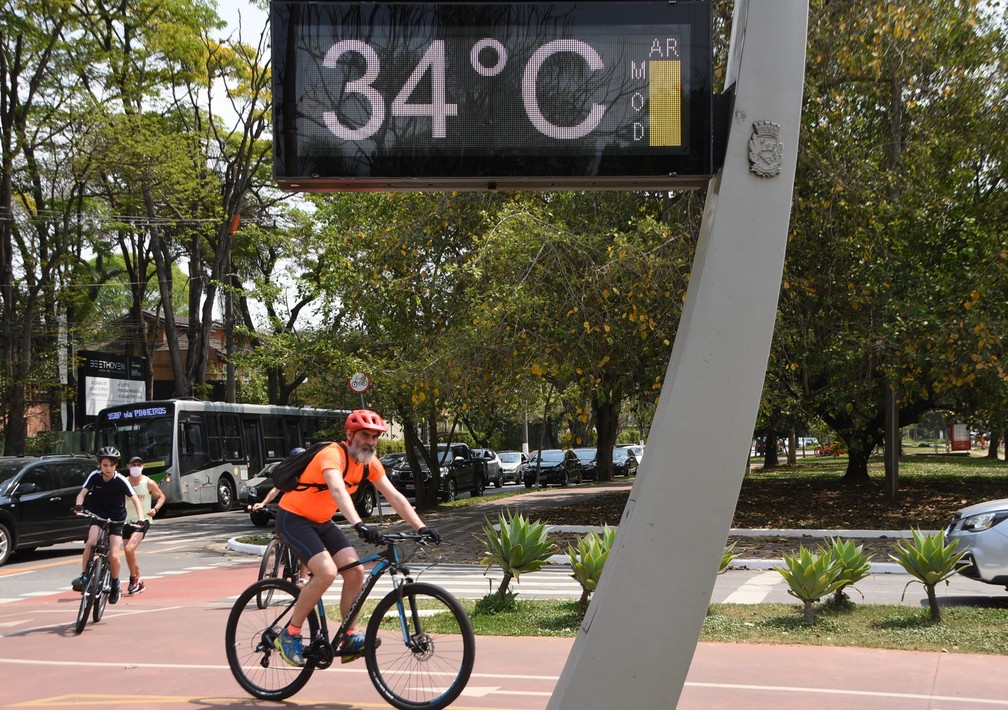
In addition to dry weather, above-average temperatures have been observed in several parts of Brazil. Cuiabá broke the heat record in over 100 years, registering 42.7ºC on Sunday, September 13th. The capital of Mato Grosso also recorded an extremely low air humidity: seven percent.
On Saturday, September 12th, São Paulo registered the hottest afternoon of the year, with 34.1ºC, according to the Center for Emergency Management (CGE). The peak surpassed the 33.7ºC recorded on January 1st. The temperature is very high for the season: according to the CGE, the average maximum for September is 25.6ºC.
Below are weather forecast for some capital cities, according to INMET:
Cuiabá: minimum of 25ºC and maximum of 42ºC on Monday; on Tuesday, minimum of 23ºC and maximum of 39ºC. On Wednesday, minimum of 25ºC and maximum of 41ºC; on Thursday, minimum of 25ºC and maximum of 42ºC. On Friday, minimum of 25ºC and maximum of 42ºC. Minimum humidity can reach ten percent every day of the week.
São Paulo: minimum of 21ºC and maximum of 34ºC on Monday; on Tuesday, minimum of 16ºC and maximum of 21ºC. On Wednesday, minimum 17ºC and maximum 31ºC; on Thursday, minimum 18ºC and maximum 33ºC. On Friday, minimum of 19ºC and maximum of 29ºC. Minimum humidity could reach 20 percent on Monday, September 1th, the lowest rate for the week.
Curitiba: minimum of 17ºC and maximum of 34ºC on Monday; on Tuesday, minimum of 9ºC and maximum of 17ºC. On Wednesday, minimum of 11ºC and maximum of 28ºC; on Thursday, minimum of 17ºC and maximum of 26ºC. On Friday, minimum of 16ºC and maximum of 25ºC. Minimum humidity could reach 25 percent on Monday, September 14th, the lowest rate of the week.
Palmas: minimum of 27ºC and maximum of 37ºC on Monday; on Tuesday, minimum of 27ºC and maximum of 37ºC. On Wednesday, minimum 27ºC and maximum 38ºC; on Thursday, minimum 27ºC and maximum 39ºC. On Friday, minimum of 28ºC and maximum of 39ºC. Minimum humidity may reach 15 percent every day of the week.
Teresina: minimum of 19ºC and maximum of 37ºC on Monday; on Tuesday, minimum of 24ºC and maximum of 37ºC. Wednesday: minimum of 24ºC and maximum of 37ºC; Thursday: minimum of 25ºC and maximum of 38ºC. On Friday, minimum of 25ºC and maximum of 38ºC. Minimum humidity may reach 20 percent every day of the week.
Brasília: minimum of 16ºC and maximum of 30ºC on Monday; on Tuesday, minimum of 16ºC and maximum of 30ºC. Wednesday: minimum of 16ºC and maximum of 30ºC; Thursday: minimum of 15ºC and maximum of 31ºC. On Friday, minimum of 16ºC and maximum of 32ºC. Minimum humidity may reach 15 percent on Friday, September 18th. Maximum humidity of 70 percent can be reached on Wednesday, September 16th.
Source: G1
More: Brazil news in English, every day from The Rio Times.
This article was produced by The Rio Times’ automated newsroom system. How we use AI · Report an error · Editorial responsibility: Matthias Camenzind, Editor-in-Chief
Brazil runoff, Sunday, October 25: Brazil runoff: date, poll closing times and when results start. Latest: Brazil runoff polls, Flávio 51%, Lula 49%.