Unemployment Impacts One-Third of Lower-Income Households in Brazil
RIO DE JANEIRO, BRAZIL – Since the quarantine to fight the coronavirus began, housemaid Izabel Cruz de Oliveira has lost all the cleaning she used to do during the week. She succeeded in making R$800 (US$160) a month – money used to support her three children, the youngest being one year old. “With the pandemic, I was dismissed from all houses.”

Today, out of work, she lives on donations. Her father, retired, buys her baby’s diapers and a neighbor donates milk. The church also helps with other products, says Izabel.
She lives in a squatter settlement in the eastern part of São Paulo, so she is not paying for water or power. “I had never seen anything as frightening as this we are experiencing now,” she says.
As in Izabel’s house, unemployment has already knocked on the door of almost a third of families who earn up to a minimum wage – R$1.045, less than US$ 200 per month. According to a survey by the German consultancy firm Roland Berger, 30 percent of respondents – in this income bracket – say they already have at least one jobless member of their household because of the coronavirus.
“The lower the income, the greater the impact of the crisis on this most vulnerable population,” says Marcus Ayres, a partner in the consulting firm and one of the people behind the survey.
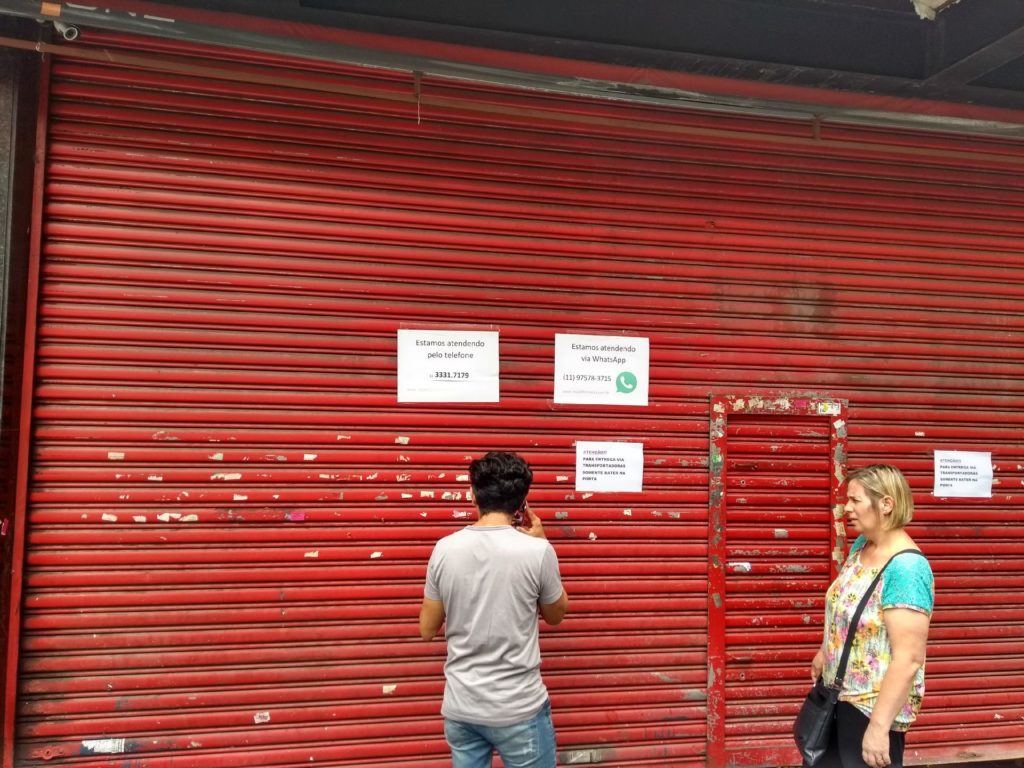
According to him, the result reflects the impact of the crisis on small businesses, which concentrate low-income jobs. There is a cascade effect: the neighborhood store closes its doors, stops earning, and fires the attendant, who stops consuming, he explains.
The survey, according to the executive, interviewed 700 people nationwide in the first weeks of quarantine. “Every day the deterioration in the indicators worsens.”
In the scenario of the economist of Tendências Integrated Consultancy, Thiago Xavier, the deterioration of the labor market is perverse and swift. At the start of quarantine, he projected unemployment at 12.9 percent by the end of this year, in a basic scenario, and 14.1 percent in a pessimistic scenario. Over the past few days, the pessimistic scenario has become the basic scenario and nothing guarantees that the projections will not worsen.
According to Xavier, the scenario anticipates an increase in layoffs, of discouraged and vulnerable people. The projection takes into account precisely the share of small businesses in the labor market. “About 50 percent of the employed (40 million people) are in companies with up to five employees,” says the economist. Of that total, 72 percent are in the casual sector.
He says that in a recent survey by Sebrae (Brazil’s Small Business Institute), 18.1 percent of small businesses said they have been forced to lay off an average of three employees in the past few weeks.
Emergency Reserve
Another worrying aspect is the lack of reserves in this section of the population. According to the Roland Berger survey, 57 percent have no emergency reserve to support themselves while jobless and another 14 percent have money for only one month. Only five percent “For that portion of the population, the result is not surprising, but when we look at families with higher incomes and see that they don’t have a reserve either, we get worried,” Ayres says.
Almost a third of people with a monthly income between R$5,000 and R$10,000 In other words, even the middle class is unable to support itself.
According to him, the question is how to reinstate these people in the post-pandemic period. “They may enter a state of vulnerability that hinders their search for new opportunities. This can further slow the return to growth.”
In Xavier’s opinion, the rebound – which may occur during the third and fourth quarters – will be based on occupation rather than employment and income. This is because the crisis is killing the small employer’s capital, who will become more indebted. “Therefore, the rebound will be based on casual employment and lower income”.
Plan B
When the quarantine began in March, Herbert Bierwagen was completing a year’s work in a restaurant in downtown São Paulo. He was developing a coffee shop project and had no record in his worker’s book. “It was my main income. I don’t have a plan B,” he says, who lives with his family.
As he had credit with the restaurant, he is being paid R$300 a week. “I can eat, but I don’t know how long I’ll be paid that amount.”
Felippe Fazan also lost his job at the start of quarantine. He had been working for ten months in a law firm where 90 percent of clients were shopping malls. With no job, he will have to rely on his mother’s help – the only one working in his household at the moment – to cover his expenses.
His grandmother, who has never worked, is not eligible for a pension. “It will get tougher. Even though my salary is low, I would help with some of the household bills.”
Since she was fired last month, Marcela Lima has been trying to get a job on websites and social media. “But given the economic shutdown, they say vacancies are either blocked or canceled.”
She says she lives with her son in a rented house and relies on her income to survive. Due to her savings in recent years, she has a reserve to keep herself for eight months. “I’ll have to cut back further. I won’t starve to death, but I need to get another job soon.”
Source: Estadão Conteúdo
More: Brazil news in English, every day from The Rio Times.
This article was produced by The Rio Times’ automated newsroom system. How we use AI · Report an error · Editorial responsibility: Matthias Camenzind, Editor-in-Chief