Police Violence Excluded from Report on Rights Violations in Brazil
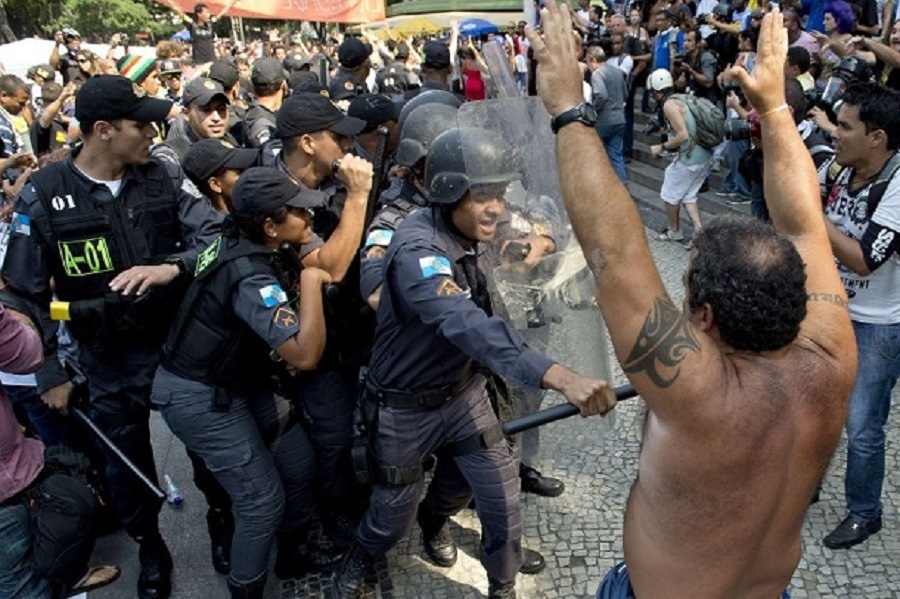
RIO DE JANEIRO, BRAZIL – The Federal Government has excluded from its annual human rights report, Disque Direitos Humanos (Dial Human Rights), the indicators on police violence committed in Brazil in 2019, the first year of the Bolsonaro administration. According to the Ministry of Women, Family, and Human Rights, in charge of disclosure, there is inconsistency in the data collected.
The report is considered one of the main available indicators in the country on human rights violations. Thus, the figures could help understand how the security forces – in particular the state police – behaved in the Bolsonaro management.

It is produced based on complaints made to ‘Disque 100’ (Dial 100), a channel established in 1997, under the responsibility of the federal government since 2003, to address reports of human rights violations in the country. It includes violence of any kind, such as against children, adolescents, and the elderly – and police violence.
“The service can be considered a ‘first-aid’ of human rights since it also attends to serious situations of violations that have just occurred or are still ongoing, triggering the relevant bodies, enabling a flagrant violation,” says a government explanatory note in 2018, on the 15th anniversary of the service under the federal umbrella.
According to experts, this may be the first time the report fails to disclose data on police violence.
In the most recent documents, the indicator had been steadily increasing. In 2016, complaints totaled 1,009 cases, rising to 1,319 in the following year (up 30.7 percent), and by 2018 they had increased to 1,637, up 24 percent.
The relport also includes data on human rights violations committed in police stations, generally the civil police.
For Ariel de Castro Alves, an attorney and member of the group ‘Tortura Nunca Mais’ (Torture Never Again), the non-disclosure option seems to be “something ordered,” aimed at the Bolsonaro bases, “where he has the most support, which is the state police. Mainly the military,” says Alves, “who are the main ones reported”.
Alves qualifies ‘Disque Direitos Humanos’ (“Dial Human Rights”) as the most important document on human rights violations in the country, particularly in the childhood and adolescence area.
“It is unacceptable and unusual not to have police violence on the list of human rights violations,” says Alves, considering the indicator’s history. “If we talk about human rights violations, the first thing we remember is police violence. This is pretending that police violence does not exist in Brazil”.
For the president of the National Human Rights Committee of the Brazilian Bar Association (OAB), Hélio Leitão, the exclusion of these data by the Bolsonaro administration is no surprise, due to the history of lack of transparency in other cases. “It seems there is something to hide.”
“All evidence points to a dramatic increase in police violence and police lethality. This is happening all over the country,” continues Leitão.
“There are data – referring only to one state, where this issue is chronic – that in 2019 police lethality increased 92 percent in Rio de Janeiro. No more, no less than 92 percent.”
The chair of the OAB Committee says he sees a direct link between the increase in police violence and public administrators’ statements, such as the governor of Rio, Wilson Witzel.
“We see a direct relationship between the warnings made by the top executive in relation to a real incentive to violence and police lethality,” says Leitão.
In his opinion, the “phenomenon also starts at the Planalto Palace, when there is a President who encourages this violence discourse, this discourse of eliminating the other”. “This consequence is inevitable.”
Both Alves and Leitão claim to be unaware of any other time when these data have not been released by the federal government.
For prosecutor Antonio Suxberger, an assistant member of the Prison System, External Control of Police Activity and Public Safety Commitee of the CNMP (National Council of the Prosecutor’s Office), the country lacks a solid database for monitoring cases of police violence in order to guide public policy.
According to him, Disque 100 is more of a channel of communication and immediate action rather than a means to build a database.
“We need to qualify and improve the database of public safety departments themselves, as well as the Ministry of Justice. This is the key. Effectively allow us to improve these data and enable us to have the data collated. It is the comparison, it is the echo, and not the sound, that we then compare with other data coming from ombudsmen and services, such as Disque 100.”
OTHER SIDE
Queried, the Ministry of Women, Family and Human Rights said data on human rights violations involving security agents have not been disclosed because “inconsistencies were identified in the records”.
“There are records of a suspect being marked as a police officer, but the information in the description is contradictory, just as there are records that don’t have a marker, but the information is related to a violation allegedly committed by a police officer,” he says.
Still according to the federal government, in order to ensure “the reliability of the data reported,” the records were reserved for in-depth investigation and “subsequent disclosure, without prejudice to other data of relevance to the population”.
“In view of this, we confirm that the data will be disclosed,” he says. The government says there is no estimate of when this will be the case.
The Ministry of Women, Family, and Human Rights said this was a technical decision and was not made in consideration of any specific requests. “The option for later disclosure was technical, to ensure the accuracy of the information, and there was no request for non-disclosure or delay by any authority or body”.
“We recall that the categorization of violations adopted until 2019 remained unchanged from that produced in the Disque Direitos Humanos systems since 2011, and is inherited from previous administrations.”
Source: Folhapress
More: Brazil news in English, every day from The Rio Times.
This article was produced by The Rio Times’ automated newsroom system. How we use AI · Report an error · Editorial responsibility: Matthias Camenzind, Editor-in-Chief