Brazil Required to Invest R$2 Billion to Monitor Spill Disasters at Sea
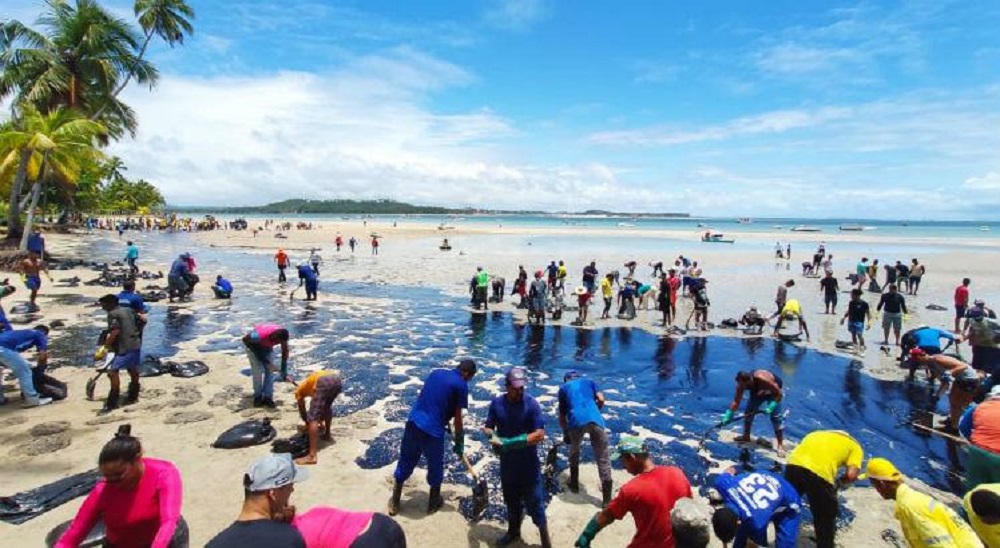
RIO DE JANEIRO, BRAZIL – The commander of the Brazilian Navy, Admiral Ilques Barbosa Junior, says that one of the lessons learned from the crisis surrounding the oil spill along the Brazilian coast is that the country needs to invest in a monitoring system for its coastline similar to what is happening in the airspace.

The cost of the Blue Amazon Management System would be approximately R$2 billion (US$500 million). However, at a time when the country is experiencing contingency of public funds and reduction of expenses in the environmental area, there is no provision for this project to leave the planning stage.
“There are flaws that have been pointed out in the monitoring of merchant ships. This monitoring must follow the example of what is done with airplanes. Today commercial airplanes are monitored. The ships are not,” said the head of the team in an interview this week with a group of five foreign media correspondents based in Brasília.
The Admiral will seek support in Congress so that the next budgets will allocate funds for this system to be developed. He is preparing to testify before the Oil CPI, the parliamentary inquiry committee to be set up in the Chamber to investigate the causes and try to identify those responsible for the environmental tragedy that has so far affected the beaches of the nine states from the Northeast down to Espírito Santo.
Government data points out that approximately 6,000 tons of oil have already been collected from the coast.
In addition to trying to seek more resources, the commander said that a representative of the Brazilian navy planned to make a statement at the international maritime convention, in London, to call for changes in treaties on merchant shipping in the oceans in order to demand better monitoring of vessels as well as to punish criminal activities.
“This issue can happen to any country. This is a new weapon. Do you remember the planes that crashed into the twin towers? It’s an attack of this magnitude.”
In the world, there are approximately 80,000 active merchant ships. According to the Brazilian Navy, it is expected that by 2040 this fleet will have reached 272,000 ships. “If we do not have the positive control of the movement of these merchant ships, the probability of such threats or even terrorist involvement is very high, very high,” said Ilques.
So far, the Navy, the Brazilian Environmental Institute (IBAMA), the Federal Police, and the National Petroleum Agency are investigating four scenarios for this environmental crisis: accidental or intentional spillage during the transfer of oil between oil tankers, sinking of old or new ships, the leaks from deep sea oils wells and the spilling of oil in drums.
The main suspect pointed out by the Federal Police and the Navy was the ship Bouboulina, owned by the Greek company Delta Tankers, which denies any irregularity in its vessel. This ship allegedly sailed between South America and South Africa with the transponder, a tracking device, turned off.
The leak, according to the findings, should have occurred in late July. The first slicks on northeastern beaches were not noticeable until late August, and due to high tide. New slicks are likely to be sighted as of November 26th, according to the Navy commander.
Last Sunday, the Satellite Image Analysis and Processing Laboratory of the Federal University of Alagoas released images showing that another vessel may have been the cause of the oil spill. The authorities do not rule out holding another ship responsible. “The Navy’s approach is as follows: we will go as far as possible to find the culprit. I will even talk to the devil to find out. Whatever it takes, however long it takes,” said the commander.
Source: El País
More: Brazil news in English, every day from The Rio Times.
Editorial responsibility: Matthias Camenzind, Editor-in-Chief · Editorial standards · Report an error