Fernández’s Stance Regarding Maduro Impacts Brazil/Argentina Relationship
RIO DE JANEIRO, BRAZIL – Argentinian President Alberto Fernández has chosen to distance himself from the policy of isolation from Venezuela’s autocratic leader Nicolás Maduro that characterized his predecessor, Mauricio Macri.
The president who came to power in December is also unwilling to be an unconditional ally of the Venezuelan leader, unlike former president Cristina Kirchner (2007-2015), now Argentina’s vice-president.

“The Argentine government deeply regrets the events that took place today in the Bolivarian Republic of Venezuela“, said the Foreign Office in a communiqué issued on Sunday night.
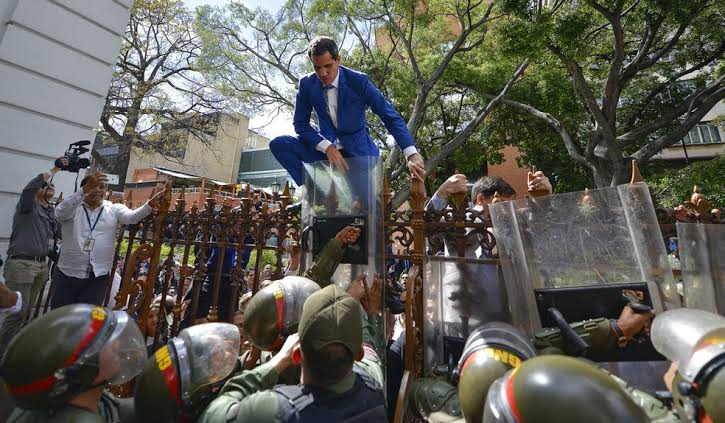
Argentina repudiated the blockade by Parliament and the ruling maneuver that ended with the self-proclamation of the opposition dissident Luis Parra as President of the National Assembly of Venezuela, after his election with the support of Chavists under Maduro.
“The hostile acts suffered by deputies, journalists and members of the diplomatic body when attempting to enter the National Assembly building to elect the new authorities of its presidential board are unacceptable to democratic coexistence,” added the Ministry of Foreign Relations, now led by Felipe Solá.
Fernández’s government avoided speaking of a coup by Maduro in the National Assembly, but urged Venezuelan political forces to restore dialogue “on a basis of full respect for freedoms and institutional mechanisms”.
Argentina’s change of stance left Brazil as the main advocate of the hard-line against Maduro in the Lima Group, founded in 2017 to assist the Venezuelan opposition in its search for a solution to the crisis.
Just six months ago, under the presidency of Macri, the foreign ministers of the bloc’s member countries – including Peru, Colombia, Chile, and Paraguay – met in Buenos Aires to support Guaidó and warn that human rights violations “leave no room for some countries to continue supporting Maduro’s illegitimate regime”.
The Macri supporters, now in opposition, asked Fernández to immediately convene a Mercosur meeting to repudiate the appointment of new parliamentary authorities, a proposal that does not seem to be accepted.
“Preventing the access and the deliberation of the interim president [Juan Guaidó] and of more than 40 deputies by the Armed Forces and police not only delegitimizes the fraudulently elected deputy but also explicitly indicates a real ‘Coup d’Etat’ that cannot be endorsed or consented,” the conservative alliance’ Together for Change’ said in a statement.
Fernandez’s change of regional agenda is not limited to Venezuela, it is also visible with neighboring Brazil and Bolivia. Buenos Aires and Brasília are condemned to dealing with each other for their important bilateral trade, but the lack of harmony between the two presidents could complicate the relationship.
Jair Bolsonaro campaigned for Macri’s re-election and refused to congratulate the president-elect on his victory. Shortly thereafter, he suggested that should the Argentinian government refuse to join the free trade agreement signed between Mercosur and the European Union, “it will have to be removed” as a member of the regional bloc, in which Fernández is currently the only leader who is not from the right-wing.
The relationship with Bolivia is marked by the Argentinian government’s decision to grant Evo Morales asylum. From Buenos Aires, the former Bolivian president, who resigned after losing the support of the Armed Forces, attacks the interim Bolivian president, Jeanine Áñez, on a daily basis and attempts to determine the candidate for his party Movement for Socialism (MAS) who will contest the presidential elections on May 3rd.
The United States, in favor of supporting Áñez and the electoral process, expressed unease over the stance adopted towards Caracas and the refuge granted to Morales.
On December 10th, a representative of Donald Trump’s cabinet flew to Buenos Aires for the inauguration of the Argentine president, but did not attend the ceremony upon learning that a member of Maduro’s government, condemned by Trump’s administration, was among those present.
Some US officials warned days ago that Argentina’s foreign policy could endanger their government’s support for the South American country in negotiations with the International Monetary Fund for debt repayment, and rule out any investment in shale gas and oil in the Vaca Muerta fields.
More: Brazil news in English, every day from The Rio Times.
This article was produced by The Rio Times’ automated newsroom system. How we use AI · Report an error · Editorial responsibility: Matthias Camenzind, Editor-in-Chief