Government Bill Would Permit Extensive Economic Exploitation on Indigenous Lands
RIO DE JANEIRO, BRAZIL – The federal government is finalizing a bill to be submitted to Congress that provides for the exploitation of indigenous lands, one of President Jair Bolsonaro’s campaign pledges.
According to Globo, the proposal authorizes not only mining in these areas, but is much broader: it provides for the possibility of construction of hydroelectric plants, oil and gas exploration, in addition to allowing “the exercise of economic activities by Indians on their lands, such as agriculture, livestock, extraction, and tourism”.
In the case of agriculture, the government’s proposal also enables the cultivation of genetically modified organisms.
Brazil’s 1988 Constitution authorizes mineral exploration on indigenous lands as long as it is regulated by law. However, Congress has never voted on a statute, which has prevented legalized mining in these areas, some known to harbor precious metals reserves, like gold.
The government text states that indigenous people will always be consulted, but will not have the power to veto activities. They will be compensated financially for economic exploitation.
According to the Constitution, the exploitation of indigenous lands “can only be carried out with the authorization of the National Congress, listening to the affected communities, and they will be guaranteed participation in the results of the exploitation”.

The justification for the proposal was sent to the Planalto Palace by the ministers of Mines and Energy, Bento Albuquerque, and Justice, Sérgio Moro.
In the text, they advocate that the non-regulation of the activity “entails harmful consequences for the country,” such as non-payment of financial compensations and taxes; absence of inspection of the use of mineral and water resources; risks to life, health, customs and traditions of indigenous peoples; and conflicts between entrepreneurs and indigenous peoples.
The government’s proposal for mining in areas occupied by indigenous people has faced resistance, amid environmentalists’ concerns and fears over the measure’s international repercussion.
Chamber president Rodrigo Maia said last year that he would not captain projects that make mining on indigenous land more flexible. At the time, Maia said his intention was to signal to the international community that the country is concerned about the environment and native peoples.
The text allows ‘garimpos’ (placer mines) on indigenous lands, exclusively in zones previously defined by the National Mining Agency (ANM). In this case, however, the consent of the affected indigenous communities will be required.
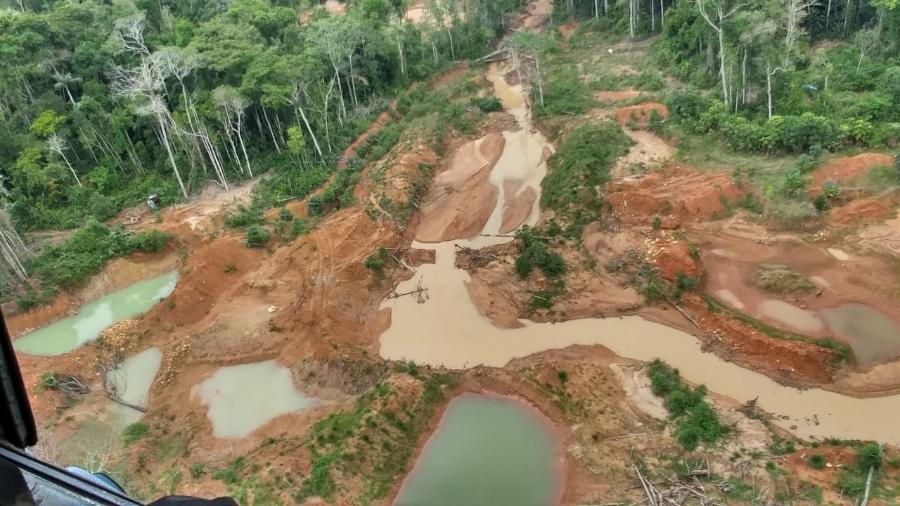
Today, there are 462 regularized indigenous lands, representing 12 percent of the national territory. The presence of illegal mines in some of them is well-known by the authorities. This is the case with the irregular exploitation of diamonds in Rondônia, and of gold in Yanomami areas, in Roraima.
In the case of the electricity sector, of the total hydroelectric potential set out in the sector planning, 39 percent is located in areas overlapping between indigenous lands and conversion units, according to data from the Ministry of Mines and Energy.
The bill provides for payment of compensation to Indians for the exploration of their areas. This will be 0.7 percent of the value of the electric energy produced; from 0.5 percent to one percent of the production of oil or natural gas; and half of the value of Financial Compensation for Exploration of Mineral Resources (CFEM) – the figure varies in terms of minerals; for gold, for instance, the rate today is one percent.
Source: Globo
More: Brazil news in English, every day from The Rio Times.
This article was drafted with automated assistance and reviewed before publication. How we use AI · Report an error · Editorial responsibility: Matthias Camenzind, Editor-in-Chief