The “Chile Effect” Alarms Brazilian Economic Team
RIO DE JANEIRO, BRAZIL – The protests in Chile against President Sebastián Piñera’s government and the dire economic conditions of the poverty-stricken, a crisis that has led to at least 19 deaths, have triggered a new wave of attacks on Jair Bolsonaro’s liberal agenda and that of his Economy Minister, Paulo Guedes.

Since the outbreak of demonstrations, Brazil’s likenesses to Chile have been the motive for criticism that the economic agenda of privatizations, reforms and fiscal tightening could deepen inequality and leave the country in the same situation as Chile, taking Brazilians to the streets.
In reaction to criticism, the economic team is preparing to fight what it calls a mistaken narrative. This defense is regarded as important because the government is about to submit a set of new reforms and there is now concern lest this new, post-Welfare agenda be contaminated in Congress by the anti-liberal discourse.
In a document prepared by experts to strengthen the communication of Guedes’ team, obtained by newspaper O Estado de S. Paulo, the Ministry of Economy rejects this association.
“Chile has better economic and social results than its peers in Latin America. There is certainly room for improvement, but to attribute the recent social protests in the country to a poor economic and social performance, compared to Latin American countries, is not a position corroborated by the data,” says the document.
The text states that, in Brazil, several pro-market reforms are underway, with a central focus on correcting economic and social distortions and careful attention to public accounts. According to the text, they will be responsible for ensuring a decade of growth, reducing poverty and increasing opportunities.
According to Guedes’ team, Chile’s economic growth has been different from most Latin American countries in recent decades, thanks to pro-market measures and the search for the best allocation of the economy’s resources.
As a result, the improved performance of Chile’s Gross Domestic Product (GDP) was not limited to the 1980-2000s, when the country’s major reforms occurred, but has persisted in recent years.
The average growth in Chilean business activity over the past ten years was 3.1 percent, while for Brazil it was 1.5 percent and for Latin America, it was 2 percent. Despite the deceleration recorded between 2011 and 2017, the variation in the Chilean GDP was above the average of its peers in the region.
“Chicago boys”
Guedes’ liberal agenda is always associated with Chile, as the minister is a contemporary of the team of young liberals graduating from the University of Chicago, who reformed the Chilean economy during the dictatorship of Augusto Pinochet. The association with the Chilean group began as soon as the first names of Bolsonaro’s economic team were known.
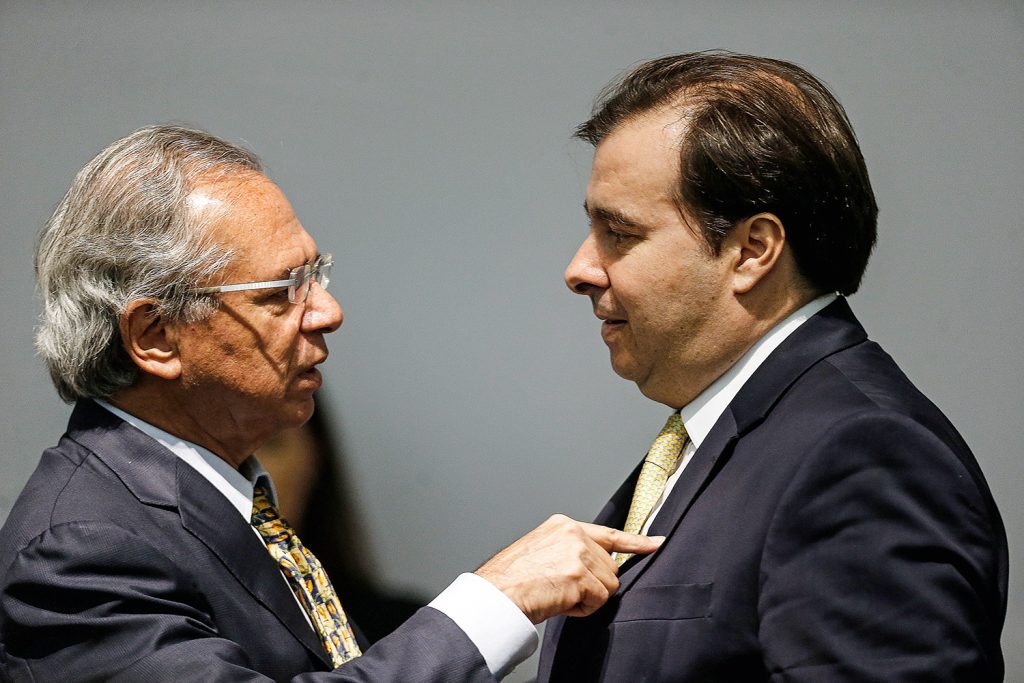
Chamber President Rodrigo Maia told O Estado de S. Paulo that the Chilean liberal movement was built on the foundations of a dictatorship. “The modernization of the Brazilian state is being built within a democracy. It is very different.”
However, Maia believes that progress needs to be linked to improving the quality of life. “It is not an agenda in which we impose our agenda to a closed or silent Parliament that came from Chicago,” said Maia, who was born in Chile, where his father, César Maia, was exiled during the military dictatorship in Brazil.
Maia is preparing to introduce an agenda for the social area, with projects aimed at changes to reduce inequalities. “We need to have an agenda that unblocks the economy and in which we can reduce poverty,” he says.
During the votes in Congress last week, many senators and deputies used the opportunity to attack the government’s liberal agenda. “The economic team sent us a proposal that would put an end to BPC (Continuous Cash Benefit), which had Chile as an example. We have made great progress. Chile is not an example for Brazil,” said Senator Omar Aziz (PSD-AM).
In the course of the Social Welfare reform, the minister’s proposal to introduce the capitalization model (in which everyone saves for their own retirement), adopted by Chileans during the dictatorship, crashed precisely due to the resistance from legislators, as a result of the comparison with the current situation of the most indigent retirees in Chile.
“We have a more than 40-year-old laboratory in Chile. Obviously, we don’t have to repeat what went wrong. What should we do? To bring here what is good and not what is bad,” said Rogério Marinho, secretary of Social Welfare and Labor. He believes that, sooner or later, capitalization will return to the debate.
Source: O Estado de S. Paulo
More: Brazil news in English, every day from The Rio Times.
This article was produced by The Rio Times’ automated newsroom system. How we use AI · Report an error · Editorial responsibility: Matthias Camenzind, Editor-in-Chief
Brazil runoff, Sunday, October 25: Brazil runoff date. Latest: Brazil runoff polls, Flávio 51%, Lula 49%.