Transparency International Says 82 Percent Believe Fake News was Used in Brazil’s Elections
RIO DE JANEIRO, BRAZIL – The figures can be found in the Global Barometer on Corruption: Latin America and the Caribbean, released on Monday, September 23th, around the world. In Brazil, the survey was conducted in the first months of President Jair Bolsonaro’s government.
A thousand people in Brazil were heard between February and April by the IPSOS Institute. The survey has a margin of error of 2.8 percentage points, plus-or-minus, with 95 percent reliability.

Among the 18 countries taking part in the survey in Latin America and the Caribbean, Brazil appears near the top in this category with 82 percent in answers agreeing there was “false information or false news being circulated to influence voting results”. The Bahamas scored 85 percent in this category.
Argentina ranks just behind Brazil, with 81 percent, and Venezuela, with 80 percent; however, it is worth noting that, given the margin of error, the four countries are in a virtual tie for the lead. The nations with the lowest rates are Costa Rica (52 percent) and Chile (59 percent).
“In this fake news question, Brazil has, in fact, a frightening result. People talk about how often fake news is used to influence the country’s political results.”
“This is undoubtedly due to that moment during the 2018 elections in which fake news was rampant,” said Guilherme France, the survey coordinator in Brazil, in an interview with UOL.
Among the institutions evaluated as corrupt, Congress leads (63 percent), behind local government representatives (62 percent) and the President of the Republic (57 percent). In the case of the presidency, between 2017 and 2019, there is an increase of five percentage points – the previous survey was conducted shortly after the impeachment of former president Dilma Rousseff (PT).
For the first time, the survey also asked about the corruption of journalists. Brazil shows a 23 percent share. “About this press data, the survey shows that the media is one of the institutions that the population sees as less corrupt when compared to the other institutions evaluated. But this figure also reflects the existing campaign in certain sectors of society, not only against the press but also against civil society,” says Mr. France.
Among those interviewed, 36 percent stated that there is corruption in non-governmental organizations. “This figure reflects the impact of this collective campaign to criminalize the press and civil society,” says France.
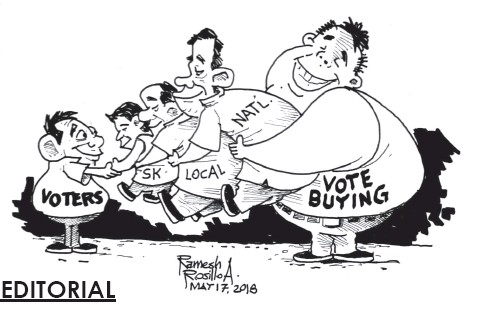
The Transparency International report also highlights that in Brazil, 40 percent of respondents reported having received bribes in exchange for votes. It is the third-highest number in the region, behind Mexico (50 percent) and the Dominican Republic (46 percent).
Venezuela shows up with 26 percent and is the only country where the survey was conducted with paper and pen; the remainder was done digitally. The Bahamas was the only place where the study was conducted by telephone.
France explains that the question regarding people’s experience with buying votes involves the last five years, i.e., 2014, 2016, and 2018 elections.
“It is a high number, all the more so if we think that the issue of vote-buying in Brazil has been a longstanding problem. The law against buying votes is 20 years old and is still a significant problem. Maybe it’s no longer that traditional vote-buying, but in exchange for favors, services, a basic food basket,” says the researcher.
The Transparency International survey also shows that more than half of the Brazilian population still believes that corruption has increased in the 12 months before the survey period; that is, 2018. In 2017, this number reached 78 percent.
Among the Brazilians who participated in the survey, 48 percent consider that the government is acting positively in the fight against corruption – in 2017, this number was 35 percent.
Another 46 percent think that the government is not acting adequately in the fight against corruption – this figure was 56 percent in 2017.
“While the question on the growth of corruption covers the past 12 months, we consider that the question on the government’s performance in the fight against corruption already reflects the first measures of Bolsonaro’s government,” explains France.
In Brazil, 84 percent of respondents said that an ordinary citizen could make a difference in the fight against corruption.
However, 12 percent of those surveyed reported paying bribes to police officers; 11 percent pointed to paying bribes to access essential public services; 5 percent to judges and 4 percent to public schools.
More: Brazil news in English, every day from The Rio Times.
This article was produced by The Rio Times’ automated newsroom system. How we use AI · Report an error · Editorial responsibility: Matthias Camenzind, Editor-in-Chief
In depth
Brazil runoff, Sunday, October 25: Brazil runoff date. Latest: Brazil runoff polls, Flávio 51%, Lula 49%.