Volkswagen Announces Plan for Production and Sales of Electric Trucks in Brazil
RIO DE JANEIRO, BRAZIL – Volkswagen Trucks and Buses announced this Wednesday, October 2nd, in Södertälje, a city located approximately 30 km from Stockholm, the Swedish capital, the plan to sell electric trucks in Brazil starting next year.
The models will be developed and manufactured in the country.
The project includes not only new products but also components and after-purchase services, with installation and operation of recharging points throughout Brazil and measures for battery disposal after the end of its useful life.

Called an e-Consortium, the plan is based on a partnership with several companies. The concept is already used in the production of trucks and buses at the Resende plant (RJ), with suppliers working directly in vehicle production.
For electric vehicles, the new feature is that Volkswagen’s partners will also act in the post-sale.
Among Volkswagen’s partners are Siemens, supplying electric chargers, and Moura, which will assist in the handling of the batteries. German Bosch and Brazilian WEG will be in charge of the electric set.
The e-Consortium is part of a R$1.5 billion (US$375 million) investment that the company is making in Brazil.
“Based on this type of construction, which we started more than 20 years ago, we will take a new step”, says Roberto Cortes, president of Volkswagen Trucks and Buses.
Releases
Also new is the release of an electric truck with the capacity to carry up to four tons. It is a smaller version of the e-Delivery, introduced two years ago, running on a pilot project through the streets of Brazil.
The new model will have an electric 116hp engine and 28.6 kgfm as well as 200 km autonomy. A difference in relation to the larger truck is its front-wheel drive.
It will also be equipped with an integrated charger, which allows supplying the batteries even where there is no ready structure.
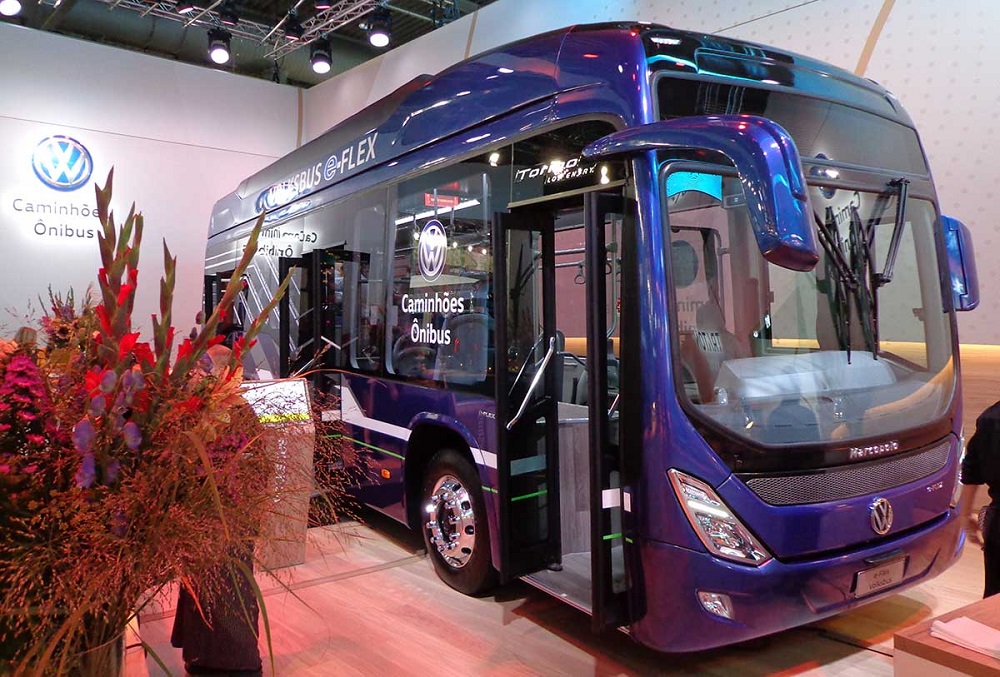
There is also an urban bus called e-Flex. It has an electric motor of 300 hp and 225 kgfm of torque. A roof-mounted battery pack may also be supplied by a 1.4 turbo engine supplied by Volkswagen’s automotive division. It has 150 hp, and may be flex or powered by natural gas.
Both models should reach the Brazilian market in the coming years, with the possibility of exporting to other countries.
Gaining experience
The smaller of the e-Delivery was developed based on the experience acquired with the larger version.
So far, the unit delivering drinks to the AmBev brewery has traveled more than 15,000 km. According to Volkswagen, it stopped emissions of 11 tons of carbon dioxide (CO2), in addition to having saved 3.3 thousand liters of diesel.
Volkswagen also says that 43 percent of the energy used by the truck came from the braking process. The amount is almost double what the company expected.
The first e-Delivery vehicles will be sold to the public next year, in 11 and 13-ton versions. Therefore, the Resende plant is already being prepared.
“We use a good part of the existing production line. We have only completed a new stage to insert the electrical components, which need other safety precautions”, says Cortes.
For Christian Levin, chief operating officer of Traton, a group formed by Volkswagen Trucks and Buses, in addition to Scania and Man, “the energy use efficiency is the key to the success (of electric trucks and buses)”.
“The batteries will remain expensive and heavy, so it is crucial to optimize the relationship between batteries and energy use,” added Levin.
The manufacturer did not mention prices but said that savings in consumption range from 50 to 70 percent compared to a diesel-like truck. In addition, maintenance is 50 percent cheaper.
As a result, they believe that in the case of an urban truck, such as the one used by the brewery in Brazil, the vehicle’s additional cost will be reimbursed in approximately five years.
Today, urban trucks remain in companies’ fleets for three to five years.
Modular production
Volkswagen’s “trick” to creating a line of electric trucks is the modularity.
There are 3 modules, which can vary according to customers’ needs: front (cabin), center (batteries) and rear (driveline). They can be combined, resulting in greater load capacity, power or autonomy, for instance.
The development of the 4-ton e-Delivery took only 4 months. ” Modularization will revolutionize the way we work,” said Christian Levin.
Source: Globo
More: Brazil news in English, every day from The Rio Times.
This article was produced by The Rio Times’ automated newsroom system. How we use AI · Report an error · Editorial responsibility: Matthias Camenzind, Editor-in-Chief