Women Hit Streets to Protest Rights, Against Femicide Culture and Bolsonaro
RIO DE JANEIRO, BRAZIL – Women in Brazil have not yet succeeded in crowding the streets to the same extent as their peers in Argentina, Chile, or the United States and Spain, when it comes to fighting for women’s rights – or feminists.
However, on Sunday, March 8th, protests organized in more than 70 cities in the country intended to mark the position of Brazilian women who identify with the feminist agenda and feel threatened by the current government’s retrocession.

Criticism of President Jair Bolsonaro’s policies were among the slogans of several demonstrations, such as Women against Bolsonaro, the World March of Women and the collective Juntas (“Together”). The protest also marked an outcry against the increase of femicide in Brazil, the world’s fifth deadliest country for women.
Although the total homicide rate is dropping, violence against women has grown over the past year. Data compiled by Folha de S. Paulo newspaper shows that femicide increased by 7.2 percent in 2019.
In total, there were 1,310 victims of domestic violence due to their gender. In 2018, femicide had already increased by four percent, according to data from the Brazilian Annual Report on Public Safety. Every hour, four girls up to 13 years old are raped in the country.
In São Paulo, the protests took place at 2 PM on Paulista Avenue. President Bolsonaro’s blatant attack on women journalists, such as Patricia Campos Mello and Vera Magalhães, also figured on the agenda, as did the specific demands of black women, who suffer from an even more vulnerable social and economic situation.
“There is no denying that there are specific agendas for black women, since there is inequality among women in Brazil.
It is the black women who die the most, the ones who are imprisoned the most, the ones with less access to health and the ones who earn the least,” explains Juliana Gonçalves, one of the organizers of the black women’s march in São Paulo.
Black or mixed race women continue to be at the bottom of the income inequality in the country. In 2018, they earned, on average, less than half the wages of white men (44.4 percent), who top the wage scale.
Speaking of the specificities of black women was, for a long time, regarded as something that did not add to the struggle, but divided the feminist movement, according to Gonçalves.
“But when we don’t talk about it, we ignore the more precarious and vulnerable conditions that are more intense in the life of black women,” she says. However, she explains that in recent years, this debate has improved. “White women have greatly increased their awareness. It’s an improvement, black indigenous women came forward in 2018,” she says.
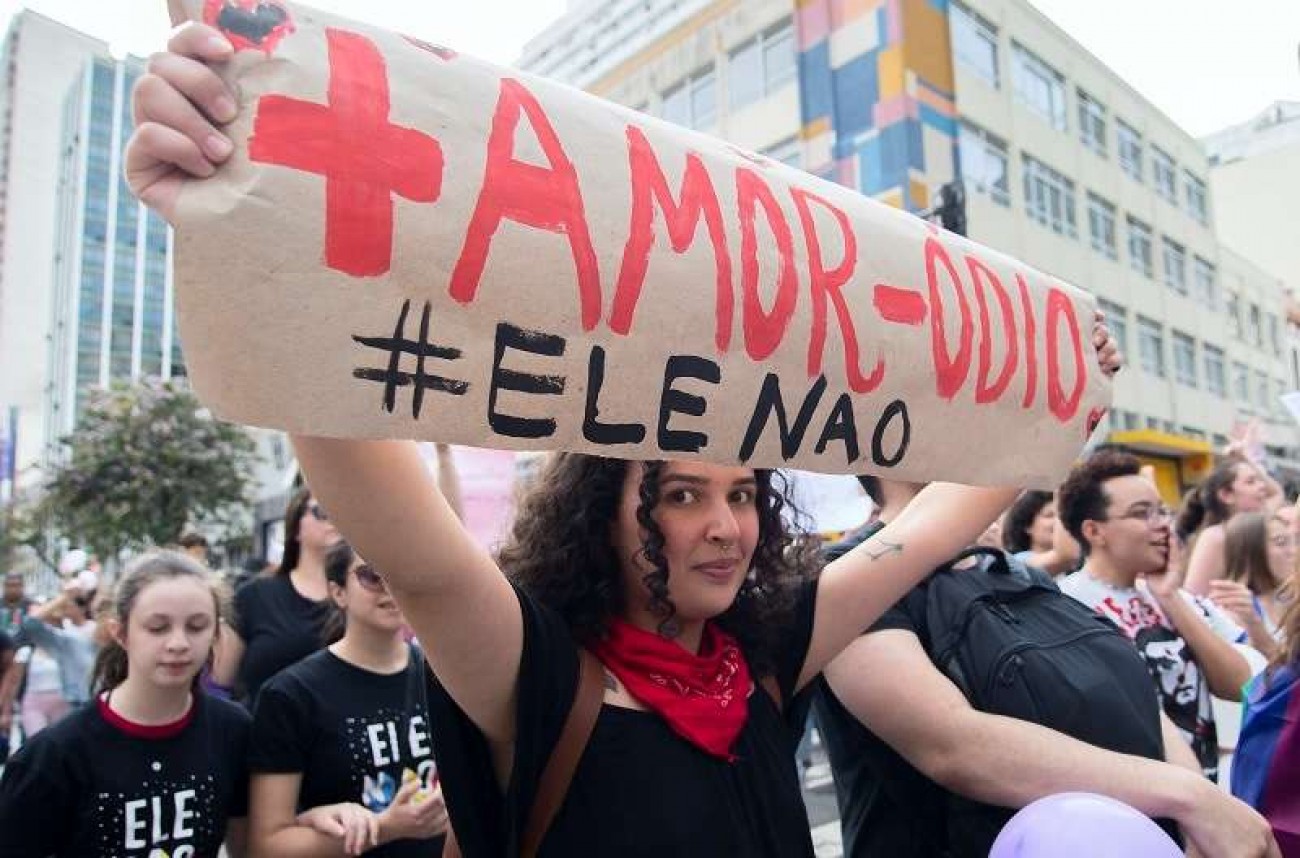
However, the representative of the black women’s movement believes that there is still a long way to go, since many white women who call themselves feminists reproduce a sexist discourse. “In Big Brother there is a racist situation against Babu. There is no way of being feminist and not being anti-racist”.
According to Gonçalves, when the leader of a nation legitimizes the homophobic, racist discourse, which has always been part of society, it is time to take to the streets. “To be part of March 8th is a way of crying out our fight. It is a way to reiterate the democratic values at risk.
“We will also march on July 25th, the international day of the Latin American black woman, and on March 14th, when the barbaric murder of Marielle Franco completes two years unsolved,” she says.
Femicide
Since 2015, when the femicide law was created, the number of murders of women has risen. According to a number of experts, femicides have indeed increased, while others argue that only the number of records has risen. To Gabriela Mansur, a prosecutor and specialist in women’s law, although violence against women is on the rise, the increase in femicide records is the result of the police being more familiar with the law and handling cases correctly.
“But we cannot turn a blind eye to this situation. The more voice and power women are gaining, the more violence they are also suffering. We need to change the whole society. We need more investment in education and in public policies aimed at equality,” says Mansur, who alerts that the issue should be a priority agenda in the country and not only raised on international women’s day or when a serious case occurs,” she says.
The murder of Marielle Franco and her driver Anderson Gomes, for instance, is one of the events that are driving protests – there is another scheduled for the 14th, when the execution of the Rio City Councilor will complete two years.
Mansur believes that the country today has an evolving legislation to protect women, with the criminalization of harassment, the introduction of femicide, the Maria da Penha law (against domestic violence) and a new law that compels health professionals to report evidence of violence against women to the police within 24 hours.
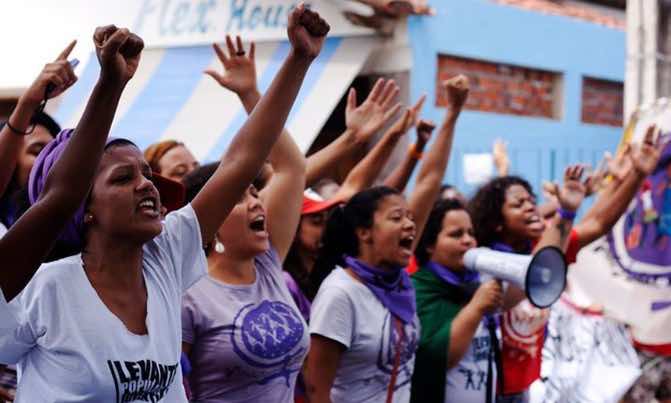
“Fortunately, today we are witnessing a greater commitment from society to the issue. In São Paulo, we have the example of the program Tem Saída (There is a way out), which relies on the support of private companies that offer jobs to women in situations of domestic violence to generate financial independence. We are more and more united in taking up our space”, she explains.
Luiza Eluf, a criminal attorney and author of legal books on sex and passion crimes, agrees that the country has made great progress in recent years in protecting women, but the laws need to be better enforced. “We have very clear notions and very precise laws that impose women’s rights. We still need to comply,” says the retired prosecutor.
Luiza laments that the pattern of Jair Bolsonaro’s government’s behavior is one of disrespect for women and that attacks, such as those made upon female journalists (Partícia Campos Mello and Vera Magalhães) are so persistent. “The president uses women as useful objects and is not concerned about insulting them on their sexuality,” she says.
The attorney sees the government’s approach to the subordination of women as a major step backwards. “Damares Alves, the Minister of Women, Equality and Human Rights, who takes care of women’s public policies, has not yet realized the need to regard women as a full human being with the right to self-determination. She sees a woman as subordinate to her husband or the man next to her,” she says.
Damares has been questioned about Bolsonaro’s attacks on women, like journalist Patricia Campos Mello, but the Minister has always justified the President’s actions.
Despite the effort to increase its presence on the streets, the feminist movement in Brazil today is more closely associated with left-wing agendas in the country, which has driven away women who mistake the protest for reproductive rights, labor guarantees or the same democracy as partisan political actions. This us a challenge for Brazilian feminists, who perceive the neighboring countries’ organizations as a model.
Chileans and Argentineans are becoming more and more the protagonists of street movements. In recent months, massive protests for women’s rights have progressed in several countries in the region, focusing on equal rights and against gender violence.
In Chile, the performance “Un violador en tu camino” (“A Rapist in Your Path”), by the LasTesis collective, broke barriers and spread worldwide. In Brazil, the feminist struggle also throbs with changes within the legal system, but it has not yet gained a significant expression in the streets as abroad. This Sunday was a new test.
More: Brazil news in English, every day from The Rio Times.
This article was produced by The Rio Times’ automated newsroom system. How we use AI · Report an error · Editorial responsibility: Matthias Camenzind, Editor-in-Chief