Argentina Starts Gradual Release of Compulsory Quarantine
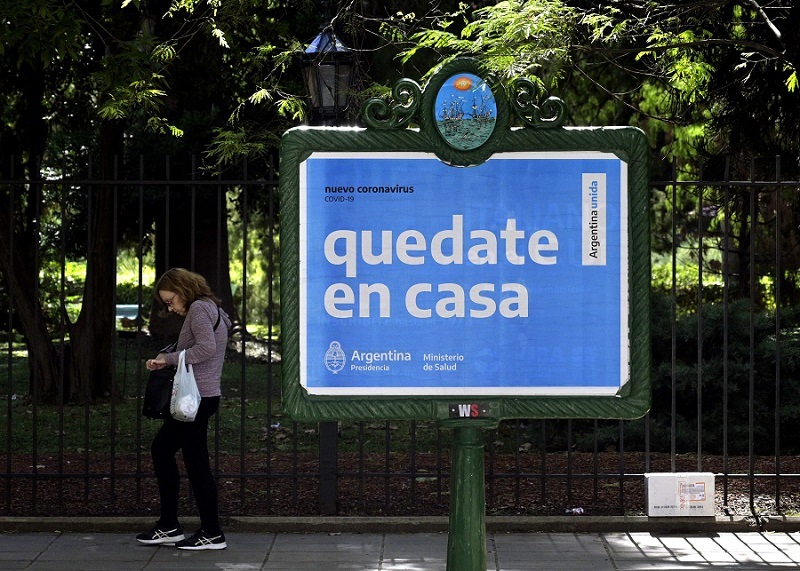
RIO DE JANEIRO, BRAZIL – Argentina has relaxed the confinement in place since March 20th, albeit not by much. After almost 50 days of compulsory quarantine, the strictest and most extensive in the region, Alberto Fernández’s government has begun to open up activities in most of the country gradually, but will maintain confinement in the city and province of Buenos Aires, the two most affected districts.
The partial opening coincides with the progressive slope of the contagion curve. On Friday, Argentina recorded 240 positive cases of covid-19, the highest figure since the start of the pandemic. There are 293 deaths and the total number of people infected reaches 5,611.

Fernández withstood pressure from business leaders, various economists, and unions, who have warned in recent weeks that quarantine has brought the economy to the brink of collapse.
“They won’t twist my arm, I will take care of people first and foremost. We will end this discussion in which they want us to believe that if we open the economy we will be better off. There are people overwhelmed with anxiety over opening up the economy disregarding their health,” the President said.
Argentina has two provinces with no cases of coronavirus and large regions where the rate of contagion multiplies every 25 days. But the reality is very different in Buenos Aires and its suburbs, a consequence of demographic density. “This region accounts for 86 percent of cases. We cannot, in the name of the economy, open everything in Buenos Aires”.
The quarantine will run until May 24th, but the map will be diverse. “The decree we are publishing states that all of Argentina, except the Buenos Aires metropolitan area, is moving into a new phase. Buenos Aires and its suburbs will remain as they have been until now”.
“Transport is still banned, except for those who perform essential work. In the interior of the country, the decision to open industries and shops is in the hands of governors and mayors. What we do in the presidency is to enable opening protocols”.
This Friday’s quarantine extension was the fourth in a row. But unlike earlier occasions, it merited a private performance. Fernández was accompanied by the political leaders of the two most populated, wealthiest, and most affected districts: the governor of Buenos Aires, Axel Kicillof, and the Mayor of the city of Buenos Aires, opposition leader Horacio Rodríguez Larreta.
In addition, for the first time, the government health advisors were on stage. “I value the joint work we are doing,” said Rodríguez Larreta, in an unprecedented gesture in Argentine politics. “Quarantine continues in the city of Buenos Aires. But we will be adding that on weekends children will be able to go out for a walk with their parents. That doesn’t mean they’ll meet with friends, and the squares will remain closed,” Rodríguez Larreta said.
Argentina was one of the first countries in Latin America to decree the total shutdown of economic activities and the confinement of the population on March 20th. Quarantine has flattened the contagion curve to such an extent that there are now health care workers who question whether the much-feared peak will ever come. But success was also a major obstacle for the economy of a country that this year will experience its third consecutive drop in GDP.
Positive cases have skyrocketed in the city of Buenos Aires in the past week, caused by infections in slums. The two most affected have 280 and 100 confirmed cases.
Overcrowding in homes, where four or five people often share a room, and frequent cuts in water supply make these neighborhoods an easy target for the rapid spread of the coronavirus.
Social organizations accuse the Buenos Aires government of not having acted on time to isolate the most vulnerable population, the elderly, and people with previous pathologies.
Source: El País
More: Brazil news in English, every day from The Rio Times.
This article was produced by The Rio Times’ automated newsroom system. How we use AI · Report an error · Editorial responsibility: Matthias Camenzind, Editor-in-Chief