Argentina to Renegotiate Debt With IMF and Other Institutional Creditors
RIO DE JANEIRO, BRAZIL – After another day of economic turmoil, the government of Argentina announced on Wednesday, August 28th, that it had requested that the International Monetary Fund (IMF) revise the maturities of a US$56 billion loan, which should begin to be repaid in 2021.
The government further announced that it intends to extend its short-term debt to legal entities, such as banks and insurance companies, which own ten percent of these securities. Individuals, who hold ninety percent of the short-term debt, will not be affected.
“The priority today is to ensure stability because it is useless to introduce reccovery measures if there is no stability,” said Finance Minister Hernan Lacunza, who took office last week.

According to the Argentine government’s proposal, short-term debts to individuals will be paid in full. Short-term debts with legal entities will be paid using the following formula: fifteen percent at maturity, 25 percent three months after maturity, and sixty percent six months after the original term.
Finally, long-term foreign debt, such as the loan granted by the IMF, will be rescheduled, with a request for a term extension. In this case, the creditors’ acceptance is voluntary, according to the Argentine government.
Lacunza also estimated that negotiations with the IMF could start under President Mauricio Macri, but would “inevitably” end under the next government, which will begin on December 10th.
The Finance Minister said, however, that the start of talks would not alter the fulfillment of the current targets already set for the Fund.
Financial Turmoil
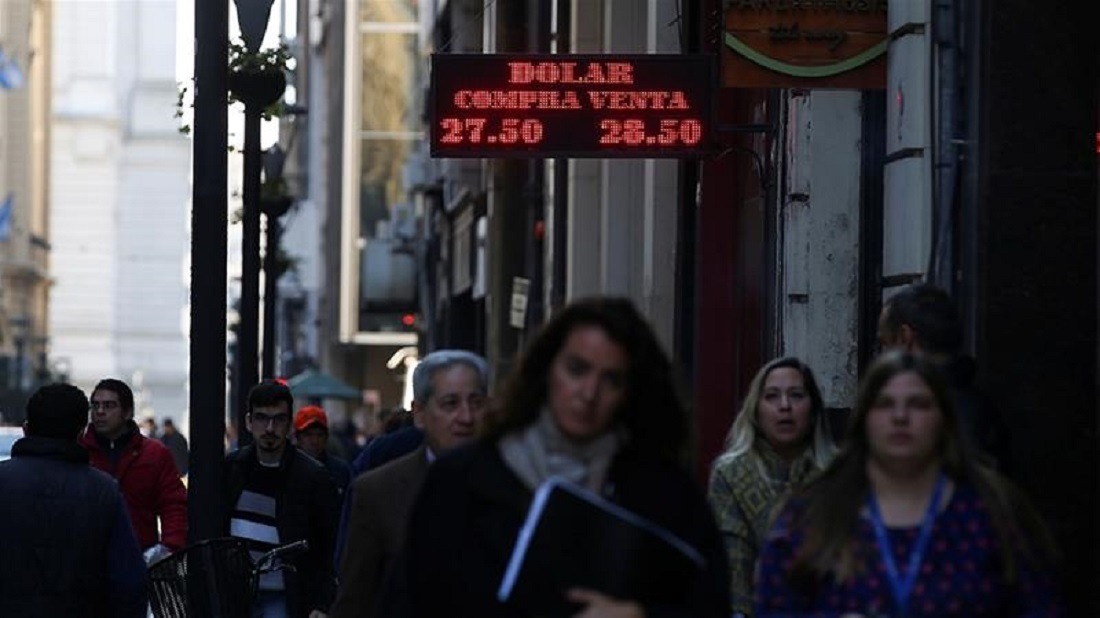
Argentina has been going through severe financial turmoil, with a depreciation of the peso in excess of twenty percent and an increase in country risk. The picture worsened after President Mauricio Macri suffered a defeat in the primary elections on August 11th for Kirchenerist candidate Alberto Fernández.
On Wednesday, August 29th, the dollar exchange rate exceeded sixty pesos, despite the Argentine Central Bank offering over US$350 million for sale. The country risk, on the other hand, shot up more than 2,100 points.
The use of the terms “debt rescheduling” instead of “restructuring” or “moratorium” has confused Argentine commentators and economists.
Asked about the meaning of the terms after presenting the measures, Lacunza said: “The rescheduling is a voluntary negotiation to extend the term in the case of medium and long term debts. It is to change maturities, but not the remaining conditions.”
For economist Miguel Boggiano, the “rescheduling” is “a change in the maturity date of the debt. In a short-term debt, changing the repayment date means that interest continues to run for institutions, while individuals will be paid.”
Economist Camilo Tiscornia described it as “a euphemism,” and added: “In fact, what they are doing is getting ahead of the game.”
He says there is a difference between the measure announced by the minister whether the case refers to short or long term bonds. “In long-term bonds, the creditor is given a chance to exchange old bonds for new ones. In the case of short-term bonds, the terms of the agreement are changed without the creditor’s acceptance.”
Central Bank President Guido Sandleris, who spoke earlier yesterday evening, said the announced measures “prioritize the use of international reserves to preserve monetary and financial stability, even if it means postponing the repayment of the public debt to large investors.”
Four Measurements
For those who have the Letes, Lecaps, Lecer and Lelinks bonds, that is, short-term debt, fifteen percent will be paid on the due date, 25 percent three months later and sixty percent after another six months.
A bill will be brought to Congress providing the necessary tools to promote a voluntary “rescheduling” of capital maturities under local jurisdiction, without deductions, only with the extension of the terms.
There will be a “rescheduling” of bonds governed by foreign law, containing reciprocal action clauses, with the same purpose of extending maturities, without interest rebates, in order to complete a less demanding financial profile for the period 2020-2023, which generates financial relief to implement economic and social policies that induce the country on a path of sustained growth.
Argentina will meet all the fiscal and monetary targets contained in the IMF agreement to pursue the current agreement. The government has proposed to start talks with the IMF, which should inevitably be concluded by the next government, in order to reshape the debt.
More: Brazil news in English, every day from The Rio Times.
This article was produced by The Rio Times’ automated AI newsroom. Editorial responsibility: Matthias Camenzind, Publisher and Editor-in-Chief. The Rio Times also runs Ask Rio Times, which answers from 100,000+ of our own articles, the daily Latin America Power Map, and prediction-market odds on elections and markets.. How we use AI · Report an error
Brazil runoff, Sunday, October 25: When is the Brazil runoff election. Latest: Brazil runoff polls, Flávio 51%, Lula 49%.