Chile Is Burning, Yet No One Knows How to Put Out the Fires
RIO DE JANEIRO, BRAZIL – Social unrest in Chile exploded on October 18th, a date that will be remembered in the country’s history. It first broke out in the form of student protests against an increase in Santiago’s subway fares, with crowds jumping the turnstiles without paying.

Second, violence erupted: in only a few hours, 118 of the 136 subway stations were destroyed, 25 were set on fire and seven were completely burned, with losses estimated at US$376 million (RS$1.5 billion).
Third, supermarkets and other commercial establishments were looted, whereby the Ministry of the Interior lodged 175 criminal charges in the capital alone.
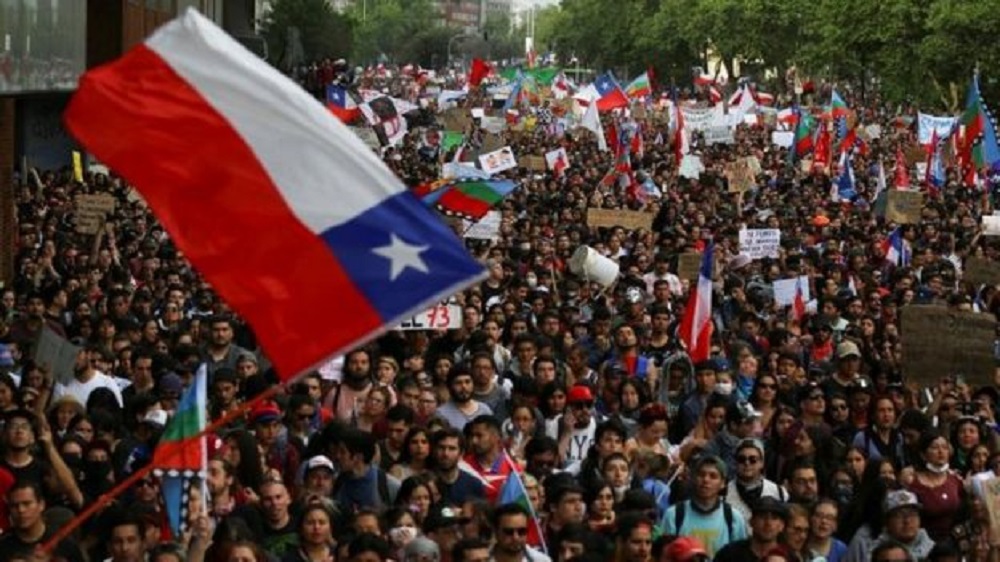
Fourth: the peaceful demonstrations – Chile’s largest ever – that gathered 1.2 million people in the heart of the capital only a week into the social upheaval .
But after 20 deaths, 592 civilians wounded, hundreds of detainees and denunciations of human rights violations, neither the government nor the opposition are able to address the dissatisfaction of Chilean society, facing inequality on all fronts. The protests and violence are unrelenting.
“The problem is still that Chilean politics has closed itself in a bubble,” says historian Iván Jaksic. “There is a discrediting of politics and malaise takes on increasingly worrying forms (…). We are experiencing a situation in which the triumphalism of economic discourse coexists with the disappointment of those who do not see its benefits, and where expectations are growing”.
What we have seen since October 18th is a complex conflict with multiple causes, which is partly explained by a society that demands public goods and services within everyone’s reach. This is not the case today: the military dictatorship (1973-1990) established an exclusively pro-market model and allowed the private supply of goods and services which, in many other economies, usually lie with the public sector, such as education and pensions.
The divorce between Chileans and those who presumably represent them – both the governing parties and the opposition – seems to be yet another cause of the population’s anger, felt on the fringes of the development path of the past three decades. But it also largely explains Chile’s difficulties in finding a way out of this crisis, the greatest since the return of democracy in 1990.
During these 15 days, center-right President Sebastián Piñera took a long time to understand the backdrop of his countrymen’s anger and, at first, focused his speech exclusively on public order, in the face of the intense violence that shattered the city.
He called the military to the streets in a complex political decision: the armed forces had not left the barracks to take control of the cities since the dictatorship, except in the event of natural disasters. Later, he repented and apologized on behalf of the political class for the lack of vision of the problems that had been building up.
He announced a broad package of social measures, such as an immediate 20 percent increase in pensions for 1.5 million people. He changed his Cabinet and centered his efforts on his political and economic team, although it was not a radical move.
So far, at least, his actions continue to seem insufficient. His popularity is reflected in the fact that the population has punished him and his support plummeted to a historical record low of 14 percent.
Daniel Mansuy, PhD in Political Science and professor at the University of Los Andes, speaks of an accumulated and widespread discontent:
“This crisis has persisted for so long because the ruling class in general, and politics in particular, have not yet been able to organize, contain or direct this discontent,” he says. “The crisis persists because the population does not feel understood by anything or anyone who can provide it with an institutional channel. It is serious.”
The opposition is divided and, in the population’s opinion, has not performed any better. The survey conducted by the Cadem institute, which reported a 14 percent popularity rating for Piñera, also showed that all leftist and center-left parties rank below this percentage, with the exception of the Frente Ampla (Broad Front), which achieves 16 percent approval — only two points above that of the president.
Frente Ampla is a new political pary coalition inspired by Spain’s Podemos, but it has failed to capitalize on Chile’s discontent, evident since at least 2006, with the first student protests.
In the early days of the crisis, the Socialist Party, a key member of the Concertación party coalition that ruled Chile between 1990 and 2010, refused to take part in the meetings called by the president in an attempt to find a way out of the emergency, arguing that it would not do so while there were soldiers on the streets.
The Frente Ampla and the Partido Comunista – which was part of Michelle Bachelet’s second government together with the center-left – are seeking to push a constitutional motion in Congress to overthrow Piñera. “It’s a parliamentary show. The political class remains involved in small arguments, which is exactly what is bothering people,” said Mansuy. “Moreover, at first, the opposition took a long time to denounce the violence and was very ambiguous, which is part of the political problem we are facing”.
So far, the Chilean movement has lacked coordination: neither leaders, nor spokespeople, nor a list of specific demands. Different interests and needs concur in their petitions. While the political class seeks the appropriate diagnosis and solution, some citizens are meeting in assemblies to discuss lines of action.
Source: El Pais
More: Latin America news in English, every day from The Rio Times.
This article was produced by The Rio Times’ automated newsroom system. How we use AI · Report an error · Editorial responsibility: Matthias Camenzind, Editor-in-Chief