Chilean Youths Revolt Against “Neoliberal” Social Model Inherited From Pinochet
RIO DE JANEIRO, BRAZIL – The Chilean uprising is a matter for ‘muchachos’ (youths). Sometimes, almost children. Students have been rebelling for over a decade against the educational system implemented by Augusto Pinochet and against the legacy of the dictatorship. This time, they have garnered the support of a large portion of Chilean society.

“We have become accustomed to violence, we have nothing to lose,” says Víctor Chanfreau, 17, spokesman for the assembly of high school students. “Neoliberalism was born in Chile and will die in Chile”.
On the streets of Santiago, devastated after almost five weeks of protests and wreckage, the battles are daily. Both the Army and the Carabineros [militarized police], known as Pacos, acted with a harshness that borders brutality during the state of emergency. Twenty-three people have died throughout the country.
More than 200 people have lost their eyes or suffered serious eye injuries because the security forces do not hesitate to fire non-lethal bullets. But young people are still demonstrating. The wounded receive medical attention in makeshift centers.
“They have a bravery that we, intimidated by the experience of the dictatorship, could not have,” said Carla Peñaloza, a doctor of history and professor at the University of Chile.
We had to talk to Peñaloza in an off-campus café because the University building was taken over by the students. It’s an organized occupation, and a friendly receptionist sits at a table that blocks the entrance. Outside there is a teacher demonstration.
The atmosphere seems to be typical of a revolutionary state. “All this sometimes tires and frightens us, but the normalcy we were living in was false; reality is what we are living now,” says the teacher.
Pinochet promulgated the Organic Constitutional Law on Education, published in the Official Gazette on March 10th, 1990 – the very day in which the dictator surrendered the presidency to Patricio Aylwin. His last legacy was an education system that delegated public education to the municipalities and favored segregation between centers for the wealthy and centers for the impoverished, in addition to limiting state spending, which even today, after several reforms, remains the lowest among the OECD countries.
It was an education adjusted to fit neoliberal dogmas. Students need years or decades to pay down the loans permitting them to pay for their private university courses.
The first major student explosion occurred in 2006. It was the so-called penguin revolution because of required black-and-white school uniforms. Over 400 learning centers closed, and 600,000 young men took part in the marches and strikes on May 30th: it was the great crisis that inaugurated the presidency of Michelle Bachelet, a former victim of the dictatorship who had just reached the La Moneda Palace.
The youth rebellion exploded again in 2008, 2011, 2012, 2015, and 2018.
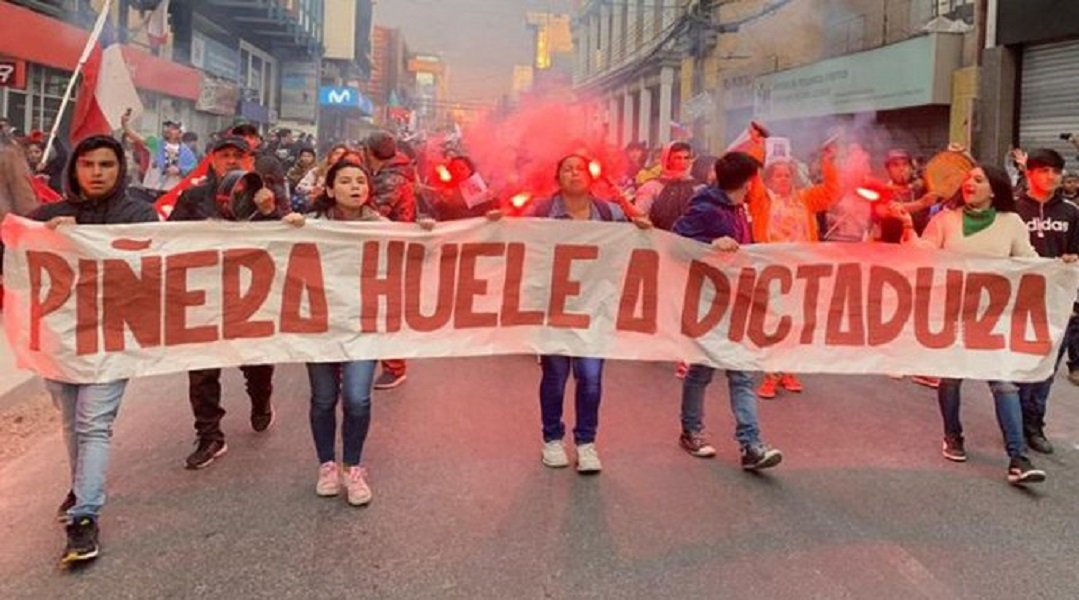
The current president, conservative Sebastián Piñera, had a plan to end the student rebellions. His Safe Room law, passed last year by Congress, allowed the expulsion of students who carried some kind of weapon, committed some form of aggression, or caused “damages to the infrastructure”.
In practice, the rule allowed for the expulsion of those engaging in acts of protest, such as the occupation of a school. As a result, many young men realized that they should not expect anything from the presidency or legislators. Today, Congress is an institution devoid of any prestige among young protesters and, according to various studies, is perceived by the majority of society as virtually irrelevant.
Many deputies ascribe the issue to the inability to end the constitutional adjustment imposed by Pinochet.
The social Darwinism bequeathed by the dictatorship – the cult of that which is individual and private, as against collective and public – marked a generation. “In the demonstrations of the last few days, I experienced for the first time in my life a feeling of community,” says a young author born when the dictatorship was turned into a democracy supervised by Pinochet from the Army headquarters.
Divergent opinions
The young woman prefers not to provide her name. It is a frequent caution. Maybe because of a (justified) distrust of the press, maybe because of a fear of expressing opinions that diverge from the collective feeling. A group of students sitting on Providencia Avenue and blocking traffic at noon also prefers their comments to be credited to “us”.
“We want this unjust system to end now, for the repressors to pay and for Chile to stop being the property of the cuicos [upper and dominant class],” says a teenage girl in uniform, just before the Carabineros dispersed the group with water jets.
The students blocking traffic do not belong to poor families, but neither do they feel part of this abstract “core” that is often summarized in some surnames turned into symbols (Larraín, Walker, Edwards, Zaldívar) and recited as a prayer.
There is no doubt that the system privileges the powerful. A clear example was the case involving businessmen Carlos Délano and Carlos Lavín, who last year, after committing an enormous tax fraud, were sentenced to four years in prison, which the judge himself replaced by a requirement only to attend ethics classes. “The abuses are scandalous,” says a Spanish executive who works for a Chilean company.
“We are fighting for education, but also for decent pensions, for a decent minimum wage, for the right to abortion, for the end of the oppressive system,” says student spokesman Victor Chanfreau. “Let them not tell us that these things are not our business, because they are: they affect our families and will affect us in the future,” he said.
Chanfreau, who was arrested a few times during the presidential terms of both Bachelet and Piñera, is the grandson of Alfonso Chanfreau, a missing person under the 1974 dictatorship. He doesn’t blame his parents for their fear of street protests. “They suffered the military dictatorship and terrible repression. It is natural. I understand that my mother fears for me”.
The important aspect, according to him, is that fear is turning into “anger, joy, organizational ability”. ” We, the youth, are not the heroes of this story. Every person mobilizing is heroic,” he says.
Source: El País
More: Latin America news in English, every day from The Rio Times.
This article was produced by The Rio Times’ automated newsroom system. How we use AI · Report an error · Editorial responsibility: Matthias Camenzind, Editor-in-Chief