Coronavirus: Peruvians Die in Their Homes, Venezuelans Collect the Bodies
RIO DE JANEIRO, BRAZIL – The situation in Peru caused by coronavirus is critical. Despite being the first country in Latin America to decree a total quarantine on March 15th, Peru records over 104,000 infections and 3,000 deaths. On Wednesday, it ranked 12th in the world in the number of confirmed cases, above China and below India.
And the true extent of the disaster is greater. With more than half of cases unaccounted for, according to estimates by several experts, authorities are calling the coronavirus the most devastating pandemic to strike the region since Europeans brought diseases like smallpox and measles to the Americas in 1492.

According to authorities, Peruvians are dying by the dozens in their homes, usually in areas close to food markets that have become the most dangerous contagion sources. And the job of collecting the bodies rests with people like Jhoan Faneite, 35, and Luis Zerpa, 21, who left Venezuela two years ago to escape the economic crisis plaguing their country.
“Every day I pray to God that I won’t be infected,” said Faneite, who worked as an electrician in his native Venezuela before migrating to Peru, where until last month, there were about 865,000 Venezuelan migrants.
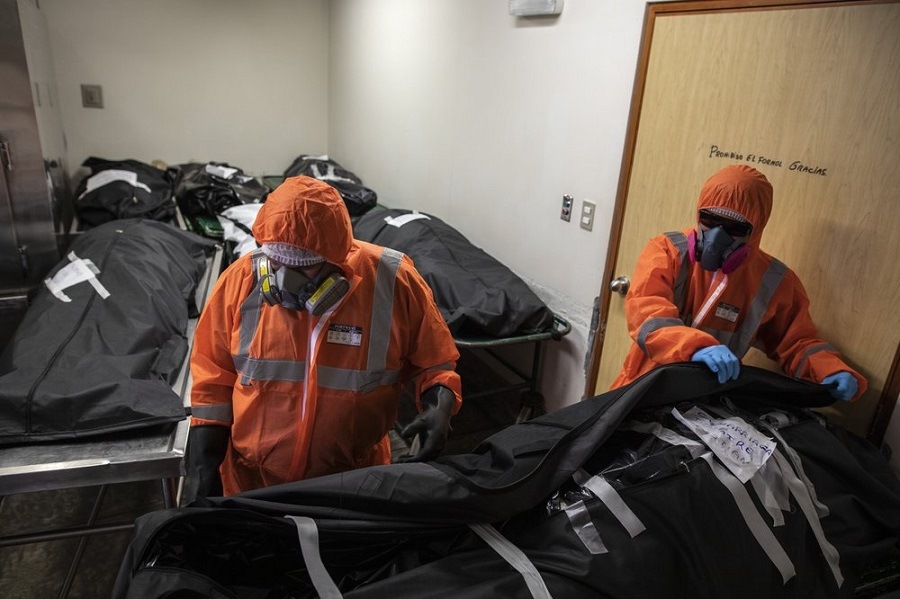
From Monday to Sunday, even at night and in the early hours of the morning, the ‘body collectors’ drive hearses through the wealthy neighborhoods along the Pacific coast, but they also go into the hill’s crowded slums where the virus strikes hard, fully dressed in protective suits and masks.
And so they came to Faustino’s house to collect his body. Faustino Lopez was terrified to see his wife’s health deteriorate. She was admitted to a hospital in Lima in late April with Covid-19. While his wife Angélica Berrocal remained in the hospital, Faustino had no choice but to stay home, where he lived alone. He stopped sleeping in the double bed they had shared for 45 years; he couldn’t stop crying as he looked at her clothes and listened to music in Quechua, their mother tongue.
Faustino, a 68-year-old gardener, and Angelica, a 60-year-old street sweeper, had reached this point in their lives without significant health issues and with two children and 11 healthy grandchildren. But the novel coronavirus destroyed this family’s happiness, which in more than four decades had never known misfortune. And another tragedy was yet to come.
At one point, Faustino developed a fever and chills. He also felt his taste and smell altered, according to a clinical-epidemiological research report available to The Associated Press. He was tested positive for Covid-19.
In desperation, he knocked on the doors of a state-run shelter where nearly 2,000 people are recovering from the virus. He was not accepted because a hospital had not referred him. He returned home, and in the early morning of May 5th, he drank muriatic acid and hanged himself with a wire.
His eldest son found him and called the police, but Faustino remained in his living room for several hours without anyone wanting to touch him. Then Jhoan Faneite and his adopted son Luis Zerpa arrived, two Venezuelans who work at the Piedrangel funeral home, which the city government hired to remove the bodies of people infected with the virus from their homes and then incinerate them.
A week later, his wife Angelica died in the hospital from the virus.
Another morning in early May, the body of Marcos Espinoza was collected. He was a 51-year-old electrician, single and childless, who lived on a dusty hill near the Pachacámac archaeological complex, the most famous archaeological site in the Inca empire.
Óscar Espinoza, brother of the deceased, said that Marcos tried to cure himself by drinking eucalyptus water with ginger and lemon. His eyes hurt as if they had been pierced with a pen, and shortly before his death, he reviewed his life while urinating in a plastic bowl. “Why did I get this plague, if I didn’t hurt anyone,” Óscar heard, sleeping in the next room.
Marcos’ death occurred early on Friday morning, May 8th, at 2:45 AM. He lay down on his left side, curled up in his loneliness, and died in his sleep. Eight hours later, Faneite, Zerpa, and another countryman, Luis Brito, 26, climbed the hill dressed in white overalls, boots, double gloves, and masks that barely showed their eyes.
They carried Marcos’ body down the hill and, at times, to rest, they placed the corpse on the ground wrapped in a black cloth bag, while the wind blew, the dogs barked, and the neighborhood residents with no water or sewage silently watched the strange event.
Due to the increase in mortality, authorities have installed almost two dozen shipping containers in Lima’s hospitals that keep the corpses at zero degrees.
Piedrangel, a Peruvian funeral home, took on a key role in Lima when no one else would dare to collect the dead from the novel virus. In March, they collected the first Covid-19 victim in Peru, a psychologist who died in the solitude of his apartment in a building facing the Pacific.
Edgard Gonzalez, one of the four brothers who own the funeral home, discussed it with his two sons and took a chance. “A window of opportunity can be opened,” he told them. He was not wrong.
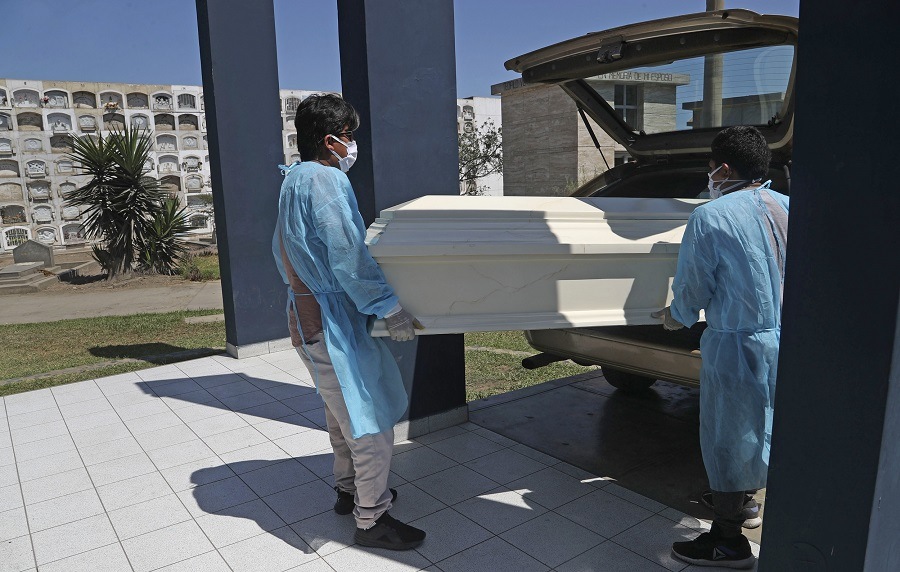
Now the funeral home not only collects the infected bodies but also cremates them in its two retorts installed inside a cemetery and delivers the ashes to the bereaved.
Ricardo Noriega, a 77-year-old clothes salesman, could not find a taxi driver to take him to the hospital when he fell ill, and no relatives were available. So he sat in the main chair of his living room and died staring at a wall where he had hung his family pictures. That’s where the staff of the Piedrangel funeral home found him.
Luis Zerpa, Faneite’s son, his countryman Alexánder Carballo and Peruvian Angelo Aza wrapped Noriega’s body, which lay on the candy-colored tile floor next to the plastic carts and skates of his four young grandchildren.
The weight of death is felt as Faneite and his colleagues from the Piedrangel funeral home tour the city. The military who control the capital’s roads walk away from the hearse in horror when they confirm that they are carrying bodies of Covid-19 victims. Some of the uniformed soldiers, who amid the pandemic must continue their work, silently make the sign of the cross.
More than 5,000 police officers have been diagnosed with the disease, with 92 deaths out of a force of approximately 100,000. The Army has been less affected by the disease.
When Faneite returns home in the early hours of the morning, he finds his wife asleep with their two young children. He then quietly changes, showers and washes his clothes with disinfectant. Sometimes he gargles with saltwater and with hydrogen peroxide when he is desperate.
He says that he has to stay healthy for his family, which includes his elderly parents, who have been waiting for him in Venezuela. “Before they leave, before the inevitable comes, I want to go and see them, I want to be with them,” he said.
Source: AP
More: Brazil news in English, every day from The Rio Times.
This article was produced by The Rio Times’ automated newsroom system. How we use AI · Report an error · Editorial responsibility: Matthias Camenzind, Editor-in-Chief