Latin America Scurries to Prepare Infrastructure Before Pandemic Peak
RIO DE JANEIRO, BRAZIL – Latin America has seen how the coronavirus pandemic is spreading around the world. As an advantage, it saw how the disease and its management evolved in Asia, Europe, and the United States, but as the days went by it proved to be insufficiently prepared.

Most countries in the region, particularly the two giants, Brazil and Mexico, are rushing in an attempt to buy ventilators and protective equipment for health professionals, whose complaints are multiplying and revealing the shortcomings of already fragile health systems.
The high demand faced by all countries and the scarcity of economic resources, in some cases, challenge the ability to respond to the peak of the epidemic, which is expected to occur in the coming weeks.
In Brazil, the government has announced the manufacture and purchase of 6,500 ventilators from a consortium of domestic manufacturers, but delivery will take weeks or months. An increasing number of Brazilians are disregarding the recommendation to remain at home to stop the spread of the coronavirus, as shown by data from São Paulo, the epicenter megalopolis of the pandemic in Brazil.
This week only half of its millions of inhabitants have remained confined, compared to 60 percent in previous weeks, which is still far from the 70 percent that health experts believe is necessary so that cases do not skyrocket and hospitals collapse. Although the death toll and new cases are higher every day -1,124 deaths and 20,727 infections by Saturday across the country – social isolation measures are not being respected.
Brazil also faces a remarkable deficit of tests – it has performed only 63,000 tests, of which 13,000 were positive – of personal protective equipment (PPE) because it needs to import them, and the difficulties associated with a country having 210 million inhabitants spread over a massive territory in which the State is unable to reach every location even under ordinary circumstances.
The Brazilian State of Amazonas warned that its ICUs are about to collapse and in Rio’s favelas some people have already died.
The schools have been closed for three weeks in São Paulo, trade and museums too, but the huge subway network is still open, restaurants serve take-away meals and those who wanted to, were able to go on holiday to the coastal cities.
The governor of São Paulo, João Dória, warned that this Easter weekend was a test. If the population failed to take the threat seriously and isolates itself, fines and even imprisonment would be enforced. Dória’s team estimates that, with strict isolation, the dead in the state could be 110,000; absent of any measure, it would reach 270,000.
In Brazil, the officials’ cacophony is a heavy burden when it comes to facing the pandemic. President Jair Bolsonaro continues to insist that the population wants to return to work on the streets, while the governors try, with greater or lesser effort, to get the population to follow the recommendations made by WHO and the federal Ministry of Health so that the health care infrastructure can prepare for the peak of the disease.
There is also no consensus on whether or not to use the controversial Chloroquine, which Bolsonaro has been enthusiastically advocating since the onset of the crisis. The President announced that a shipment of supplies to produce hydroxychloroquine locally would arrive from India over the weekend.
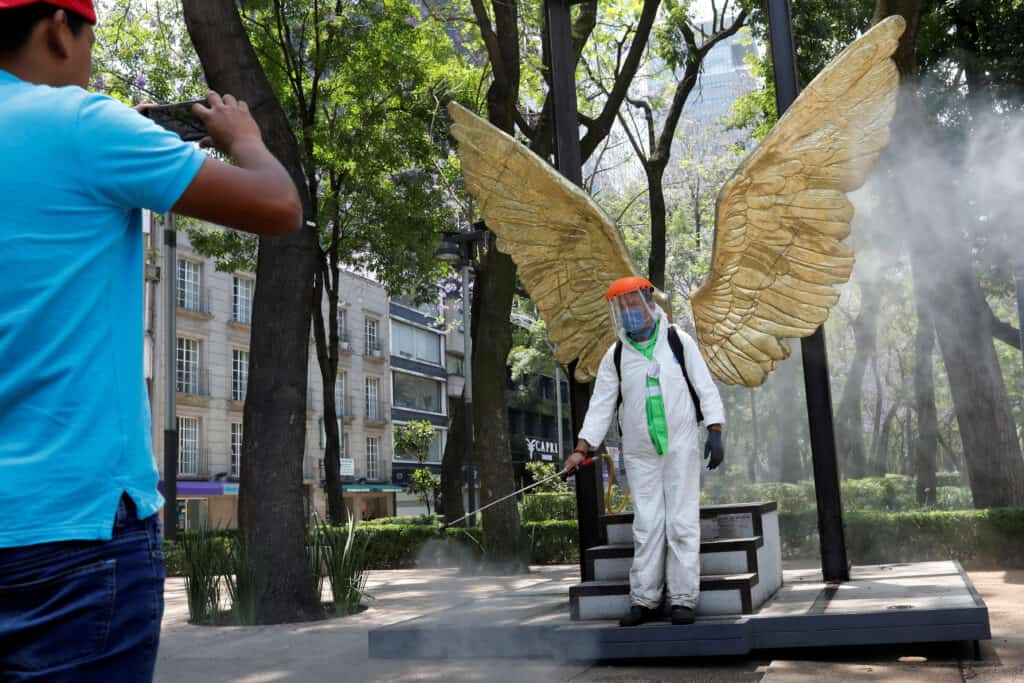
In Mexico, the region’s second-largest economy, the outlook is not at all encouraging, as it is about to face the most complex stage. President Andrés Manuel López Obrador has tried to convey a sense of reassurance, if not downplaying the impact of the pandemic.
Until last week, the government refrained from enforcing strict confinement measures on the population, in an attempt to mitigate the economic damages. Theoretically, it moved ahead in halting the country’s economic activity; but in practice, keeping millions of people to their homes is not easy: more than half the country needs to go out every day to earn a living.
In terms of health, the shift has been radical in recent days. A few days after the government spokesperson for the fight against the pandemic had argued that the tests were not that important to prevent the spread of the virus, the administration reversed its position in the face of pressure from governors and hospitals, and approved the distribution of 300,000 tests, almost five times more than estimated at the outset, during stage 2.
Mexico acquired the tests in Europe, primarily Germany, China and the United States. From the Asian giant two planes loaded with tons of medical supplies for health professionals arrived in one week. The Mexican public health system professionals protested in recent days about the lack of preparation and materials, which led to several outbreaks in various hospitals in the country among the professionals who treated patients infected with Covid-19.
The shortage of equipment also became apparent on Friday, when López Obrador, in a call with his US counterpart, asked Donald Trump to sell 10,000 ventilators and 10,000 monitors, which he initially agreed to.
In the Southern Cone, Ecuador has become the epicenter of the outbreak in Latin America, as the state has entered a crisis due to its inability to remove bodies from homes, particularly in the city of Guayaquil. The collapse experienced by the South American country is the greatest concern in the whole region.
Argentina, one of the countries that has taken drastic measures most rapidly – this weekend completed 20 days of forced confinement, with closed borders and business activity dormant – believes that quarantine and the reinforcement of the health care infrastructure will help to mitigate the blow. In early March, the government took control of Argentina’s only assisted-breathing equipment plant, and instituted the monopoly on test kit purchases, all of which are imported.
The Argentine health system has also received an additional 15,000 health professionals, including residents who must remain at their posts, medical students and volunteers. In order to prevent social conflicts, the government has granted extra money to the peripheral populations outside the city of Buenos Aires, where the largest pockets of poverty are centered.
Alarms also sounded early in Venezuela, where the destruction of the health care system in recent years has further complicated a potential scenario for the virus to spread. Nicolás Maduro has banned flights into and out of the country and ordered the entire population to wear masks, as well as asking China for help. Help, one of the most repeated words, in the case of Latin America, is also an economic one.
Colombia, aware of the impact of the crisis, asked the IMF to renew a US$11 billion (R$56 billion) credit line. On March 25th, the country decreed a mandatory quarantine which will last at least until the end of April while, like Argentina, it closed its borders and suspended air traffic.
Source: El País
More: Brazil news in English, every day from The Rio Times.
This article was produced by The Rio Times’ automated newsroom system. How we use AI · Report an error · Editorial responsibility: Matthias Camenzind, Editor-in-Chief