Mexico’s Silver Belt Helps Make Country World´s Leading Silver Producer
RIO DE JANEIRO, BRAZIL – Exploration companies often receive favourable incentives such as tax deferrals to prospect in underexplored jurisdictions, and it can often result in higher profitability for mining operations. Fortunately for North American investors, Mexico is in the vicinity and it is one of the world’s premier mining jurisdictions, while being an economic powerhouse in its own right.

The arrival of Spanish Conquistadors in Mexico 500 years ago was marked by an intense search for gold and silver to provide the capital Spain required for its global adventures and expansion abroad. Gold and silver were sent home on ships. As the territory evolved into present-day Mexico, mining became one of the principal contributors to the Mexican economy and helped transform the country into the economic giant it is now. In addition to gold and silver, copper, zinc, tin, and other metals are actively mined.
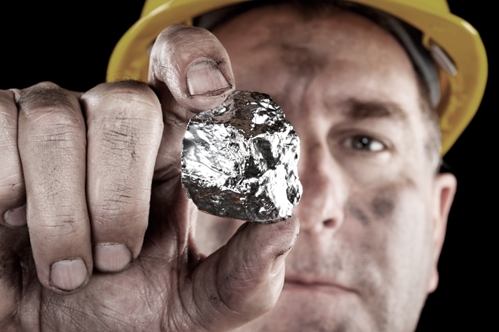
Today Mexico is the world’s largest silver producer with 17% of the world’s silver production and the worlds 8th largest gold producer. While mining occurs throughout Mexico, this article will focus on the two primary mining regions in Mexico, Sonora and Zacatecas.
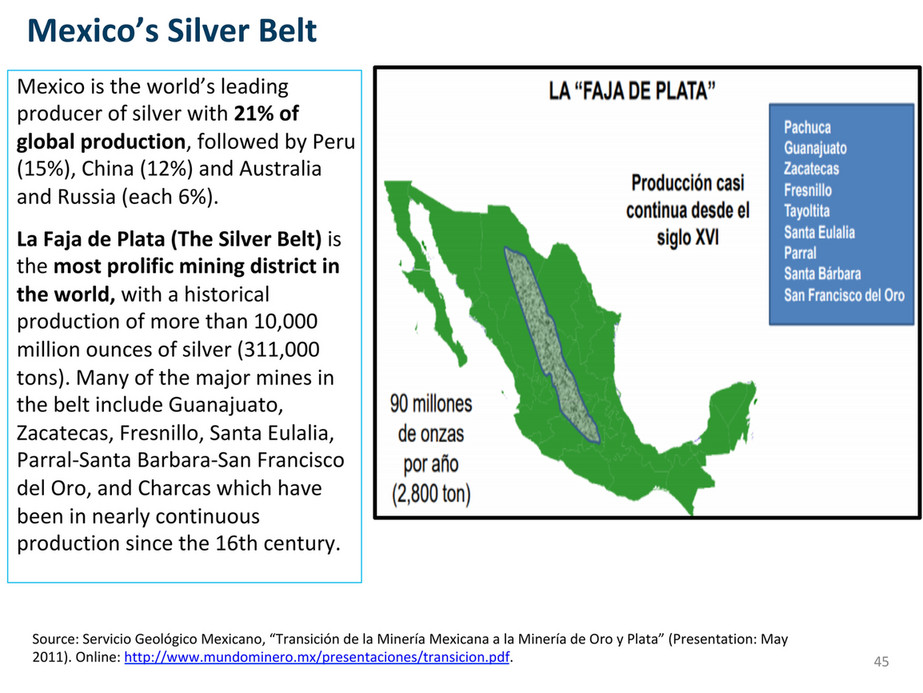
The states of Sonora and Zacatecas collectively account for roughly 55% of Mexico’s mining GDP. In 2019, the state of Zacatecas produced 2,124.48 metric tons of silver, accounting for 36.4% of Mexico’s silver production, followed by Chihuahua, which produced 1.2 million metric tons, Sonora state accounted for one third of Mexico’s gold production in 2019 with 36.2 metric tons produced, followed by Guerrero state with 18.7% from 20.4 metric to-s of gold.
Sonora has a climate that enables year-long operations, well-established infrastructure and a skilled workforce to support the mining industry, including an abundant supply of water and power, and an excellent road system. The Mexican government is very mining-friendly as the industry employs hundreds of thousands of workers, and it collects a steady stream of royalty payments from producers.
The Regulatory Framework
Mining is enshrined in Mexico’s constitution, with mineral exploration and exploitation having a preference over any other land use. Laws exist to provide a well-defined mining regime which operates under a concession system, whereby concessions are required for exploration or extraction.
Once a concession is granted, the holder must negotiate with the surface landowners to be able to conduct subsurface exploration. Exploration concessions have a 6-year timespan and are not renewable. However, mining concessions run for 50 years and are renewable for another 50 years. This encourages active and efficient exploration activity geared toward development and mineral production.
Concessions commonly have specified expenditure requirements as well as provisions for conforming to established standards for health, safety and environmental protection. Mexico has stringent environmental laws and all mining companies must meet environmental impact permitting regulations that include tailings and water remediation plans before being allowed to commence operations. The duties for mining companies are 7.5% tied to a form of EBITDA and 0.5% of gold and silver sales.
The Geology
A key feature of Mexico’s geology is the Sierra Madre Occidental, a high plateau which is part of a mountain range system that runs from western Antarctica, up through South America, Central America, through Mexico and into the western United States. The plateau was formed through volcanic activity, and sits atop a sedimentary basement composed of metamorphic rocks.
The basement is considered to be part of the Older North American basement, which itself sits atop the Precambrian basement and is intertwined with Paleozoic-era sedimentary layers. The Sierra Occidental runs from the northern part of Sonora state southwards, where it intersects the Trans-Mexican Volcanic Belt that stretches from east to west across central and southern Mexico. This belt consists of mineral-rich high-sulphidation epithermal deposits that host eleven mines with reserves of over 563 million ounces of silver, and several copper-lead-zinc mines.
Geology in the state of Zacatecas in north-central Mexico comprises a number of marine beds of the Lower Cretaceous era and Upper Triassic greenstones, lava, and sedimentary rocks. Silver mineralization occurs mainly in epithermal veins, which are prime targets for precious metal exploration.
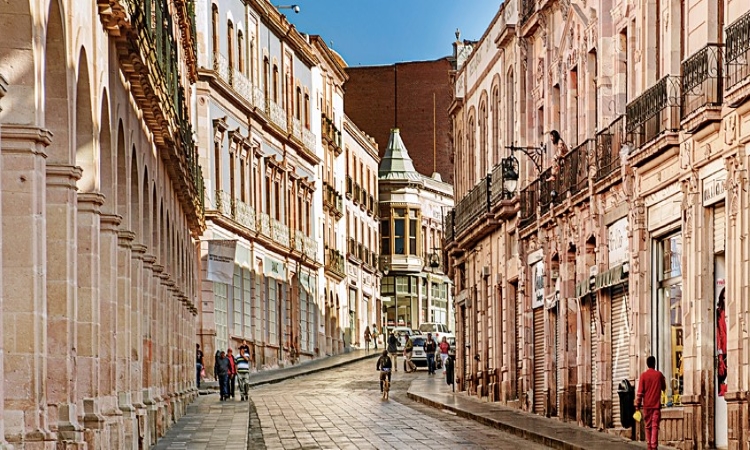
Zacatecas is located within the Mexican Silver Belt, which is considered to be the world’s largest silver region. The Fresnillo area in Zacatecas state has seen significant mining activity since the 1500’s, having produced more than 12 tons of gold, 775 tons of silver, and approximately 1,000,000 tons of lead and zinc.
The Social Aspects
While Mexico is a very mining-friendly jurisdiction, Mexico has serious crime and violence issues related to the drug cartels throughout the country, but particularly in the northern parts closer to the US border. The federal government has ramped up its enforcement capabilities, but rampant poverty in many parts of the country makes it difficult to eradicate the cartels, who often recruit the poor into their operations.
Mining companies have to be particularly vigilant and security is a high priority at most mining projects. Like in any country with an active mining sector, Mexico experiences rising energy costs as well as variable pricing from milling operators that can impact operating costs and profitability.
More: Brazil news in English, every day from The Rio Times.
Live Market IntelligenceBrazil — Live Market Board
Rio Times · Live Market Intelligence
Brazil — Live Market Board
-0.56%
187,206.89
-0.56%
63,924.77
-0.28%
11,220.60
-0.16%
3,098,898
-1.87%
2,589.69
-1.41%
59,373.28
-0.32%
| Instrument | Last | Change | YoY | Prev. | High | Low | Volume |
|---|---|---|---|---|---|---|---|
| IBOV | 187,206.89 | -0.56% | +21.85% | 188,268.59 | 168,310 | 167,142 | — |
| USD/BRL | 5.16 | +0.01% | -5.13% | 5.16 | 5.18 | 5.14 | — |
| SELIC | 14.00% | — | — | — | — | — | |
| PETR4 | 41.64 | -0.05% | +35.19% | 41.66 | 41.97 | 41.15 | 41,499,400 |
| VALE3 | 72.97 | +0.83% | +30.75% | 72.37 | 73.54 | 72.66 | 17,658,000 |
| ITUB4 | 38.60 | -1.03% | +4.57% | 39.00 | 39.34 | 38.39 | 29,487,800 |
| BBDC4 | 16.85 | +0.36% | +3.50% | 16.79 | 16.90 | 16.67 | 19,416,900 |
| BBAS3 | 19.37 | +0.47% | +0.73% | 19.28 | 19.44 | 19.16 | 11,069,200 |
| B3SA3 | 14.26 | -0.21% | +12.73% | 14.29 | 14.47 | 14.11 | 33,037,800 |
| ABEV3 | 14.89 | -0.80% | +21.91% | 15.01 | 15.07 | 14.81 | 16,453,100 |
| WEGE3 | 47.59 | +0.49% | +29.99% | 47.36 | 48.08 | 47.36 | 3,364,600 |
| PRIO3 | 59.14 | -0.19% | +50.67% | 59.25 | 59.81 | 58.74 | 3,325,600 |
| SUZB3 | 41.33 | +2.35% | -23.55% | 40.38 | 41.48 | 40.35 | 3,914,900 |
| RENT3 | 34.68 | -0.09% | +0.84% | 34.71 | 34.96 | 34.35 | 7,979,100 |
| AZZA3 | 15.89 | -2.63% | -53.76% | 16.32 | 16.42 | 15.82 | 1,330,300 |
| CSNA3 | 4.30 | +0.47% | -42.65% | 4.28 | 4.41 | 4.26 | 10,076,100 |
| GGBR4 | 24.69 | +2.19% | +51.38% | 24.16 | 24.85 | 24.18 | 7,047,600 |
| ENEV3 | 24.21 | -1.38% | +70.49% | 24.55 | 24.64 | 23.99 | 9,297,000 |
This article was produced by The Rio Times’ automated newsroom system. How we use AI · Report an error
Read More from The Rio Times