“What Bolsonaro Does Harms All of Latin America,” Says Former Colombian President
RIO DE JANEIRO, BRAZIL – After ruling Colombia for eight years, winning the Nobel Peace Prize for the negotiation that ended the conflict with the FARC guerrillas, Juan Manuel Santos has embraced the environmental cause. He is one of the world figures who have been meeting by videoconference with a group dedicated to seeking specific solutions for the Amazon.

In the project, which includes names from the political, economic, and cultural spheres, are also economist Jeffrey Sachs and photographer Sebastião Salgado. Santos believes that one of the ways to reduce deforestation is through pressure from voters and consumers on governments and companies.
Isolated in Anapoima, a municipality 90 kilometers from Bogotá, he granted a video interview to Estadão newspaper, focusing on bioeconomics and geopolitics. Santos believes the pandemic, the damage of which he considers minor next to the consequences of global warming, is driving the world’s ideological pointer back to the center.
Large companies, farmers’ associations, and banks have become interested in the environmental issue in Brazil. While environmental destruction can bring economic losses, this risk is not new. Why do actors so closely connected to capitalism now advocate sustainability?
The world is quickly becoming aware of the significance of sustainability policies. There was a negation, which many leaders in the world still nurture. But the evidence is showing us that it is not merely an issue, but that it is urgent to make decisions that preserve the environment and biodiversity. Companies are under pressure to act in this direction. It is a positive sign that many companies in countries where the environment is being destroyed are hearing “If you keep destroying, we will not buy your products.”
There are cases of companies with environmental disasters and pollution in their track record that associate their name to environmental projects and hide what matters. Are citizens capable of detecting these companies?
There are companies that have truly changed their way of thinking and are correcting themselves. And there are others that simply want to improve their image and persist with unsustainable policies. Citizens are beginning to differentiate between them. Companies that are truly pursuing sustainable policies are different from those that merely want to improve their image. Ultimately, it is the citizenry that is putting the pressure on.
Are European countries really interested in preservation or do they mention other people’s deforestation to preserve historical subsidies to their agriculture?
Most European countries are aware of the need to preserve the environment. But there is a historical injustice there. They have developed by destroying the environment and now want to force countries to halt their development. We have to find a way to allow these countries to develop while preserving. But I do believe that most European countries are genuinely concerned about what is happening in the world with climate change.
Is payments by wealthy countries to those developing nations that preserve the environment an ideal system?
That is one of the tools. Fortunately, this pandemic is placing science above populism, above ideology. If this is shifted to the environment, we can expedite actions to halt global warming.
Populist governments have been getting followers by demeaning the position of scientists on environmental issues. Can the pandemic revive the weight of science?
Luckily, science is important again. Leaders and governments need to take science into account to make their decisions. It is one of this moment’s positive effects. The most successful type of leadership in controlling the pandemic has been through women. Germany, New Zealand, Norway, Finland, Taiwan are led by women. Countries led by authoritarian populists generate distrust. Just look at the difference in results.
Radicalism on the part of environmentalists has pushed a portion of central voters to choose right-wing and even ultra-right populists. Would more pragmatic environmentalists help?
Absolutely. More pragmatic environmentalists are indispensable. When someone is a fundamentalist, many doors close to them. A pragmatic environmentalist is what we need most, to stop the destruction of the Amazon, for instance.
In this context, is the emergence of personalities like Greta Thunberg positive?
I think it’s very positive because she has become a symbol. When personalities like Greta alert to a problem, many begin to put pressure on their governments.
You were the defense minister of a conservative government during a tough time in the war against the FARC. You come to power, you become a progressive president and you foster the ideal of a third way. In such a polarized world, is it more difficult to reach consensus to ensure preservation?
Populism, whether left or right-wing, is very attractive at a given circumstance but fatal in the medium and long term. History is proof of this. The main thing is to keep the dialogue in order to produce a critical mass at the center. But in this polarization the world is experiencing, we are beginning to see the pendulum returning to the center.
The Brazilian government rejects global warming and initially even denied the increase in fires in the Amazon. Has the weakening of international organizations caused international isolation to lose ground as a pressure tool?
It worries me greatly, what is happening in Brazil hurts me as a Latin American. What Bolsonaro is doing regarding the environment and the multilateral international order, in the long term, will harm the whole of Latin America. The pandemic is showing that talking and acting solely based on intuition and ideology does not produce positive results.
Can Brazil’s isolation favor other countries in the region, like Colombia?
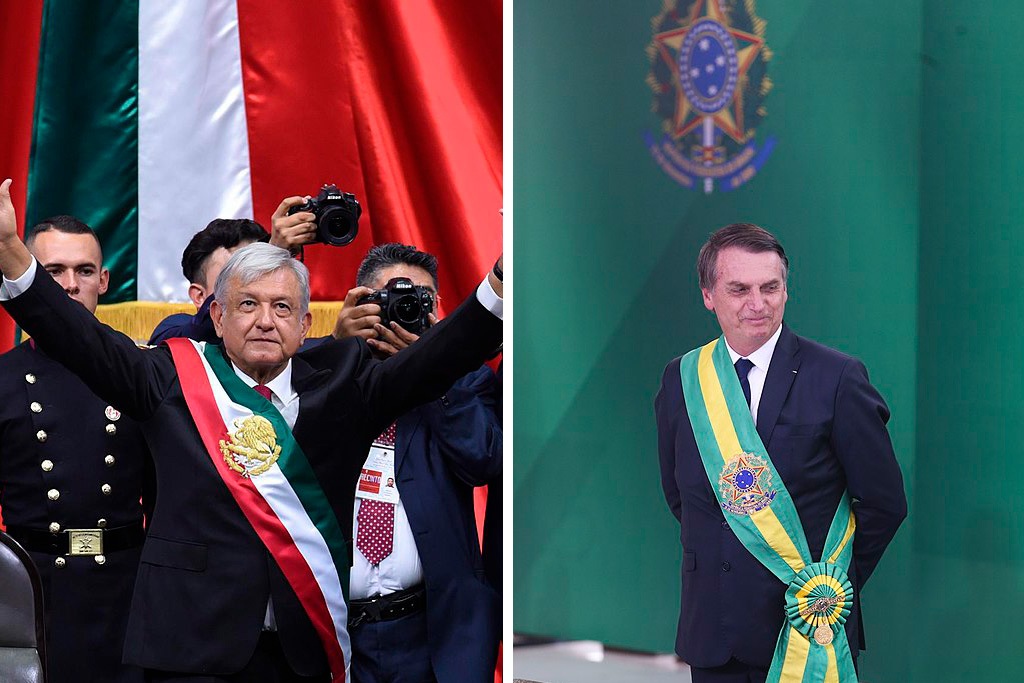
On the contrary. It is sad for Latin Americans to see the two most important countries in Latin America in the hands of populists. Brazil, with Bolsonaro, and Mexico, with López Obrador. One from the right-wing and the other from the left. As a result, Latin America has lost ground worldwide. It is unbelievable that at this time when Latin America needs funding, there is not a single voice claiming the extra funding that is being granted to the rest of the world.
It is also incredible that Latin America has lost the presidency of the IDB (Inter-American Development Bank), which for 60 years was the only international body with a Latin American representative who spoke on equal terms with the IMF ( International Monetary Fund) and the World Bank. Donald Trump proposed an American candidate and it is astonishing that many Latin American countries are supporting this American candidate (Brazil is among them).
In Brazil, the Minister of Agriculture embodied the environmental discourse and cautioned that the destruction of the Amazon could hinder exports, while the Minister of the Environment holds the toughest discourse, in opposition to NGOs. It is the opposite of what typically occurs. How is this perceived abroad?
In Colombia and the rest of Latin America, we can’t really understand it. The Minister of the Environment is less of an environmentalist than the Minister of Agriculture. These are the contradictions produced by populist regimes. It proves how populist regimes are counterproductive.
Trump was one of the first to leave the Paris Agreement and go against environmental concepts that seemed common sense. He was soon followed by other leaders. If Trump does not get re-elected, can the pendulum you spoke of move faster to the center, influence other countries?
If Trump loses, and all indications are that he will, the government of Joe Biden will regain the spaces that Trump closed. The multilateral system that the United States built after World War II was convenient for countries like Colombia and Brazil because the law of the jungle protects only the most powerful. We, Brazil, Colombia, and Latin America in general, have much more to lose than to gain without international rules of the game. Biden is in favor of a multilateral system, different from what Trump wanted to impose.
Biden has been in Latin America many times, he knows the continent. Would that facilitate contact with the region?
Of course it would. Trump’s relationship with the region is almost one of contempt.
Before the Covid, surveys showed a favorable scenario for Trump’s reelection, particularly for the economy. Some people believe that the pandemic would be a reaction by the planet to leaders like him. What do you think?
I’m not so convinced that the economy would reëlect him, though he would have a much better chance. The pandemic has had two effects in the US. One is economic, which was very negative. The second is the extent of Trump’s mistakes in his response to the pandemic. That ultimately made him lose support within his own party. The foundations that seemed solid are no longer that solid.
In regions like Catatumbo, on the border with Venezuela, there are guerrillas that hold power over part of the territory and that is connected to the environmental issue. Why is it so difficult to get something other than coca to be planted in the field? You had eight years in power, why didn’t you solve that?
While still president, I proposed a radical change in international drug policy. We reached 50 years of war on drugs and we lost. I suggest we lift the ban. Colombia was the country that paid the highest price in the fight against drugs and we are still the number one cocaine exporter. We need to change the strategy, but this can’t be done by one country alone. Furthermore, the impact of drug trafficking on ecology is great. An important part of deforestation is driven by narco-traffickers. When they are removed from their areas, they move into the forest to produce coca one, two, or three years and remain there.
Why is it so difficult to implement specific measures when one is in power?
To govern is a symphony. You have to get everyone in tune to reach a goal. That’s not easy. You face many opponents who want you to fail. Dealing with them and then coordinating forces is difficult. The most important aspect of leadership is empathy. When you put yourself in other people’s shoes, understand their anxieties.
What did you intend to achieve in the environmental area and failed?
All leaders, if we are honest and humble, we look back and we are frustrated. We have reduced inequality in Colombia, but it is still very deep, shameful. I would have liked to have protected the environment better, even though we have multiplied the protected areas by ten. Poverty has been reduced in eight years almost as much as Brazil at one time. And now this pandemic will take us back ten or 20 years.
The guerrilla warfare that you helped to eradicate began with the fight for arable land and ended with deforestation to plant coca. Does sustainability lead to peace?
Sustainability is what will allow us to continue living. We’re heading toward the precipice. The pandemic is nothing compared to what humanity can suffer if we fail to make very drastic decisions. The pandemic must open our eyes to change development paradigms, shortcomings found all over the world, but mainly in Latin America: inequality, poor wealth and land distribution. At the moment, we are destroying the most important thing we have in Latin America, biodiversity.
Source: Estadão Conteúdo
More: Brazil news in English, every day from The Rio Times.
This article was produced by The Rio Times’ automated newsroom system. How we use AI · Report an error · Editorial responsibility: Matthias Camenzind, Editor-in-Chief