IBOV 171,031.73 ▲ 1.85% IPSA 11,338.38 ▲ 0.89% IPC MEX 65,729.18 ▲ 2.14% MERVAL 2,913,184 ▲ 1.30% COLCAP 2,459.23 ▲ 0.61% BVL PERÚ 58,698.13 ▲ 2.60% USD/BRL5.14▼ 0.14% USD/MXN16.95▲ 0.30% USD/CLP914.28— 0.00% USD/COP3,038▼ 1.18% USD/PEN3.35▼ 0.06% USD/ARS1,499▲ 0.12% USD/UYU40.20▲ 1.58% USD/PYG5,996▲ 1.55% USD/BOB11.43▲ 0.41% USD/DOP58.82▲ 0.20% USD/CRC450.05▲ 3.34% USD/GTQ7.62▲ 2.21% USD/HNL26.81▲ 0.31% USD/NIO36.62— 0.00% USD/VES778.00▼ 0.13% USD/PAB1.00— 0.00% USD/BZD2.00— 0.00% USD/JMD 157.28 — 0.00% USD/TTD6.71▲ 0.79% EUR/BRL6.00▼ 0.64% BRENT 88.88 ▼ 0.03% WTI 83.11 ▼ 0.11% IRON ORE 161.91 — — COPPER 6.61 ▲ 0.03% GOLD 4,461 ▲ 1.78% SILVER 65.59 ▲ 1.26% SOY 1,184 ▲ 3.20% CORN 480.50 ▲ 10.02% WHEAT 655.00 ▲ 3.93% COFFEE 317.25 ▼ 5.51% SUGAR 16.43 ▼ 1.79% ORANGE JUICE 138.55 ▼ 0.47% COTTON 85.03 ▲ 2.33% COCOA 5,719 ▲ 3.18% BEEF 223.60 ▼ 3.93% CATTLE 339.10 ▼ 3.16% LITHIUM 75.20 ▲ 1.47% PETR4 41.64 ▼ 0.05% VALE3 72.97 ▲ 0.83% ITUB4 38.60 ▼ 1.03% BBDC4 16.85 ▲ 0.36% ABEV3 14.89 ▼ 0.80% BBAS3 19.37 ▲ 0.47% B3SA3 14.26 ▼ 0.21% WEGE3 47.59 ▲ 0.49% PRIO3 59.14 ▼ 0.19% SUZB3 41.33 ▲ 2.35% RENT3 34.68 ▼ 0.09% AZZA3 15.89 ▼ 2.63% CSAN3 3.22 ▼ 1.83% RAIZ4 0.25 — 0.00% PCAR3 2.75 ▼ 0.36% GMAT3 3.65 ▼ 1.08% PSSA3 48.13 ▼ 0.54% CVCB3 1.33 ▼ 2.92% POSI3 3.36 ▲ 2.44% SLCE3 13.34 ▲ 0.30% NATU3 8.14 ▼ 0.73% IBOV 171,031.73 ▲ 1.85% IPSA 11,338.38 ▲ 0.89% IPC MEX 65,729.18 ▲ 2.14% MERVAL 2,913,184 ▲ 1.30% COLCAP 2,459.23 ▲ 0.61% BVL PERÚ 58,698.13 ▲ 2.60% USD/BRL 5.16 ▲ 0.01% USD/MXN 17.06 ▼ 0.24% USD/CLP 913.98 ▲ 0.04% USD/COP 3,140 ▲ 0.03% USD/PEN 3.36 ▼ 0.66% USD/ARS 1,493 ▲ 0.10% USD/UYU 40.27 ▲ 1.24% USD/PYG 5,939 ▲ 1.68% USD/BOB 11.64 ▼ 0.76% USD/DOP 58.34 ▲ 1.25% USD/CRC 445.92 ▲ 0.89% USD/GTQ 7.62 ▲ 2.21% USD/HNL 26.79 ▲ 1.57% USD/NIO 36.62 ▲ 0.69% USD/VES 762.44 ▼ 0.13% USD/PAB 1.00 — 0.00% USD/BZD 2.00 — 0.00% USD/JMD 157.28 — 0.00% USD/TTD 6.70 ▲ 0.61% EUR/BRL 5.95 ▲ 1.01% BRENT 88.88 ▼ 0.03% WTI 83.11 ▼ 0.11% IRON ORE 161.91 — — COPPER 6.61 ▲ 0.03% GOLD 4,461 ▲ 1.78% SILVER 65.59 ▲ 1.26% SOY 1,184 ▲ 3.20% CORN 480.50 ▲ 10.02% WHEAT 655.00 ▲ 3.93% COFFEE 317.25 ▼ 5.51% SUGAR 16.43 ▼ 1.79% ORANGE JUICE 138.55 ▼ 0.47% COTTON 85.03 ▲ 2.33% COCOA 5,719 ▲ 3.18% BEEF 223.60 ▼ 3.93% CATTLE 339.10 ▼ 3.16% LITHIUM 75.20 ▲ 1.47% PETR4 41.64 ▼ 0.05% VALE3 72.97 ▲ 0.83% ITUB4 38.60 ▼ 1.03% BBDC4 16.85 ▲ 0.36% ABEV3 14.89 ▼ 0.80% BBAS3 19.37 ▲ 0.47% B3SA3 14.26 ▼ 0.21% WEGE3 47.59 ▲ 0.49% PRIO3 59.14 ▼ 0.19% SUZB3 41.33 ▲ 2.35% RENT3 34.68 ▼ 0.09% AZZA3 15.89 ▼ 2.63% CSAN3 3.22 ▼ 1.83% RAIZ4 0.25 — 0.00% PCAR3 2.75 ▼ 0.36% GMAT3 3.65 ▼ 1.08% PSSA3 48.13 ▼ 0.54% CVCB3 1.33 ▼ 2.92% POSI3 3.36 ▲ 2.44% SLCE3 13.34 ▲ 0.30% NATU3 8.14 ▼ 0.73%
since 2009
Sunday, August 23, 2026

Competitive Devaluations: Is a post-COVID Currency War Coming?

By · December 4, 2020 · 4 min read

Daily Brief

The morning intel from across Latin America. Free.

By subscribing you agree to our privacy policy. We never share your email.

By Marc Jones, Elizabeth Howcroft

RIO DE JANEIRO, BRAZIL – Financial markets’ euphoric reaction to the recent COVID-19 vaccine breakthroughs and U.S. election results is pushing some currencies up so fast that rumblings have begun about a potential new FX war.

Almost a decade after Brazil’s finance minister likened Western central bank money-printing to economic warfare, some of the conditions that led countries to weaken their currencies then look to be forming again.

Investors’ growing eagerness to buy into risky assets gave emerging market currencies their best month in nearly two years in November, stretching a run of gains that started in June.

RT
Ask Rio Times
17 years of Latin America reporting, on demand.
Open the full Ask Rio Times →
One-stop reference
Company Intelligence
Every listed company in Latin America — financials, ownership and structure for 1,450+ companies across 26 exchanges, in one place.
Browse the directory →

A further extension — seen as likely after the dollar hit a two-year low on Thursday — would mark be their longest uninterrupted climb since 2012.

South Korea, Taiwan and Thailand are already worried enough that they have either intervened in their foreign exchange markets or taken other steps to try to prevent fragile economic recoveries being snuffed out.

In Sweden, whose crown is this year’s best-performing currency, the central bank unexpectedly increased its money-printing programme last week.

“I think currency war would be a bit of a dramatic term to use right now, but you could say there have been some early warning shots,” said UBS’s head of emerging market strategy Manik Narain. “And if this currency strength continues, these countries could start to push back harder.”

Competitive currency devaluations are blamed by economists for exacerbating the 1930s Great Depression and dragging for decades on world trade by fostering protectionism.

The cycle usually starts with tit-for-tat interest rate cuts and interventions, but can quickly escalate into capital controls or investment taxes to ward off hot foreign money like that now flooding into emerging markets.

Institute of International Finance data on Tuesday showed investors splurged a record US$40 billion on stocks and US$37 billion on bonds in emerging markets last month, a spree that was more than the previous three months combined.

The Mexican peso, Brazilian real, Turkish Lira, South African rand, Russian rouble and Polish zloty all jumped between 5% and 10%, adding to 5%-12% leaps in China, Taiwan and Korea’s currencies since June.

ROOM TO BOOM

It is not only the expectation that COVID-19 vaccines will normalise trade, travel and commodity prices driving the trend.

Low global interest rates mean developing countries are among the few places left where investors make positive returns on bonds, while the boom in electric cars and automation has seen money pour into Asia’s big microchip makers.

Global trade is expected to see the first expansion next year in three years, with the hope too that U.S. President-elect Joe Biden’s government will be more predictable on that front.
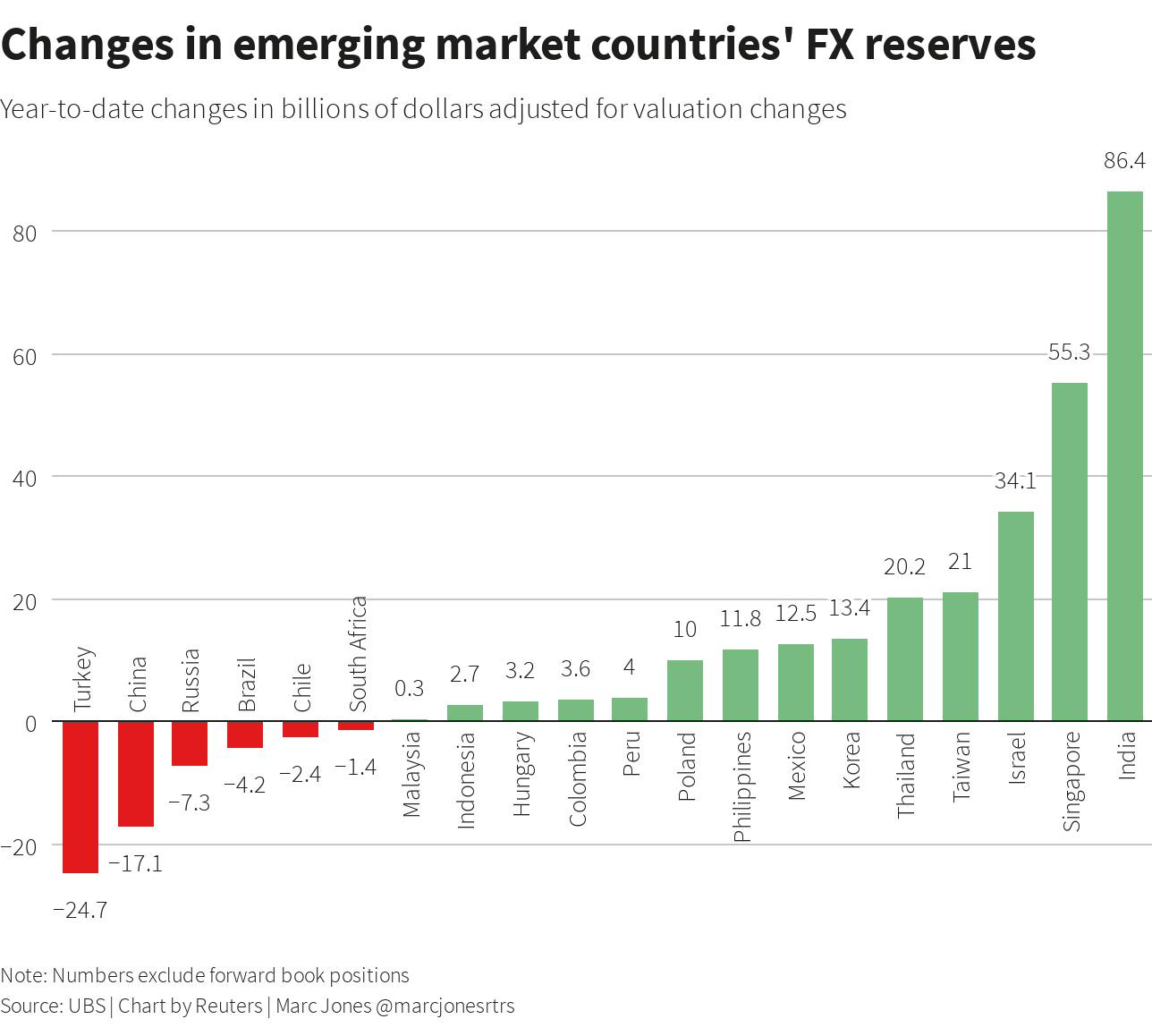
“If you look at the areas in which potential currency wars could break out it would be the areas which have attracted the most capital flows or the most equity flows,” PIMCO’s head of emerging markets portfolio management Pramol Dhawan said.

He cited Taiwan, South Korea and China as the main hotspots, and potentially India going forward. It has already stacked up $85 billion worth of dollar reserves this year, Narain at UBS added, helping keep the rupee on the leash.

DON’T WORRY, BE HAPPY

It is usually the pace rather than the extent of FX moves that lead countries to act.

When Brazil’s Guido Mantega declared a currency war had broken out in September 2010, the dollar had lost more than 10% in around three months. And it didn’t stop there, falling 17% by June 2011.

This time around the greenback is down 11% in eight months. But U.S. investment bank Morgan Stanley thinks it is still 10% overvalued and Citi forecasts a record 20% drop next year as economies recover and the Federal Reserve continues stimulus.

IIF chief economist Robin Brooks doubts even that kind of move would trigger a full-blown currency war.

Taking away the 8% leap in China’s yuan, EM currencies are still down 5% this year, and some of the hardest hit, like Brazil’s real and Turkey’s lira, are down 25% and worth a fraction of what they were a decade ago.

“Honestly, if I were an EM policymaker, every day where my currency was strengthening I would be happy,” Brooks said, noting that a stronger currency also makes it cheaper to repay the dollar-denominated debt that has been piling up.

Nevertheless, he thinks the euro and the yen will be shoved higher, requiring the European Central Bank and Bank of Japan to respond. China’s reaction will also be watched closely, while Thailand’s statement that it is watching the baht’s rise “24 hours a day” highlights the building tensions.

“Our concern is the speed of the adjustment,” Thailand’s central bank governor, Sethaput Suthiwart-Narueput, said last week. “It has been largely nothing to do with us”.

Source: Reuters

Read More from The Rio Times

The Rio Times · Power Map
See who really holds power in Latin America
Click to open the Power Map
All News Brazil art news Brazil Best English News Brazil Best News Brazil Brazil Brazil economy Brazil football Brazil Museum Fire Brazil national football team Brazil News Brazil Pension Reform Brazil Real Brazil Visa Brazilian Newspaper Business News Brazil Covid-19 Argentina Covid-19 Brazil Covid-19 Latin America culture news Brazil currency war English Culture News Brazil English Info Brazil English Info Rio de Janeiro English News Argentina English News Belo Horizonte English News Bolivia English News Brasilia English News Brazil English News Chile English News Colombia English News Cuba English News Curitiba English News Ecuador English News El Salvador English News Falklands English News Florianopolis English News Guetamala English News Latin America English News Mexico English News Panama English News Paraguay English News Peru English News Rio de Janeiro English News Sao Paulo English News Uruguay English News Venezuela English Newspaper Brazil English Newspaper Rio de Janeiro Escape from Venezuela Falkland Islands Falklands General News Brazil Info Brazil Info Rio de Janeiro Invest in Brazil Mining News Brazil Natioal Museum of Brazil News Argentina News Bolivia News Brasilia news Brazil News Chile News Colombia News Cuba News Ecuador News El Salvador News Falklands News Florianopolis News Guatemala News Latin America News Mexico News Panama News Paraguay News Peru News Rio de Janeiro News Uruguay News Venezuela Oil News Brazil President of Brazil Rio de Janeiro São Paulo News Science News Brazil travel Brazil Travel News Brazil Universities Brazil

Rotate for Best Experience

This report is optimized for landscape viewing. Rotate your phone for the full experience.