“Argentina on the verge of an unprecedented health catastrophe,” warns intensive care physician
RIO DE JANEIRO, BRAZIL – For Arnaldo Dubin, the situation of the healthcare system, added to the epidemiological reality, suggests that “a worse disaster than the one experienced last year is in the offing.”
The statements of intensive care specialist Arnaldo Dubin never go unnoticed. It must be because, as he himself acknowledges, intensive care specialists learn to work with the worst-case scenario.
After the latest restrictions announced this week by the national and Buenos Aires authorities and given the sustained increase in new cases of COVID-19 throughout the country, the specialist predicted that Argentina “is on the brink of an unprecedented health catastrophe”.

According to the doctor, who is also a professor and researcher at the National University of La Plata (UNLP) in an interview with Infobae, “when the first wave passed in the northern hemisphere, it did not happen here; the first stage of the pandemic was never overcome, and there was always a very high level of viral circulation.”
“And now, when the cold weather has not yet arrived, we are facing a precipitous increase of cases almost at the levels of last year’s peak,” he emphasized.
With an average of more than 1,200 cases per day in the last seven days in the city of Buenos Aires and a high level of new infections in the province of Buenos Aires, Dubin observed: “Unlike the first wave, when there was a quarantine that saved thousands of lives and allowed strengthening a health system that was already weakened and made the curve grow slowly and that all the sick could be treated, now we are in the second wave with an abrupt increase in the number of cases and a health system that is in much worse conditions than in the first wave.”
When asked about this, neurologist Conrado Estol, who the pandemic has made a voice of almost obligatory consultation due to his permanent study of data and indicators, preferred “not to make dire forecasts”, but recognized that “the situation is delicate”, and analyzed: “The number of hospitalized patients is increasing in a health system that has always been weak; younger people are being hospitalized, there is less staff -who are also tired- and who are perhaps not as expert.”
“We health care workers can’t give more,” admitted Dubin. During the first wave, there was an increase in CABA lethality, and one hypothesis is that this increase had to do with the overload of intensive care units.” Dubin, together with other colleagues, has carried out a study with almost 2,000 critical mechanically ventilated patients and characterized the determinants of mortality, among which they evaluated the severity of the disease, complications, comorbidities, etc., “but an independent determinant of mortality was the month of admission.”
“Mortality always decreases over time with a new disease, and here it was the other way around, and what we suppose is that this has to do with the stress on the health system,” he said about the conclusions of the study, which is still under review for publication.
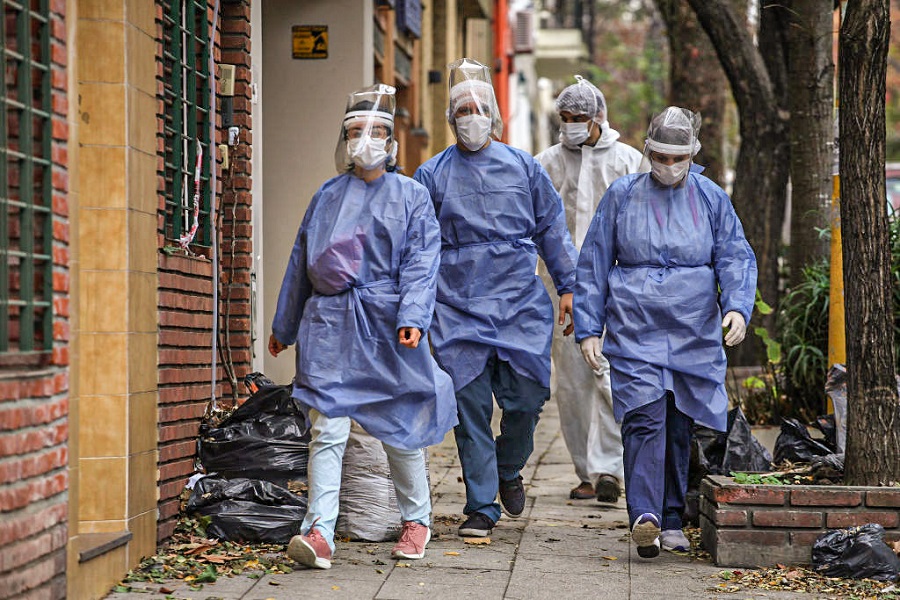
After highlighting that the intensivists, nurses, kinesiologists, and health personnel, in general, are “exhausted”, he emphasized: “We were few, and now there are many colleagues who have become ill and have not returned, there are deaths. We are in terrible conditions to face the second wave.”
“At times there is a lack of medicines that are essential for mechanical ventilation; now, for example, there is a lack of enoxaparin, and the reason is that the main supplier in Argentina is not delivering and unofficially it has been said that its production has been diverted to other markets -he considered-. This is an example of the lack of protection in which we find ourselves, and it can be extrapolated to what is happening with the low availability of vaccines.”
Estol accepted that “the health system is in a delicate situation and dire things are happening in neighboring countries; some are under control, as in Uruguay, and others are more serious, such as what is happening in Brazil, Paraguay, Ecuador and Chile with situations of extreme collapse.”
In this sense, for him, the variables that operate to know what will happen are three.
And he enumerated: “In the first place, the people. I believe that there is a responsible and aware majority who wear masks and have already understood how to reduce infection risk. Still, there will always be a critical mass of people who hold clandestine parties, although there is a respectful majority.”
Secondly, he placed the role of testing. “Last week, more than 80,000 PCR tests were carried out on Friday when there were more than 12,900 cases. Why not carry out 100,000 or 150,000 per day and find as many infected people as possible and isolate them? And at the same time, make a strong incursion into genomic sequencing to know how much the variants of the virus that are already known to be circulating in the country multiply and transmit.”
And finally, vaccination. “In low and insufficient doses, what is certain is that the doses are constantly arriving; I believe that if this arrival is maintained and they are applied neatly, we are creating immunity.”
When asked about the role played in this catastrophe of which he speaks by the diseases neglected during the last year, Dubin said that “there is no doubt that other diseases were neglected for multiple reasons and now this translates into a great tension in the health system, in which the two hospitalizations are accumulated: COVID and non-COVID.”
In the last 24 hours, 10,154 cases of coronavirus were diagnosed in the country, bringing the total to 2,332,765 since the beginning of the pandemic. According to the daily report issued by the National Ministry of Health, the number of deaths amounts to 55,736.
Also, Intensive Care Unit (ICU) beds in the country are 56% occupied (61% in the AMBA). According to the Worldometers statistical site, Argentina is the eighth country globally with the highest number of people suffering from severe coronavirus, with 3,702 patients.
“Most people take care of themselves if the virus is tested more and sequenced to know how much it spreads and if vaccination, however insufficient and slow, is constant and generates immunity, it should be possible to avoid an extreme catastrophe,” said Estol. “No one can argue that the situation is alarming. Still, it seems to me that there are things that can be done.”
Source: Infobae
More: Argentina news in English, every day from The Rio Times.
This article was produced by The Rio Times’ automated newsroom system. How we use AI · Report an error · Editorial responsibility: Matthias Camenzind, Editor-in-Chief