Jacinda Ardern Turns New Zealand Into New Utopia Where Everyone Wants To Live
RIO DE JANEIRO, BRAZIL – For years we have been sighing over Scandinavian and other Nordic countries’ utopia. We wanted to be mothers in Finland. We dreamed of our children going to daycare for R$300 (US$55) a month, with public education until their doctorate and working a maximum of eight hours a day.

Because in Helsinki, if you lose your wallet and someone finds it, they will return it. Because they even had a word for the (pre-coronavirus) glory of staying home in nothing but their underwear (kalsarikänni)! And a sauna per every two inhabitants! Who wouldn’t like to live in this honorable country that has found the formula for happiness? But the fact is that a few months ago, the utopian progressives stopped longing for Finland.
Now they turn their jealous eyes to Jacinda Ardern, New Zealand’s Prime Minister and the new icon of social utopia. Everyone dreams of moving to New Zealand. To get a sense of this, just check social media every time Ardern proposes a social measure:
“I love you. What do I have to do to live over there?”, “What do we do to make you the president of the whole planet?”, “How not to love you?”, “I want a president like her! “, “Jacinda, you did it again”, “I want to go to New Zealand”, “I’m in”, “New Zealand is all good” or “Take me there” are some of the enthusiastic comments that followed the retweets when EL PAÍS newspaper published Ardern’s latest proposal on Twitter: to establish a four-day working week to revive the economy after the impact of the coronavirus and thus be able to boost tourism while helping citizens to reconcile professional and personal life.
Since becoming New Zealand’s prime minister at age 37 in 2017, Jacinda Ardern, the third woman to head the government in her country and its youngest leader since 1856, has become a global political pop icon of the left-wing, particularly among those who surf the progressive Internet bubble: those who applauded her gesture of silencing the sexists when they asked her why she wasn’t a mother (she has been), or those who defended her against a smear campaign by the right-wing (#TurnAdern).
Following the trail of another political pop star, US Congresswoman Alexandria Ocasio-Cortez, Ardern makes strategic use of social media and does not hesitate to appear live on Instagram in a sweatshirt to chat with her followers about the coronavirus crisis. She also relies on external help: the Facebook account @NZLPMemes, allegedly with no political background, gathers a community of over 40,000 followers who enjoy and viralize positive memes about Jacinda’s proposals. Everyone loves her; her face is printed on T-shirts (which run out of stock quickly).
A Google search will show 119,000 hits for “Jacinda merchandise”. There are embroideries on sale for €35 that read “WWJD”: What would Jacinda do? “Team Jacinda” t-shirts for €42, masks covered in tiny Jacindas for €9, illustrations in which she takes the form of Princess Leia, Wonder Woman, or even the historically iconic feminist character Rosie the Riveter.
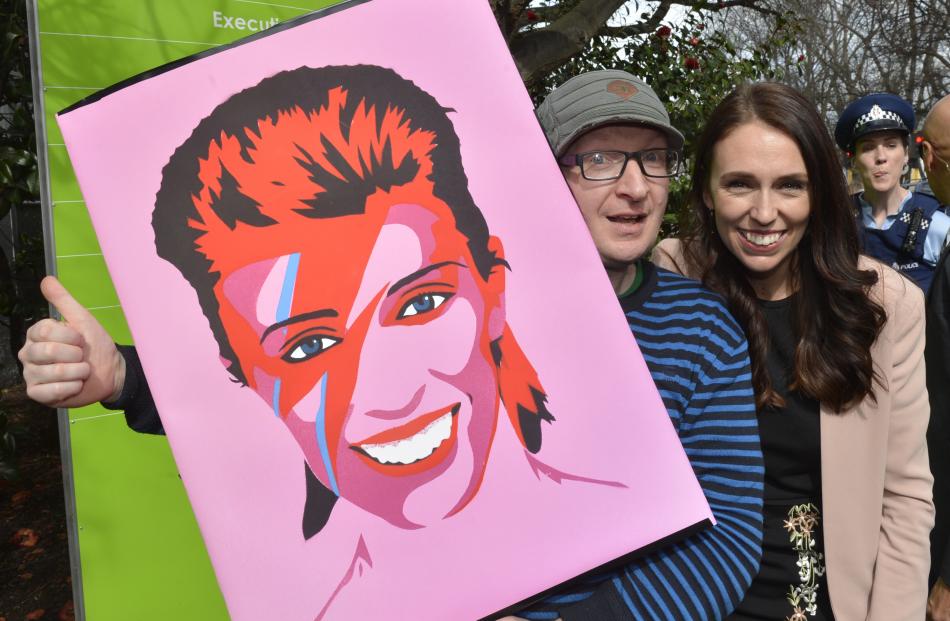
Feminist iconography is also combined with pop veneration: Jacinda Stardust’s illustration, giving a new meaning to Bowie’s cover designed by Phoebe Philo’s mother for his Aladdin Sane album cover, is one of the most popular and reproduced. It was devised by artist Todd Atticus in a Madrid café in just two hours after her main rival in the campaign, Bill English, tried to belittle her in a televised debate by saying, “Now that the stardust [Bowie’s character’s name as well] has settled down, we can see the frailty of her proposals”.
As with “Nevertheless she persisted” against Elizabeth Warren, the disqualification became a viral motto in her favor. Three years after that sentence, her fame and veneration for her country have not dwindled at all.
Why does the Internet want to move to New Zealand?
What does a small country in the Southwest Pacific with less than five million inhabitants have for everyone to idealize it these days?
For one thing, it has a charismatic leader who is committed to social policies. Ardern joined the list of female leaders who have shown effective health and social management in the face of the coronavirus: she passed a law which, under the motto of “hit hard and hit fast”, managed to flatten the pandemic curve in just three weeks (with only 21 dead so far). Although it is the programs, agendas, and ideology that define the results, and gender is not the sole criterion for a politician’s worthiness, Ardern proved that New Zealand is an appealing country to live in.
Ardern paved the way for a unifying policy when she said “they are us” and succeeded in managing the crisis caused by a white supremacist terrorist attack against mosques, covering herself with a hijab and hugging the victims’ families in a public event: “It was not weakness that Jacinda Ardern showed: rather, she displayed an unusual strength in the ruling political class, recognizing vulnerability as the reference point for considering politics from elsewhere,” wrote Máriam Martínez-Bascuñán on the gesture.
She also said that her country was “on the right side of history” in the fight against climate change when it passed the historic zero-carbon law and committed to eradicating greenhouse gas emissions by 2050, as the Paris Agreement demands.
Her coalition government approved one of the most applauded social packages against the anxiety epidemic, given the high rates of gender violence detected when she took office (it is among the worst-ranked in the OECD). She has invested the equivalent of about R$6 billion in all, of which a good part will be allocated to the so-called “lost center”: New Zealanders who suffer mild to moderate anxiety and depressive disorders, those in an intermediate stage and who do not require hospitalization, but whose discomfort significantly affects their quality of life. She also announced that she will invest another billion reais in policies against gender-based violence, including a network of shelters for battered women, assistance to indigenous Maori citizens, and educational courses for attorneys.
As a result of the Covid-19 crisis, she announced a 20 percent cut in the salaries of public executives, ministers, and, of course, her own. And she again made history by proposing to establish a four-day work week to revive the economy after the impact of the coronavirus.
“I heard a lot of people say we should have a four-day work week. It’s an agreement that should be made between employer and employee. But we have learned a lot during Covid-19, about people’s flexibility working from home and the productivity you can get out of it,” she said.
Meanwhile, the Internet will continue to dream of moving to New Zealand.
Source: El País
More: Brazil news in English, every day from The Rio Times.
This article was produced by The Rio Times’ automated newsroom system. How we use AI · Report an error · Editorial responsibility: Matthias Camenzind, Editor-in-Chief