The Intricate History of Ibirapuera Park, São Paulo Locals’ Favorite
SÃO PAULO, BRAZIL – Today, when we stroll through the famous and popular Ibirapuera Park, we do not know what a long history this masterwork had suffered in the big urban jungle that is São Paulo. We have reconstructed the history of its origin for you.
The region surrounding the beautiful Ibirapuera Park was once, in the distant past, a wetland part of a large indigenous village. Its very name reflects its origin: Ibirapuera means “rotten wood” or “rotten tree” in Tupi language.

The idea for the park arose in the late nineteenth century, more specifically in 1890, when the region’s lands, which were previously not incorporated into the municipality, became part of the city of São Paulo.
This area was only recognized as a São Paulo city heritage in 1916, through State Decree No. 2669. Before this ordinance, the region was part of an area known as Várzea de Santo Amaro. Once the bureaucratic red tape was resolved, it was time to find a worthy fate for these lands.
In 1918, the third mayor of São Paulo, Washington Luís, decided to divide part of this land into small lots. His idea was to start developing the region. The subdivision was approved by Law No. 2122 of 1918, when the land was sold by public auction and today comprises the district of Jardim Lusitânia. However, this project was quickly abandoned because it met too much resistance from the population.
After several other projects had been approved, but then rejected during the time from 1918 until 1945, a truly new proposal for the construction of the Ibirapuera Park emerged in 1948 .
Conceived by members of city hall, on January 14th that same year, the new design contained a large green area and a list of buildings to be built, with their area and construction value estimates. This project confirms the circular square and implants in its center, as determined by the government, the July 9th Monument.
Ibirapuera was first considered an artistic creation
Christiano Stockler das Neves emerges at this moment in the history of Ibirapuera. In 1951, he harshly criticized the concept, saying that Ibirapuera should be more than just a project; it should be a work of art for the city.
Stockler was the founder of the Faculty of Architecture and Urbanism of Mackenzie Presbyterian University, the oldest in São Paulo.
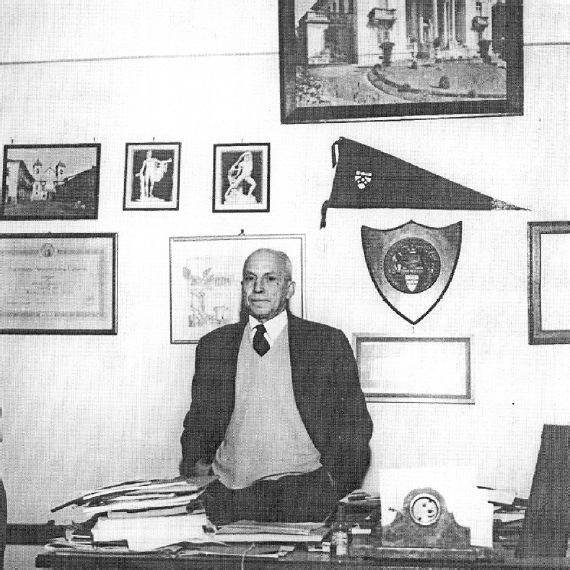
He introduced his proposal for the park in the spirit of the City’s 4th Centennial celebrations which was about to happen. In the opinion written by the famous architect, he reaffirmed that Ibirapuera Park should be an artistic creation.
However, despite Stockler’s efforts, Cicillo Matarazzo, president of the 4th Centennial Commission, with the support of municipal and state officials, established a planning team, which devised a study completely contrary to that presented by Stockler das Neves, instigating a new way of envisioning the urbanism and architecture proposed for the park.
Ibirapuera Park, according to their proposal, would focus on the activities of popular and cultural entertainment and exhibitions, which would massively attract the general public. However, this Planning Team’s work did not last long. In January 1951, the members asked to be removed due to a severe financial crisis that struck São Paulo.
As a result, Cicillo Matarazzo was virtually compelled to invite architect Oscar Niemeyer to idealize the project. The hiring of Niemeyer would primarily give continuity to the style that guided Matarazzp’s thoughts regarding the park’s design, even if it differed from the previous proposal.
Niemeyer’s team and the final project
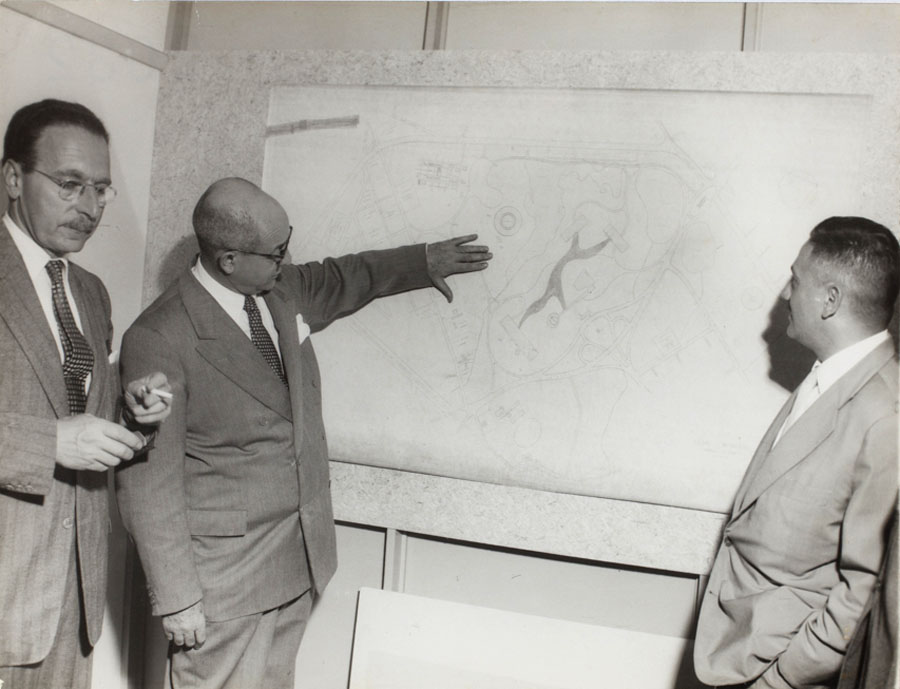
To design the final project for the park, Niemeyer summoned the very best. His final team was made up of Zenon Lotufo, Eduardo Kneese de Mello, and Hélio Cavalcanti, with the cooperation of Gauss Estelita and Carlos Lemos.
![Mockup of the definitive project for the Park, approved in 1953. Author: Oscar Niemeyer and group [Acervo Divisão de Iconografia e Museus - DPH/SMC/PMSP].](https://www.riotimesonline.com/wp-content/uploads/2019/08/Ibir6.jpg)
The first idea consisted of a set of large buildings united by a large marquee, surrounded by the lake and amusement areas and an area for foreign pavilions, with a high platform entrance, which would allow wide-ranging views.
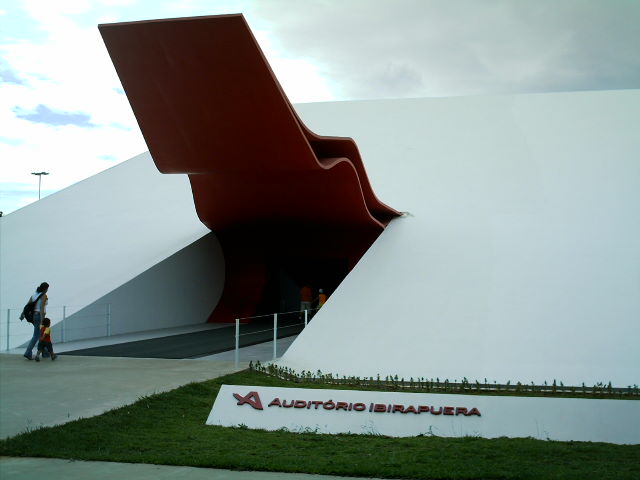
A large esplanade would also be built to connect two large buildings, studied together, which would serve the Auditorium and Planetarium as the most relevant architectural element of the exhibition.
The main issue that prevented the concept was the fate of the marquee after the end of celebrations.
The proposal clearly mentioned demolishing a large part of the buildings, leaving only the Auditorium/Planetarium, the Pavilions of Industry and Agriculture and the Restaurant. In this plan, the marquee would also be demolished, and an aquarium would be erected on site. In his presentation to the municipality, this project was severely criticized for its constructive unfeasibility and high cost.
Thus, the project needed to be revisited and, in 1953, it was approved with a narrower marquee, and with a building at each end. All pavilions suffered changes in location and size and, of course, some points such as the restaurant and a monumental entrance were eventually removed.
The Pavilion of Agriculture, currently the MAC/USP (Museum of Contemporary Art, University of São Paulo, former DETRAN); the Pavilion of Industries, now the Biennial Foundation Building; the Pavilion of Nations, now the Manuel da Nóbrega Pavilion; the Pavilion of States, currently the Prodam Building; and the Exhibition Pavilion, now known as Oca — the Lucas Nogueira Garcez Pavillion.
The Ibirapuera Park was officially inaugurated on August 21st, 1954 and conceived as an art and culture, recreation and sports venue project.
(Source: São Paulo In Foco)
More: Brazil news in English, every day from The Rio Times.
This article was produced by The Rio Times’ automated newsroom system. How we use AI · Report an error · Editorial responsibility: Matthias Camenzind, Editor-in-Chief
Living in or visiting São Paulo? See this month's events and our São Paulo city guide with rents, safety and upcoming concerts.
Brazil runoff, Sunday, October 25: When is the Brazil runoff election. Latest: Brazil runoff polls, Flávio 51%, Lula 49%.