Brazil’s Recession Cut Workers’ Real Income by 16% in Five Years
By Iolanda Fonseca
RIO DE JANEIRO, BRAZIL – In addition to having killed off jobs, which led to an increase in the number of informal workers, the recession years have also eaten away at the income of workers in most sectors.
Depending on the area of operation, the actual loss (adjusted for inflation) exceeded 16 percent in the last five years. Of the nine private sectors analyzed by the Brazilian Institute of Geography and Statistics (IBGE), five registered a significant drop in monthly employees’ income.

Between the first quarter of 2014, before the recession, and the first three months of 2019, housing and catering workers (hotels, inns, restaurants or food sellers), construction and transport workers have suffered the most considerable income loss, from 7.2 percent to 16.3 percent, according to data from the National Household Sample Survey (Pnad) by IBGE, according to LCA consultancy reporting for leading daily paper Estado de S.Paulo.
Among private sector workers, only those in agriculture had a significant actual increase of 5.2 percent in their usual income over the same period. In the group, including those working in the public sector, an even more significant actual increase of 7.5 percent was recorded.
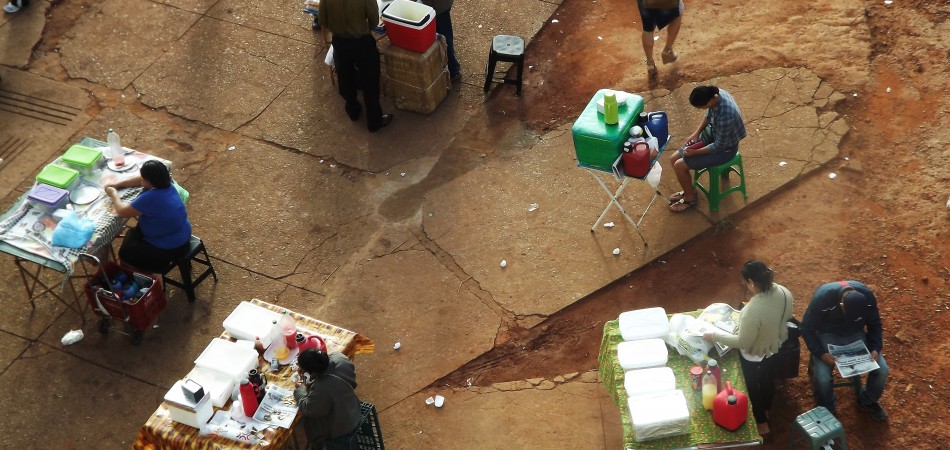
The drop in household income and the increase in informal labor – mainly in activities related to services, such as App transport and food sales – and the collapse of the construction sector helps to explain these workers’ lower income, says economist Cosmo Donato, of LCA.
On the one hand, families are less able to afford meals outside the home, transportation, and leisure today than they were in 2014, says Donato. “On the other hand, those unemployed in industry and commerce have resorted to transportation and food to survive, selling food on the street or becoming App drivers, for instance. Informal labor has dragged down income.”
Wallinson de Melo, 34, a private chauffeur and taxi driver, is among the workers who have felt the impact of increased informality in their sector. “Until 2014, we could easily get up to R$12,000 (US$3,000) per month.
That’s when I fulfilled my dream of buying a house for my mother in Paraíba. Today, if I’m lucky, I make R$6,000. Because of unemployment, people switched from taxis to buses, and the competition increased; many engineers became Uber drivers. Those days won’t come back.”
Many who lost their jobs were forced into informal labor or got new positions with lower salaries; those who remained employed failed to be promoted, says economist at the University of Brasília (UnB) José Luís Oreiro.
“The restaurant waiter with less money in his pocket spends less on the grocery store. The grocery store owner stops going to the restaurant. The decline in regular income has a cascading negative effect on the economy.”
The recession is further reflected in workers’ incomes. The businessman who had plans to expand gave up.
“Many hotels have temporarily deactivated some floors during periods of weaker activity,” adds Darly Abreu, director of Sinthoresp (a union bringing together hotel, restaurant, snack bar, and bar workers, among others).
He points out that, in addition to less regular income, those who work in restaurants are tipped less than before the recession.
(Source: O Estado de S. Paulo)
More: Brazil news in English, every day from The Rio Times.
This article was drafted with automated assistance and reviewed before publication. How we use AI · Report an error · Editorial responsibility: Matthias Camenzind, Editor-in-Chief
Brazil runoff, Sunday, October 25: Brazil runoff start time and results schedule. Latest: Brazil runoff polls, Flávio 51%, Lula 49%.