Urban Installation Exhibitions Will Occupy Prominent Rio Squares This Afternoon
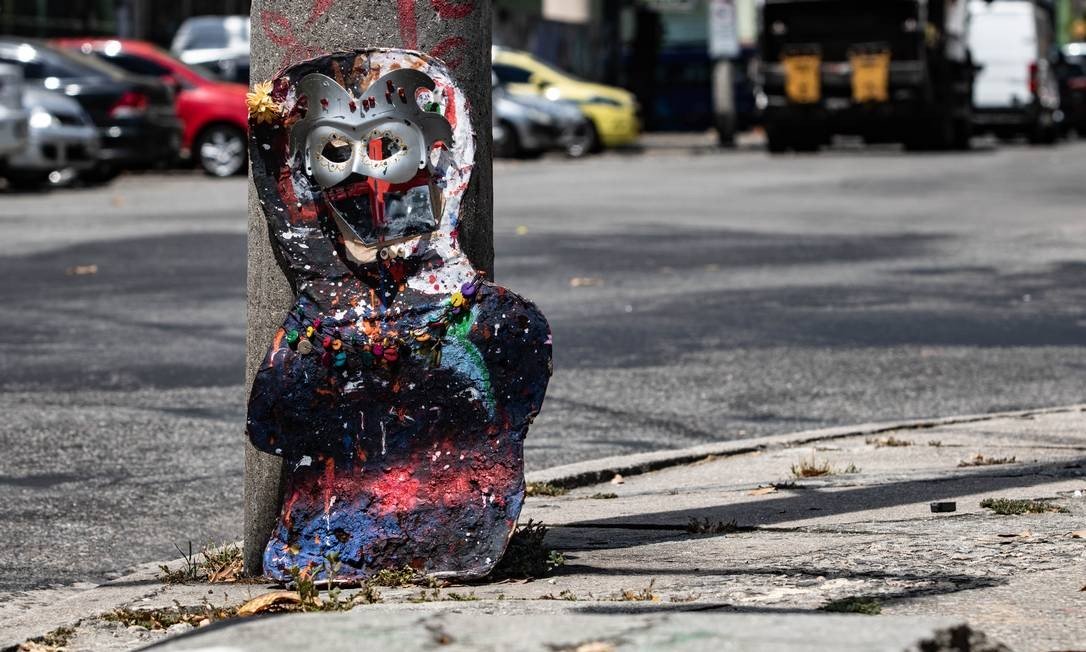
RIO DE JANEIRO, BRAZIL – The ‘Interferências3’ (“Interferences3”) exhibition, organized by the digital culture center Oi Kabum!Lab, considered the meeting and resistance point of Rio’s popular youth, promises to take over the city of Rio de Janeiro today, November 16th, with a set of urban installations and public performances by more than 70 artists from the outskirts of the capital city of Rio de Janeiro.

With varied topics and styles, the works were produced in the Laboratory of Artistic Interventions of Oi Kabum!Lab. The exhibition is the result of a partnership between the organization of the third sector Center for the Creation of Popular Image (CECIC) and the Municipal and State Departments of Culture. Through the Rio de Janeiro State Culture Incentive Law, the Oi Futuro Institute, the social innovation unit of Oi Telecommunications Company, also sponsors the exhibition.
The urban interventions will take place in Largo do Machado, a square in the southern part of the city, and in Praça Mauá, a square in the port area, both in the afternoon. After the show, each group will be free to take the projects to other parts of the city, such as the Maré Complex favela and Madureira Park.
On December 7th, the works will again be presented at an exhibition at the Hélio Oiticica Municipal Art Center, in Tiradentes Square, downtown Rio de Janeiro. The exhibition will be open to the public in this venue until February 1st next year.
Art and technology
The intervention artists work in the field of art and technology, with videos, photos, visual arts, virtual reality, mapped projection, performance, using a programming language focused on artistic installations.
“All styles of art and technology can be found at Oi Kabum! Lab to develop hybrid artistic intervention projects. They blend various techniques and styles to produce this artistic intervention, sometimes on the street, in the square, or in more closed environments, such as a festival, a soiree. These are hybrid artistic events”, explains Fernando Mozart, one of Oi Kabum!Lab’s coordinators.
The majority of the more than 70 artists who will take part in today’s event and the exhibition at the Municipal Art Center Hélio Oiticica come from favela communities in Rio de Janeiro, the metropolitan region and the Baixada Fluminense suburbs. Most of them come from neighborhoods far from downtown. According to Mozart, the location of Oi Kabum!Lab, in the Calouste Gulbenkian Center, near the Central Station, enables people to come by train and subway.
“It’s amazing how they value the activity to come from so far away from the center, so they can take part in this laboratory,” says Mozart. The Calouste Gulbenkian Center belongs to the Municipal Secretariat of Culture of Rio de Janeiro.
Talents
Over the years, Oi Kabum!Lab has been finding talents among the residents of needy areas, says Mozart. “They are people with tremendous potential. When we find out that these youths are so powerful, so capable of expressing themselves artistically and contributing with their vision of the city and the contemporary art circuit because what they bring with them through their projects are their own perspectives, of those living the life that they live”, he comments.
According to the coordinator of Oi Kabum!Lab, the project complements the conventional art circuit, which usually expresses middle-class points of view. “There is a great enrichment of Rio de Janeiro and Brazilian art. The city benefits from this, the creative economy benefits greatly from it, because there is not only a promotion of the creative economy but also a promotion for a direction that, sometimes, is not benefited. The youths regarded as peripheral, are suddenly very important to renew and to innovate our contemporary art circuit”, he declares.
Free choice
The artists have divided the set of artistic installations and public performances into four topics: urban life; environmental dystopias; equality and black culture; and body-mind. The laboratory supports the development of these projects with infrastructure, material and guidance from artists and art and technology professionals. “We are available to provide a creative incubation environment, to guide them in what they need in relation to style, technique, and content related to art and urban culture. But they are the protagonists of their projects,” explains Mozart.
The Interferências3 exhibition commemorates ten years of partnership between Oi Futuro and the Center for the Creation of Popular Image (CECIP), a civil organization that pioneered the spread of access to the media and to digital culture. The NGO was founded in 1986 by Paulo Freire, Claudius Ceccon, Eduardo Coutinho, among others. Since 2009, Oi Kabum! has become a reference in connecting artists and cultural producers from the periphery of Rio de Janeiro, with the involvement of more than two thousand youths in its courses and workshops.
Oi Futuro and Oi Kabum! are confirmed participants in the official program of the next edition of the SXSW EDU Conference & Festival, the largest innovation event in the world, that will take place in March 2020, in Austin, Texas, United States.
Source: Agência Brasil
Editorial responsibility: Matthias Camenzind, Editor-in-Chief · Editorial standards · Report an error
Living in or visiting Rio de Janeiro? See this month's events and our Rio de Janeiro city guide with rents, safety and upcoming concerts.