Brazil’s Decreased Homicide Rate vs. Increase in Police Killings
Column by Henry Montalto, Contributing Reporter
RIO DE JANEIRO, BRAZIL – Seemingly confirming one of Bolsonaro’s presidential campaign promises, Brazil registered a 23 percent drop in its homicide rate for the first quarter of 2019. On the other hand, the number of police killings rose eighteen percent, making 2019 the deadliest year in decades.
While the drop in murders for 2019 may be correct, one must ask “why” or, more specifically, “how” — a truce between Brazil’s deadliest gangs, police interventions, or both?
To verify this published drop in crime, one must take a close look at the data and where they stem from. Unfortunately the homicide data, which come from two separate government sources, rarely match, which leads to contradictions.

The Ministry of Health and Public Safety data have an alarming difference for 2017. Public health records account for deaths in interventions and how the person died. The Public Safety data, however, accounts for the type of crime, but not always for the deaths.
In recent years the difference in the respective homicide data was within the margin of error of one percent, but in 2017, it was nearly three percent. This sounded alarm bells for public safety advocates across Brazil.
The data showed the widest divergences in the states of Bahia and Amazonas. Bahia police registered 572 fewer deaths than reported by the Ministry of Health, and Amazonas health authorities registered 403 more victims than the security forces.
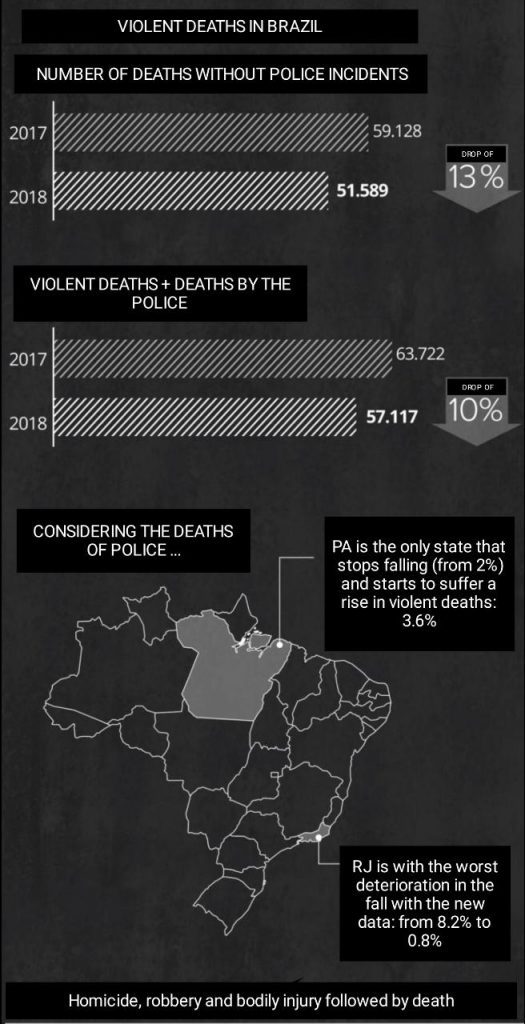
It’s important to note that this is data from 2017. In 2018 the country registered a significant reduction in violent deaths — 51,579 — down from 63,895 in 2017. However, the reasons for the decrease remain foggy and subject to debate.
Atlas of Violence and IPEA (Insitute of Applied Economic Research) show that within the 2017 data 1,707 deaths were not reported, so the correct number for that year was 65,602 homicides in Brazil.
Rio de Janeiro police killings jumped from 1,127 in 2017 to 1,534 in 2018, a 27 percent increase. Overall, 2018 police killings in Brazil increased 18 percent with 935 more than in 2017. Similarly to Rio de Janeiro, São Paulo police killings had risen by 46 percent in 2017.
This is a common occurrence in many Brazilian states, and it is on the rise. Will Brazil continue on this path?
First of all, there is no determining reason for the considerable reduction in homicides from 2017 to 2018. Historically, the homicide rate in Brazil has been like a roller coaster, going steeply up and sharply down, without apparent explanation.
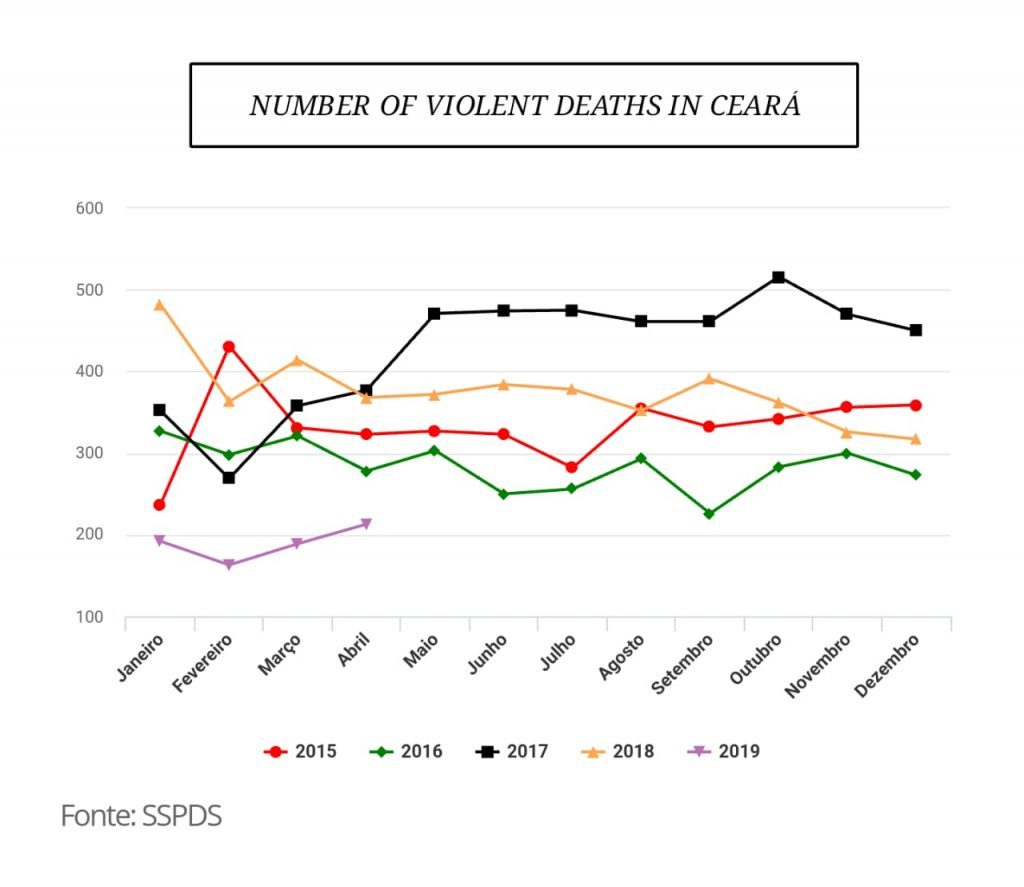
In Ceará, the first two months of 2019 had only 355 homicides, down from 844 at this time in 2018; however, 2015 had far higher rates. For 2019 the rate has been increasing again.
São Paulo data show that during the past ten years, homicide decreased from eleven victims per 100,000 residents to 6.5 in 2018. However, in March of 2019, homicides increased 27.5 percent in the city from 58 in 2018 to 74 but fell 13.8 percent in the state.
Given these wide unexplained fluctuations in the past, one can wonder whether the policies of the Bolsonaro administration are working.
Increased police intervention may not be the salvation of Brazil, but represent a growing war on some segments of its population. A lack of accurate statistics and data, together with the many discrepancies, should ring alarm bells.
Another issue is the lack of reporting for gunshot wounds. We have yet to see if the homicide rate shown by the health authorities dropped because of better technology and treatment, or because of new laws requiring ambulances to be present during police incursions.
In conclusion, it is arguable that increased police intervention and policy has created a system of unjust killings in Brazil. It’s of utmost importance that the data be improved and better technologies are put in place to monitor police killings and injuries.
The policies of the Bolsonaro administration are seemingly not worth the massive increase in police killings, whose cost is an emotionally damaged Brazil for future generations. A country at war with its population is certainly not the best path forward.
Is there sufficient proof that these “shoot first” policies have deterred homicides in Brazil? The definitive answer at this time is unavailable. As crime, rapes, assaults, and theft have only minimally decreased, attributing reduced crime rates to intervention by security forces is premature.
More: Brazil news in English, every day from The Rio Times.
This article was produced by The Rio Times’ automated AI newsroom. Editorial responsibility: Matthias Camenzind, Publisher and Editor-in-Chief. The Rio Times also runs Ask Rio Times, which answers from 100,000+ of our own articles, the daily Latin America Power Map, and prediction-market odds on elections and markets.. How we use AI · Report an error