The indigenous tribes of old Rio and the names that stay with us
RIO DE JANEIRO, BRAZIL – Most people are vaguely aware of the fact that indigenous tribes lived in Rio de Janeiro before the arrival of the Portuguese, but few people know much about them or are aware that many places name in Metropolitan Rio de Janeiro are based on the Tupi language, some even on specific villages that existed in the neighborhoods that now bear their names.

The shores of Guanabara bay would obviously have been very different 500 years ago. As of now, the mountains would have been covered in rainforest, but the lowlands would have been a mixture of forest and swampland instead of the crowded urban intensity we find now.
Tupinambá tribes were part of the wider Tupi ethnic group and lived in settlements that usually consisted of 200-600 individuals, but due to the particularly rich fishing around Guanabara Bay, some reports suggest populations of up to 2,000 in some “villages,” far larger than what most people imagine when thinking of tribal groups.
They lived from fishing, hunting, and manioc farming. They also had a strong revenge ethic which meant that tribes were required to avenge previous deaths in war. As such, there was frequent conflict between tribes that often involved kidnapping enemies.
These enemies would be allowed to live peacefully among their captors for weeks, months, or even years before being ritually killed and eaten in a communal barbecue. Despite these gory details, the quality of life among tribes good enough for many stranded Europeans to chose to stay living with them even when they had the option of returning to European settlements.
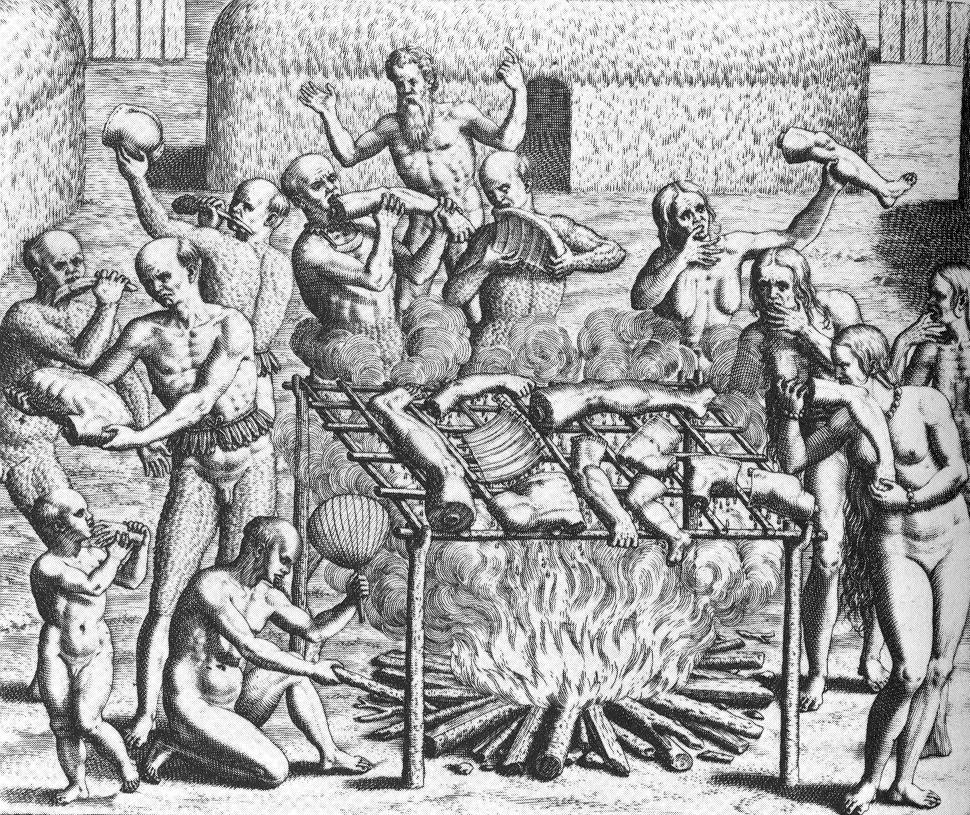
The practice of cannibalism among the Tupi was made famous in Europe by Hans Staden, a German soldier, mariner, and mercenary, traveling to Brazil to steal riches, who was captured by the Tupi in 1552. In his account published in 1557, he tells that the Tupi carried him to their village where it was claimed he was to be devoured at the next festivity. There, he allegedly won the friendship of a powerful chief, whom he cured of a disease, and his life was spared.
Maps and lists made principally by French traders and settlers (who were a stronger presence in the region than the Portuguese in the 1500s) tell us about the lives of these tribes, their language, and some of the villages and other place names, some of which we still find on maps of Rio de Janeiro to this day, 450 years after the original inhabitants were exterminated or driven away.
Here is a small selection:
- Taquara: from Tupi Takûar-usu-tyba, the name of a village in the West Zone neighbourhood of that name. The meaning is Bamboo-great-abundant.
- Tijuca: from “Ty” water and “iuk” rotten, meaning a swamp and referring to the swampy lands at the base of the mountains, not the mountains themselves.
- Nova Iguaçu: from Iguaçu River, “i” or “y” meaning water or river and “guassu” or “uassu” meaning great or big (this last element is very common place names).
- São João de Meriti: From Meriti River, itself deriving from the Meriti or Buriti palm that likes flooded areas such as would have been found by this river in the past.
- ]Guaratiba: from Guara, garça in modern Portuguese (heron) and Tiba (large quantity of something). An indigenous village near the modern neighbourhood in the West Zone.
Icaraí: from Acaru-u, Acará (Angelfish) and U, another variant of I/Y meaning water or river. So River of the Angelfish. - Carioca: Karióka, often said to come from “House of the White Man,” but more likely from Carijó, a related (but often enemy) native group from Southern Brazil and meaning something like “The House of the Indian”.
Many other places in Rio have indigenous names to this day, and others persisted for some time after colonization but eventually disappeared. Readers may have noticed that many villages were named after plants and animals. This common practice was partly because of the importance of local food sources, but also because the tribal chiefs often took the names of animals and so these became transferred to the villages.
In 1567, the Portuguese defeated a complex alliance of French and indigenous tribes. The remaining natives fled or were subsumed into the settler population, leaving us with only the names as a relic of their presence.
Tupi people
The Tupi people were one of the most numerous peoples indigenous to Brazil, before colonization. Scholars believe that while they first settled in the Amazon rainforest, about 2,900 years ago the Tupi started to migrate southward and gradually occupied the Atlantic coast of Southeast Brazil.
The Tupi people inhabited almost all of Brazil’s coast when the Portuguese first arrived there. In 1500, their population was estimated at 1 million people, nearly equal to the population of Portugal at the time.
European colonization
From the 16th century onward, the Tupi, like other natives from the region, were assimilated, enslaved, or killed by diseases such as smallpox or by Portuguese settlers and Bandeirantes (colonial Brazil scouts), nearly leading to their complete annihilation, with the exception of a few isolated communities. The remnants of these tribes are today confined to indigenous territories or acculturated to some degree into the dominant society.
More: Brazil news in English, every day from The Rio Times.
Editorial responsibility: Matthias Camenzind, Editor-in-Chief · Editorial standards · Report an error