São Paulo Vehicle Rotation Restrictions Lead to Public Transportation Crowding
SÃO PAULO, BRAZIL – The extended rotation implemented yesterday in the city of São Paulo removed cars from the streets in the capital’s business center, but led to crowding in public transportation.

The feeling for those who had to use the subway and train by late afternoon yesterday, when most people were returning home from work, was of a typical Monday, due to the number of passengers in the stations and trains. Except for the mandatory masks, it hardly seemed that the country was going through a crisis caused by the Covid-19 pandemic.
A reporter boarded the subway at 5:15 PM at República Station and made stops at the Sé and Brás subway stations and Brás CPTM train station. The number of passengers was constantly increasing, as on a typical working day, until 7 PM, when it was still busy, but less crowded.
At certain moments, despite the great adherence to masks, it was impossible for passengers to respect social distancing, as recommended by the World Health Organization (WHO), the Ministry of Health, state and municipal governments, and health experts.
12 to 15 percent increase in the morning
In an interview with Bom Dia SP, of TV Globo, the State Secretary of Transports, Alexandre Baldy de Sant’Anna Braga, said that CPTM and Metrô recorded a 12 to 15 percent increase in the number of passengers in the morning, mainly in the commuting stations.
The municipal secretary of Transports, Edson Caram, said that the extended rotation led to a reduction in the number of vehicles on the streets, although still below expectations. According to the new rotation system, vehicles with plates ending in odd numbers (1, 3, 5, 7 and 9) will only be allowed to travel on odd-numbered days; vehicles with even-numbered plates (0, 2, 4, 6 and 8) will only be allowed to travel on even-numbered days.
Nearly normal day in Brás
The Brás subway station’s access to the CPTM train station with the same name was crowded, with all snack bars open as usual, albeit with consumption at the counter prohibited. Only clothing and shoe stores were closed; a chocolate store and a perfume store had employees delivering products to customers at the door.
Contract and outsourced staff were all wearing masks, including in their resting moments. Passengers were fully compliant, although some wore the mask wrongly, many not covering their noses.
Sé was crowded
At Sé station – the blue line subway going to Jabaquara – the platform was crowded and the stairways were packed.
On the red line subway, also in Sé heading towards Itaquera, the flow was more reduced and increased progressively between 5:20 and 6:15 PM, but the time between trains was two minutes, similar to the normal day rush hour.
Clusters in accesses and trains
Between 6:20 and 7:00 PM, there were crowds in the subway access to the Brás train station, with an intense passenger flow towards the platforms of the various CPTM train lines. The largest flow observed occurred at 6:30 PM when a fully crowded train arrived at the station’s Platform 1.
A hospital professional continues to use public transports, as he provides personal training to outsourced hospital staff. He said that since Easter the number of people on the streets has been increasing.
“It’s sad because my mother is elderly and at home, but my brother and I are not. We may be bringing the disease to her, as it may have happened to my 85-year-old grandfather, who passed away last week. Everything suggests that it was Covid because he had severe pneumonia, was hospitalized for 18 days, and didn’t make it, but the test result hasn’t come out yet,” he said, asking not to have his name disclosed.
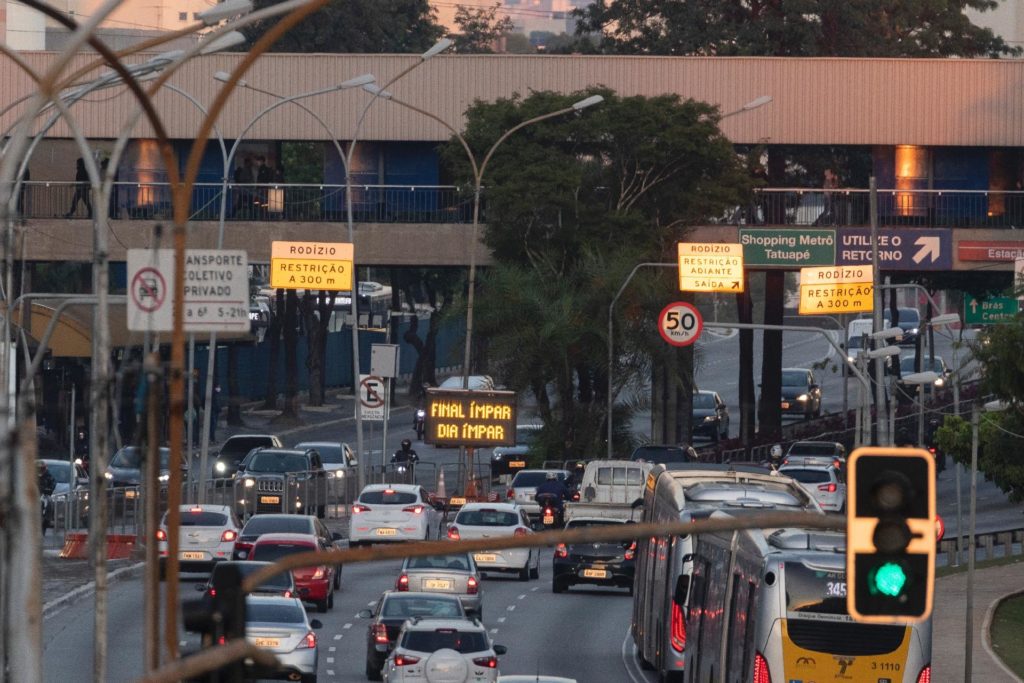
Car was switched to Subway
“They took the cars off the streets, but people who need to work take the bus or subway. My brother, for instance, is a mechanic and will go to work by car on a 25-minute drive. The driving time is one and a half hours. In other words, he’s exposed to the virus for another two hours, day in, day out, from now on,” he said.
For this hospital professional, who talked to the report while he was distracted by his cell phone, before taking the subway home to Brás, the solution would be for more companies to provide a structure for their employees to work from home.
“They should have stopped everything”
Driver João Ramos, working for the first time after a compulsory vacation period and returning by train to Guaianazes, seemed uncomfortable with the crowd.
“An absurd quarantine like that. Either they all stop, or nobody stops. I came back from compulsory vacation today and, because of the extended rotation, the flow is just like that of an ordinary day here at the station. This way, everybody is spreading the disease, taking it back and forth,” he said.
In his opinion, the restrictions should have been broader from the start of quarantine, with more classes at home. “It would have been much better if they’d stopped everything right from the start. If they stop more cars, they should send more people home. What’s the point of banning small cars and trucks? To make money?” he complained.
The state government’s Logistics and Transports Secretariat issued a statement saying that “there are no restrictions by the São Paulo government on truckers work, quite the opposite, a task force was established at the start of the pandemic to help the class keep services on São Paulo’s highways”.
Source: UOL
More: Brazil news in English, every day from The Rio Times.
This article was produced by The Rio Times’ automated newsroom system. How we use AI · Report an error
Read More from The Rio Times