“I Will Work to Unite Left, Not Only in Elections” – Defeated São Paulo Candidate Boulos
RIO DE JANEIRO, BRAZIL – Isolated at home with Covid-19, Guilherme Boulos says he wants to work at the national level against the distancing between left-wing parties after being defeated in the São Paulo mayoral second round of elections.
In a telephone interview on Monday afternoon, November 30th, the leader of the MTST (Movement of Landless Workers) stated that, despite his loss, his performance suggests a trend towards strengthening the so-called progressive camp.

Question – How is your health?
Guilherme Boulos – I’m fine. I’ve only had mild symptoms so far. A little fatigue and pain in the body, but I’m recovering well and I’m quarantining at home.
Has the doctor prescribed any medication?
No, Dr. Esper [Kallás] only asked me to keep him updated.
A direct question: why did you lose the election?
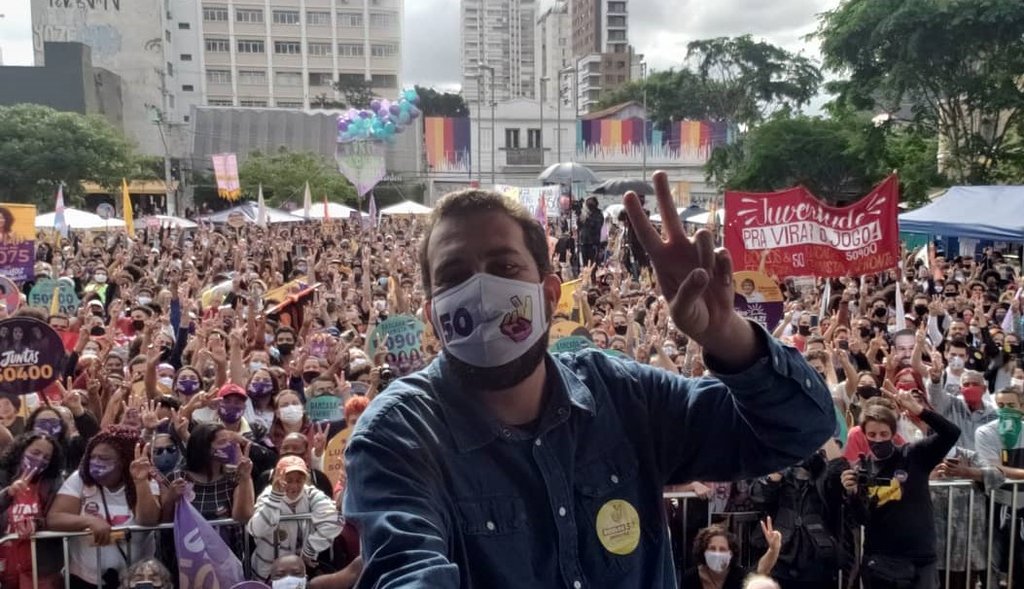
We can analyze a series of factors, starting with unequal conditions. In the second round, which was the shortest in history, the conditions were the same from the TV standpoint, but not from the resources standpoint. The restrictions imposed by the pandemic also affected a campaign like mine more directly, of very strong mobilization, of the street.
How do you see the result from an emotional perspective? Any frustration or anger?
I have a deep feeling of a mission accomplished. It is clear that I wanted to win. Especially because I know how much the periphery is suffering from abandonment and neglect.
Throughout the campaign, we managed to echo a message that these people, who are often invisible and abandoned by public power, are not alone. And it was not by chance that we had an important victory in several peripheral districts.
With R$19 million (US$3.8 million), Covas spent and collected more than other candidates, but you also had significant help from the PSOL (Socialism and Liberty Party) of around R$3.7 million.
The party’s investment was entirely proportional to the dimension of the candidacy. For the first time in PSOL’s history, there was a candidacy that reached the second round in Brazil’s largest city.
What did you say to Covas on Sunday when you acknowledged your defeat?
It was a quick and formal conversation. I simply congratulated him on his victory and wished him good luck.
What do you expect from his new government?
I hope that he has the humbleness to understand the message that the polls showed. It’s true that they gave him a victory, but two million São Paulo citizens, who voted for our project, voted for change.
Your speech pointed to the national scenario. From now on, will you take a closer look at national issues or will you focus on the local level, as opposition to Covas and Doria?
I live in São Paulo, so naturally, I am connected to São Paulo’s issues, as I have always been. But I have also been a candidate for President of the Republic.
From next year on, despite being linked to the issues of São Paulo, to tackling inequality in the city, I will be more focused on national issues, with the challenge of helping to build unity in the progressive and left-wing fields.
Do you consider or reject the idea of disputing the presidency or the state government in 2022?
What this campaign of ours has shown is that it is possible to articulate and unite left-wing players who have been distant until now. To debate any kind of names, at a time like this, is not helpful to the unity process.
And a position in the Legislative? Federal Deputy?
That is not in my mind right now.
Although a definition will depend on agreements, how do you personally intend to contribute?
I just got out of an election. I was a candidate for mayor, I had over two million votes, I made it to the second round. I’m not one of those who think and make politics every two years. Politics for me is not a career, it’s not climbing steps.
The next election is not on my agenda now. I’m concerned with helping to organize progressive and democratic forces in society to address these challenges.
Do you think it’s possible to trim the edges between parties that supported you in the second round, like the PT (Workers’ Party), PDT (Democratic Labor Party), and PSB?
The differences that currently exist in the progressive field lie in the realm of what separates us from the Bolsonarist project, from Doria. We, on the left-wing, had a strong presence in the second round, a very different scenario from 2016 and 2018, from the perspective of the power of a progressive project.
And from the pragmatic perspective, there were defeats at the polls.
Look, it’s not always when and how we want it to be. We have to look at things not only from the result of an election but from the trends. This election can be a considerable weakening of a cycle of authoritarianism.
How can this unity be built, given that the parties have the right to launch their own candidacies in the first round?
I am talking about a unity that also should not be built on the eve of the election. I’m talking about a “joint journey” in the progressive field to get Brazil out of this quagmire.
Having come out stronger from the elections, I will help build a process of unity in the progressive camp, not only from the electoral perspective but also from a political dispute.
This is not something that ended yesterday [Sunday]. It is starting. Our campaign points to the beginning of a new cycle.
When you say it is something that is starting, what exactly do you mean?
The novelty of our campaign was that it mobilized youths. It made youths again believe in politics as an instrument of change. This is much more than an election. It was a brew created, which won’t end here.
There is an analysis that the left has disconnected itself from the voter. Do you think the two parties are starting to speak the same language?
The electoral map shows that we had the best performance of the left in the periphery since 2012. There is a maturing process, under construction, of reconnecting the left with the popular base and also of disappointment on the part of the popular base in the peripheries with the project that won the 2018 elections.
Did you occupy a space that belonged to the PT?
The PT is a party with deep social roots in Brazil. It has its own capillarity, it needs to be respected. And the unity that we intend to build against Bolsonarism obviously includes the PT.
Are you self-critical? Is there a mistake in your campaign that you regret?
There is no campaign that is only right. Certainly, our campaign could have done things it didn’t do along the way, [but] I don’t see that it was politically wrong in its conduct. Frankly, I’m not looking for a scapegoat.
The argument about Social Security [that more public tenders would be part of the solution to the deficit], which you had to explain several times, can that be considered a mistake?
I have already had the opportunity to make this very clear and it was definitely closed. I expressed myself wrongly.
Could that have led to electoral damage?
I don’t think that this influenced the result of the elections.
Regarding the fact that you failed to declare your bank account [to the Electoral Justice], could there have been more transparency on your part?
I think that if there is any self-criticism in that incident, it should be from Folha de S.Paulo [which disclosed the incident in a story], which, by the way, the ombudsman did, about the way it was reported, unfortunately in a way that was not very enlightening.
The fact that my attorney failed to include a balance of R$579 in my bank account and this became a campaign issue, frankly, that was not a mistake in my campaign.
Your campaign and those of other candidates had crowded events. Do you accept any responsibility for this?
Our campaign tried to follow the sanitary protocols related to the pandemic. It wasn’t always possible, that’s true, but there was an effort.
The fact that the campaign agendas were kept, albeit reduced, after hearing about the positive result of deputy Sâmia Bomfim (PSOL), sparked criticism.
How do you react to this?
I have strictly complied with the Ministry of Health’s protocol and guidelines. The occasional contact with someone who tested positive and both wearing masks would not require any kind of isolation or interruption of social activity.
X-RAY:
Guilherme Boulos, 38, majored in philosophy and holds a master’s degree in psychiatry from USP (University of São Paulo). Coordinator of the MTST (Movement of Landless Workers), he was a candidate for president in 2018 by PSOL, when he won 617,000 votes and was placed 10th in the first round.
He made it to the second round of the election for São Paulo City Hall and on Sunday, November 29th, secured 2.1 million votes (40.62% of valid votes), being defeated by the candidate for re-election, Bruno Covas (PSDB). In the second round, the PSOL candidate had the support of the PT, PCdoB (Communist Party of Brazil), PDT, PSB, Rede (Sustainability Network), PCB (Brazilian Communist Party), and UP (Popular Unity).
Source: Folhapress
More: Brazil news in English, every day from The Rio Times.
This article was produced by The Rio Times’ automated newsroom system. How we use AI · Report an error
Read More from The Rio Times