Brazil: Fake Flávio Bolsonaro ‘Patroness’ Claim Nears 1 Million Posts
Politics: Brazil
Key Facts
—Update, 27 September. The false claim reached about 978,000 posts in 55 hours, per Democracia em Xeque; Flávio Bolsonaro asked electoral authorities to jail a Secom official who urged sharing it.
—The order. On Friday 25 September, electoral court (TSE) justice André Mendonça ordered X, Facebook, Instagram, TikTok and YouTube to remove posts falsely claiming that senator and presidential candidate Flávio Bolsonaro plans to strip Our Lady of Aparecida of her title as patroness of Brazil.
—The scope. The ruling covers around 1,170 links plus identical copies and different formats repeating the same claim, with a R$50,000 (about US$9,600) fine for non-compliance; platforms have 48 hours to report back.
—The carve-out. Journalism, debunks, criticism, satire and political opinion are expressly not covered, as long as they do not present the false factual core as true.
—The timing. The false claim went viral on Thursday night — nine days before the first round of the presidential election on 4 October.
Latest — 27 September 2026
PSD presidential candidate Ronaldo Caiado amplified the debunked story on Saturday, posting that “it hurts to see someone trying to erase Our Lady of Aparecida from Brazil’s history” and that “no one will rip Our Lady from the heart of the Brazilian people” (Revista Fórum, O Antagonista). He did not mention that electoral authorities had already ruled the claim false.
The campaign’s filing to the electoral prosecutor, reported by CNN Brasil, traces the first post to Jeferson de Oliveira Monteiro’s pro-government “Dilma Bolada” profile at 9:50 pm on Wednesday; two of the biggest amplifiers — @vitor_dlucca and @CarlosPortoRJ — passed 2 million and 2.4 million views in under 24 hours. The false posts also cited a 2007 bill by then-deputy Victório Galli that was shelved in 2008 and has no connection to Flávio Bolsonaro.
The platforms’ 48-hour deadline to report their takedown compliance to the TSE expires this weekend.
A fake claim that Flávio Bolsonaro wants to dethrone Brazil’s patron saint has hit nearly one million posts despite an electoral-court takedown order — and the candidate now wants a government communications official jailed for spreading it.
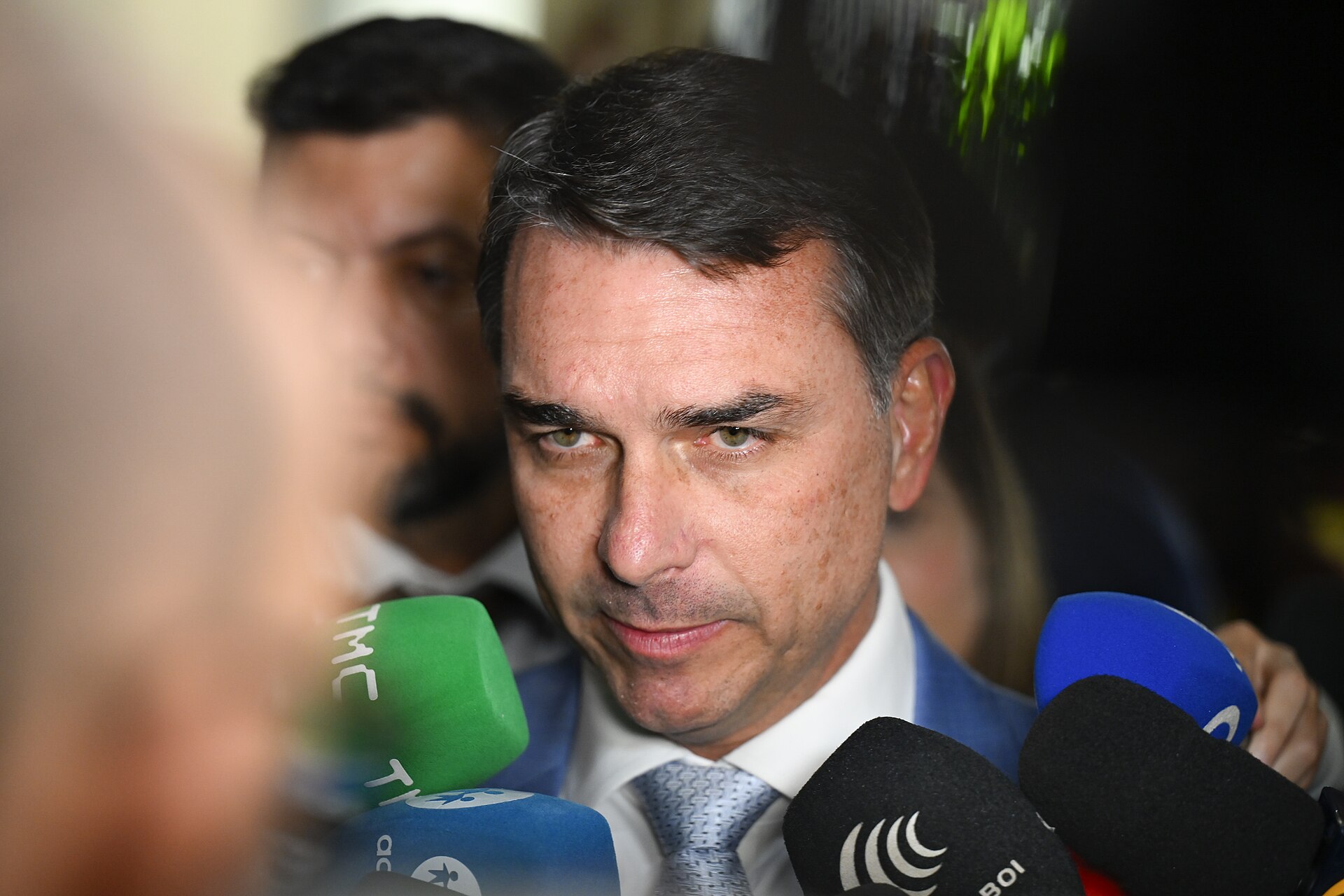
What changed on 27 September
A study by the Instituto Democracia em Xeque, released on Saturday 26 September, counted 977,600 posts on the claim in 55 hours. They drew 8.5 million interactions, making it the third-biggest political episode on Brazilian social media this year.
The same day, Flávio Bolsonaro filed a criminal complaint asking electoral authorities to preventively arrest George Marques, a strategy and information coordinator at the presidency’s communications office (Secom). He cites Article 323 of the Electoral Code, which punishes spreading known falsehoods about candidates.
Marques had reposted a message urging people to “stop sharing the retraction” and keep saying Our Lady was attacked. The repost was deleted hours later. The Planalto palace said he acted in a strictly personal capacity. Marques told Poder360 he did not recall the repost and that, if it happened, it was a mistake.
What the TSE Ordered
Justice André Mendonça, who sits on the Superior Electoral Court (TSE), ruled on Friday that X, Facebook, Instagram, TikTok and YouTube must take down publications claiming that Flávio Bolsonaro — the PL candidate for president — or his family intend to withdraw the title of Patroness of Brazil from Our Lady of Aparecida.
The order goes beyond individual URLs. Because the claim was being reproduced across platforms, Mendonça determined that identical copies and even publications in different formats — text, image or video — that carry the same narrative must also be blocked. Brazilian media report the decision covers about 1,170 links and carries a R$50,000 fine (about US$9,600, at R$5.19 per dollar) for non-compliance. Platforms have 48 hours to inform the TSE of the measures taken and the number of items removed.
Among the named targets is a post on X by the comedian Antônio Tabet, who publicly repudiated the decision. Mendonça, however, drew an explicit line around legitimate speech: journalistic coverage of the episode, content debunking the claim, criticism, satire, political opinions and general debate about religion and politics remain untouched, provided they do not present the delimited factual core as true.
How the False Claim Spread
The story went viral on Thursday night: posts alleged that Bolsonaro supported a project to strip Our Lady of Aparecida — Brazil’s most venerated Catholic figure — of her official status as the country’s patroness. Estadão reports that left-leaning profiles drove the spread of the false information.
The claim fed on a remark the senator made about a month ago, after skipping an election debate: he said one of his first acts if elected would be to “decree that Brazil belongs to the Lord Jesus Christ”. The phrase was widely read as a nod to evangelical voters, a constituency often critical of the veneration of images such as Aparecida — and the viral posts inflated it into a concrete plan that does not exist.
Bolsonaro rejected the story in blunt terms on social media, calling it “a lie, a fake news story” invented by what he described as the Workers’ Party’s online militia. “There is no such project,” he wrote, saying he was surprised by the claim while campaigning in Minas Gerais.
Why It Matters Nine Days Out
The episode shows the TSE’s disinformation machinery running at full campaign speed. With the first round on 4 October, the court is compressing response times: a viral claim on Thursday night became a binding multi-platform takedown order by Friday, with a compliance report due before the weekend ends.
Religion is a sensitive axis of this election. Bolsonaro’s coalition leans heavily on evangelical churches, while Our Lady of Aparecida resonates with Catholic voters — and with a broad, non-practising majority for whom the patroness is a cultural symbol. A false story positioning the candidate against her was tailor-made to cost him votes, which is why his campaign treated it as a coordinated attack.
The latest Datafolha poll, published on 24 September, shows President Lula at 40% and Flávio Bolsonaro at 36%, with a hypothetical run-off tied at 47-45 — margins tight enough that a viral narrative in the final stretch can matter. Mendonça, a Presbyterian pastor whom former president Jair Bolsonaro once called “terrivelmente evangélico” when nominating him to the Supreme Court, is no stranger to the intersection of faith and politics himself.
What We Could Not Confirm
We could not confirm how many posts the platforms have actually removed; their compliance reports to the TSE have not been made public. Monitoring by Flávio Bolsonaro’s campaign, reported by Estadão and CNN Brasil, traces the first post to the pro-government profile “Dilma Bolada” on Wednesday night, 23 September — a partisan source we could not independently verify.
It is also not yet clear whether the TSE will extend the same rapid-removal treatment to other viral narratives in the final week, whether any of the affected accounts will challenge the order, or how prosecutors will respond to the arrest request. We will update this report as those decisions come in.
More: Brazil news, every day from The Rio Times.
Frequently Asked Questions
What did Brazil’s electoral court order about the Flávio Bolsonaro posts?
On 25 September 2026, TSE justice André Mendonça ordered X, Facebook, Instagram, TikTok and YouTube to remove posts falsely claiming Bolsonaro plans to strip Our Lady of Aparecida of her title as patroness of Brazil. The order covers about 1,170 links and copies in any format, with a R$50,000 (about US$9,600) fine for non-compliance.
Is there a real plan to remove Our Lady of Aparecida’s title?
No. Flávio Bolsonaro denies the claim outright and no such bill exists. The viral story grew out of his remark, made about a month earlier, that he would “decree that Brazil belongs to the Lord Jesus Christ” — a phrase aimed at evangelical voters that was inflated into a fictitious plan against the patron saint.
Does the TSE order affect journalism or satire?
No. Mendonça’s ruling expressly exempts journalistic coverage, debunks, criticism, satire, political opinion and general debate about religion and politics — as long as they do not present the false factual core of the claim as true.
Why did Flávio Bolsonaro ask for a Planalto official’s arrest?
On 26 September he asked electoral authorities to jail George Marques, a Secom coordinator who reposted a message urging people to keep spreading the false claim. The Planalto palace says Marques acted in a personal capacity.
Sources
Estadão · SBT News · Poder360 · Correio Braziliense · Estadão (IDX study) · Poder360 (arrest request) · Metrópoles
Connected Coverage
The takedown order lands in a statistical dead heat — our report on the latest Datafolha numbers.
Datafolha Poll: Lula 40, Flávio 36, Runoff Tied 47–45
Mendonça has been at the centre of the court’s internal battles too — our earlier report.
Sources: Estadão; SBT News; Poder360; Correio Braziliense; Metrópoles; Instituto Democracia em Xeque.
This article was produced by The Rio Times’ automated newsroom system. How we use AI · Report an error
Read More from The Rio Times