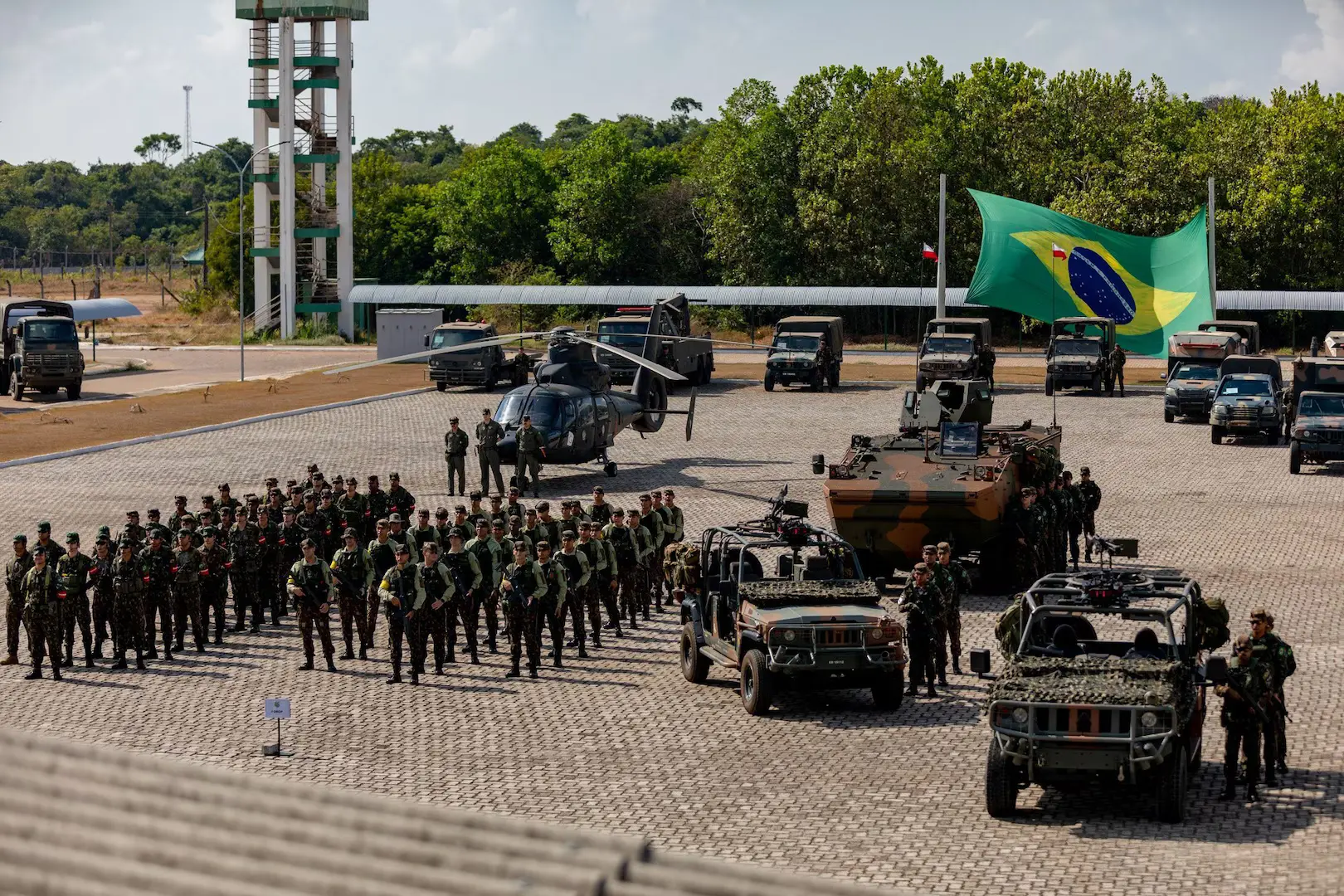
Brazil is moving roughly ten thousand troops and heavy equipment into the far north for the decisive phase of Operation Atlas, a joint Army-Navy-Air Force drill running October 3–9 around Boa Vista, Roraima.
The aim is simple to state and hard to do: shift a large force over jungle distances, keep it supplied on rivers and rough roads, and make land, sea, air, cyber, and logistics units work as one.
The hardware tells the story. ASTROS rocket-and-missile batteries have been hauled thousands of kilometers to the savanna north of the rainforest for live-fire missions.
On the ground, M109 155mm howitzers, Leopard 1A5 tanks, and Guarani, Cascavel, and Guaicurus armored vehicles form the backbone for combined-arms maneuvers.
The Army has also fielded airborne and airmobile brigades, electronic-warfare teams, chemical and radiological defense units, and combat engineers to practice bridging and rapid route opening.
At sea and along the rivers, the Navy’s flagship helicopter carrier Atlântico has delivered more than a thousand personnel and hundreds of tons of vehicles, munitions, and supplies to Belém, reinforcing the corridor into the Amazon delta.
The landing ship Almirante Saboia is moving heavy loads inland, while patrol and helicopter detachments support amphibious and riverine operations at the river mouth.
Above the canopy, the Air Force has shifted A-1M attack aircraft to Boa Vista to train forward air controllers for close air support in jungle conditions. Patrol squadrons are also flying missions to sharpen surveillance over the Atlantic approaches and river outlets.
Why now? Two reasons. First, readiness in the Amazon is about distance, weather, and time: if you can’t move fast and sustain forces in heat, rain, and mud, you don’t really control the space.
Atlas is a large-scale stress test of that problem. Second, Brazil will host COP30 in Belém in 2025. Practicing the full chain—sealift, airlift, road convoys, jungle brigades, and joint command—helps ensure the North is secure when the world’s attention turns there.
There’s also the backdrop. Tension to Brazil’s north has been higher since Venezuela revived its claim over Guyana’s Essequibo region in 2023; Brasília responded by accelerating new units and moving modern anti-armor systems into Roraima as a deterrent.
Atlas scales that posture up into a national-level rehearsal, with visible convoys, scheduled live-fire windows, and an uptick in military flights—reassurance for border communities that the state can surge when needed.
The story behind the story is about sovereignty and credibility. Brazil is not signaling a hunt for conflict; it’s demonstrating that, if a crisis spills over the border or illicit flows try to reroute through the Amazon, it can concentrate force quickly and coordinate it cleanly.
In practical terms, commanders will judge Atlas less by dramatic footage than by quiet metrics: how fast fuel moves, how often radios drop, how quickly a broken vehicle returns to service, and how long it takes to mass a dispersed force at one point.
Those numbers decide whether deterrence holds the day. Bottom line for readers outside Brazil: Operation Atlas is a national “proof of concept” in one of the hardest environments on Earth.
If it works, it strengthens border stability across the Guiana Shield and underwrites a safer, smoother COP30. If it exposes bottlenecks, there’s still time to fix them before real-world events test the system.
This article was produced by The Rio Times’ automated newsroom system. How we use AI · Report an error · Editorial responsibility: Matthias Camenzind, Editor-in-Chief
Read More from The Rio Times